Aviation Funding Stability Act of 20 21 This bill provides continuing appropriations to the Federal Aviation Administration (FAA) from the Airport and Airway Trust Fund if an appropriations bill for the FAA has not been enacted before a fiscal year begins or a joint resolution making continuing appropriations for the FAA is not in effect. The bill provides appropriations at the rate of operations that was provided for the prior fiscal year to continue programs, projects, and activities for which funds were provided in the preceding fiscal year.
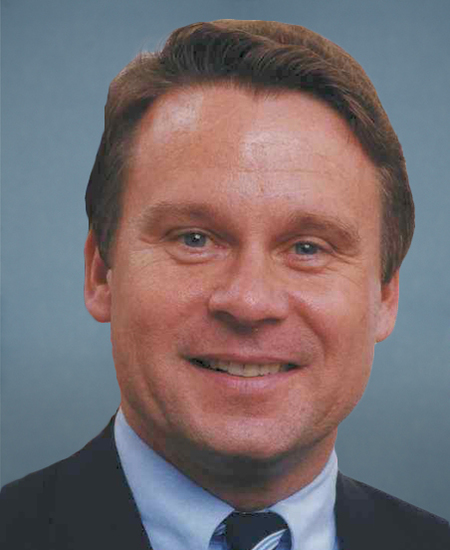
Rep. Christopher H. Smith
Sponsored bills
Uyghur Forced Labor Prevention Act This bill imposes various restrictions related to China's Xinjiang Uyghur Autonomous Region, including by prohibiting certain imports from Xinjiang and imposing sanctions on those responsible for human rights violations there. Goods manufactured or produced in Xinjiang shall not be entitled to entry into the United States unless U.S. Customs and Border Protection (1) determines that the goods were not manufactured by convict labor, forced labor, or indentured labor under penal sanctions; and (2) reports such a determination to Congress and to the public. The President shall periodically report to Congress a list of foreign entities and individuals knowingly facilitating (1) the forced labor of Uyghurs, Kazakhs, Kyrgyz, and members of other Muslim minority groups in Xinjiang; and (2) efforts to contravene U.S. laws regarding the importation of forced labor goods from Xinjiang. The President shall impose property-blocking sanctions on the listed individuals and entities and impose visa-blocking sanctions on the listed individuals. Securities issuers required to file annual or quarterly reports with the Securities Exchange Commission shall disclose in such reports instances in which the issuer knowingly engaged in certain activities related to Xinjiang, such as working with an entity building detention facilities or surveillance systems there. After such a disclosure, the President shall determine whether to investigate if sanctions or criminal charges are warranted. The Forced Labor Enforcement Task Force and the Department of State shall report to Congress strategies to address forced labor in Xinjiang or any other part of China. The State Department shall also report to Congress a determination of whether the treatment of Muslim groups in Xinjiang constitutes crimes against humanity or genocide under U.S. law.
Bring Abducted Children Home Amendments Act This bill revises various provisions regarding international child abduction, including to increase the maximum term of imprisonment from 3 years to 10 years for retaining a child outside the United States with intent to obstruct the lawful exercise of parental rights.
Fair and Open Skies Act This bill prohibits the Department of Transportation (DOT) from issuing a foreign air carrier permit or an exemption from certain air carrier certificate requirements under the United States-European Union Air Transport Agreement of April 2007, unless DOT finds that issuing the permit or exemption would be consistent with Article 17 bis of the agreement, which provides that opportunities created by the agreement do not undermine labor standards or the labor-related rights and principles contained in the laws of the respective parties to the agreement; and imposes conditions on the permit or exemption necessary to ensure compliance with Article 17 bis . The bill modifies policy considerations relating to air carrier certificates to require DOT to consider preventing entry into U.S. markets by flag of convenience carriers (i.e., foreign air carriers established in a country other the home country of their majority owner in order to avoid regulations of the home country) and preventing the undermining of labor standards. In carrying out such air carrier certificate requirements, DOT must consider preventing entry of flag of convenience carriers into U.S. markets as being in the public interest and consistent with public convenience and necessity for safety in air transportation and air commerce. In formulating U.S. international air transportation policy relating to the elimination of discrimination and unfair competition, the Department of State and DOT must include in their considerations the undermining of labor standards.
Cardiovascular Advances in Research and Opportunities Legacy Act This act addresses research, education, and awareness concerning valvular heart disease and its treatment. This disease is caused by damage to or disease affecting any valve that controls blood flow in the heart. The National Institutes of Health may conduct or support research on the disease in consultation with the National Heart, Lung, and Blood Institute (NHLBI). The NHLBI must also conduct a workshop on mitral valve prolapse, which occurs when the valve between the chambers of the left side of the heart seals improperly. The Department of Health and Human Services (HHS) must develop best practices to treat valvular heart disease. HHS may also carry out other projects to increase education and awareness of the disease.
Big Cat Public Safety Act This act revises requirements governing the trade of big cats (i.e., species of lion, tiger, leopard, cheetah, jaguar, or cougar or any hybrid of such species) under the Lacey Act to limit the possession, breeding, and exhibition of big cats. The Lacey Act prohibits any person from importing, exporting, buying, selling, transporting, receiving, or acquiring big cats across state lines or the U.S. border. However, some exemptions are provided for certain entities, such as universities and wildlife sanctuaries. (Sec. 3) The act expands the Lacey Act prohibitions to include a prohibition on possessing or breeding big cats. Breeding means facilitating propagation or reproduction (whether intentionally or negligently), or failing to prevent propagation or reproduction. Owners of big cats that were born before this act's enactment may keep their big cats, but the owners must register them with the U.S. Fish and Wildlife Service. The act modifies the list of entities that are exempt from prohibitions to export, buy, sell, transport, receive, acquire, possess, or breed big cats. The modified list includes exemptions for entities or facilities exhibiting animals to the public if they (1) hold a Class C license in good standing under the Animal Welfare Act, and (2) do not allow individuals to come into direct physical contact with big cats. However, direct contact is allowed if the individual is a trained professional, a veterinarian, or directly supporting conservation programs that do not involve commercial activities and meet other specified restrictions. (Sec. 4) A person who knowingly violates the act must be fined not more than $20,000, or imprisoned for no more than five years, or both. The act considers each violation to be a separate offense. The offense must be deemed to have been committed not only in the district where the violation first occurred, but also in any district in which the defendant may have taken or been in possession of the prohibited wildlife species. (Sec. 5) The act extends forfeiture provisions to fish, wildlife, or plants that are bred or possessed; thus, big cats bred or possessed in violation of the act are subject to forfeiture. (Sec. 6) The Department of the Interior must issue regulations to implement this act.

Heidi's Law This bill revises the Mandatory Guidelines for Federal Workplace Drug Testing Programs to include testing for methadone and newly identified drug substances. The Department of Health and Human Services must revise the guidelines to (1) expand the opiate category on the list of substances authorized for testing to include methadone, and (2) add any new drugs which may not have been previously included on such list. The Department of Transportation must update its regulations containing procedures for transportation employee workplace drug and alcohol testing programs to include testing for methadone and newly identified drug substances.
Taiwan Protection and National Resilience Act of 2022 This bill requires the Department of Defense to submit a report identifying goods and services from the United States that China relies upon and U.S. military procurement practices that are reliant on trade with China. The bill also requires the Department of the Treasury to submit a sanctions strategy that could, in response to a Chinese invasion of Taiwan (1) limit China's ability to acquire petroleum and military materiel, (2) diminish the ability of the Chinese industrial base to replenish defense articles, and (3) inhibit China's ability to evade sanctions.
Hong Kong Economic and Trade Office (HKETO) Certification Act This bill requires the President to periodically determine whether to allow the Hong Kong Economic and Trade Offices (HKETOs) to continue to operate in the United States. (The HKETOs are the official representative offices for Hong Kong, a semi-autonomous city that was established as a British colony in 1841. The United Kingdom transferred sovereignty over Hong Kong to China in 1997). Under this bill, the President must periodically (at least once a year) certify to Congress a determination as to whether the HKETOs should be covered by the International Organizations Immunities Act. (The act provides immunities and privileges to certain international organizations, such as immunity from certain lawsuits and exemption from property taxes.) If the President certifies that the HKETOs no longer merit receiving such privileges and immunities, the HKETOs must terminate operations in the United States no later than 180 days after the certification is delivered to Congress. If the President certifies that the HKETOs continue to merit such privileges and immunities, the HKETOs may continue operations for another year, unless Congress enacts a joint resolution disapproving of the certification. The President may also revoke the application of such privileges and immunities to the HKETOs. A federal government entity may enter into an agreement or partnership with an HKETO only if the HKETOs are still authorized to operate in the United States under this bill.
This bill prohibits the expenditure of federal funds to negotiate or contribute to international agreements providing for loss and damage funds as a result of climate change.