This joint resolution proposes an amendment to the Constitution to require that the Supreme Court consist of nine Justices.
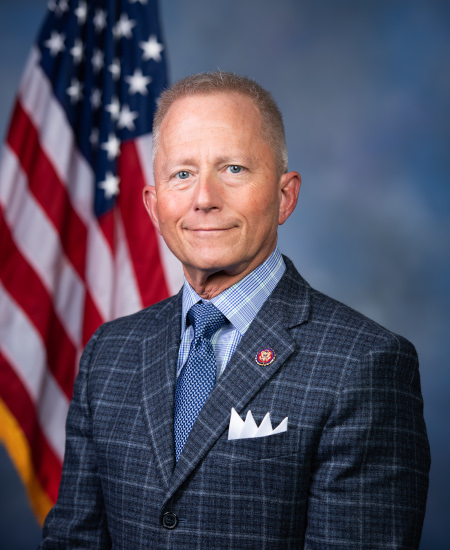
Rep. Jefferson Van Drew
Sponsored bills
Medicare Audiologist Access and Services Act of 2021 This bill provides for Medicare coverage of certain audiologist services. Specifically, the bill expands coverage to include diagnostic and treatment services that are furnished by audiologists and that would otherwise be covered if provided by a physician, including incidental services, regardless of whether such services are provided pursuant to a referral from, or under the supervision of, a physician or other health care practitioner.
Nutrition Counseling Aiding Recovery for Eating Disorders Act of 2021 or the Nutrition CARE Act of 2021 This bill provides for Medicare coverage of medical nutrition therapy services for individuals with eating disorders. Such services must be furnished by a registered dietitian or nutrition professional pursuant to a referral from a physician, psychologist, or other authorized mental health professional.
Protecting Consumer Access to Generic Drugs Act of 2021 This bill prohibits the manufacturer of a brand-name, generic, or biosimilar drug from entering into certain agreements to resolve or settle a patent infringement claim in connection with the sale of a drug or biological product. Specifically, such an agreement shall, with some exceptions, be a violation of the bill if the filer of a subsequent application to market a drug or biological product receives anything of value and agrees to limit or forego research, development, manufacturing, marketing, or sales of the subsequent drug or biological product. (Typically, a subsequent application seeks to market a generic or biosimilar version of a patented drug or biological product.) Penalties for violations of the bill include civil penalties and loss of the 180-day exclusivity period for a generic drug. The Federal Trade Commission (FTC) shall have exclusive authority to litigate to enforce the bill. When a generic or biosimilar drug manufacturer enters into an agreement with another drug manufacturer related to the manufacturing, marketing or sale of a drug, the manufacturers shall certify that the material they have given the FTC concerning the agreement contains (1) the complete agreement; and (2) any agreements related to the main agreement, including descriptions of any oral agreements or representations.
Research Investment to Spark the Economy Act of 2021 or the RISE Act of 2021 This bill authorizes the Departments of Agriculture, Commerce, Defense, Education, Energy, the Interior, Health and Human Services, and Transportation, National Aeronautics and Space Administration (NASA), National Science Foundation, and Environmental Protection Agency to provide support for research regarding COVID-19 (i.e., coronavirus disease 2019) or research disrupted by the COVID-19 pandemic. Support may be used to provide supplemental funding to extend the duration of a grant to a research institution, national laboratory, or individual that was awarded prior to the enactment of this bill, or to expand the purposes of such a grant as specified; issue awards to research the effects of the current pandemic and potential future pandemics; and provide flexibility on awards to account for facility closures or other limitations during the COVID-19 public health emergency. Agencies must provide the support as rapidly as possible. Provided funds shall remain available through FY2021.

Alzheimer's Caregiver Support Act This bill authorizes grants to expand training and support services for families and caregivers of individuals living with Alzheimer's disease or a related dementia. The Department of Health and Human Services may award these grants to community organizations and health care and social service providers.
The COVID-19 Hospital and Health Provider Loan Conversion Act of 2021 This bill establishes and otherwise modifies requirements for the Medicare Accelerated and Advance Payment Program during the public health emergency relating to COVID-19 (i.e., coronavirus disease 2019). The program provides Medicare payments in advance to eligible providers experiencing claims or cash flow disruptions, such as during national emergencies; the program was specifically expanded in response to COVID-19 to encompass more types of providers, subject to certain recoupment and repayment provisions. The bill requires the Centers for Medicare & Medicaid Services to waive recoupment and repayment for providers who meet specified requirements. Among other criteria, providers must not have engaged in surprise billing practices with respect to COVID-19 patients. Providers must still repay any amounts not used for COVID-19 expenses; the bill caps the interest rate on such repayments at 2% upon a demonstration of hardship. The bill also requires private health insurers to treat out-of-network COVID-19 services as in-network for purposes of payment and cost-sharing.
Voter Integrity Protection Act This bill imposes additional immigration-related penalties for aliens who vote in an election for federal office. It shall be an aggravated felony for an alien who is unlawfully present to violate an existing prohibition against an alien voting in a federal election. (An aggravated felony conviction carries various immigration consequences, such as rendering the alien inadmissible, deportable, and barred from establishing good moral character for naturalization.) An alien who is unlawfully present and who knowingly violates the prohibition against voting in a federal election shall be deportable.
Hearing Protection Act This bill removes silencers from the definition of firearms for purposes of the National Firearms Act. It also treats persons acquiring or possessing a firearm silencer as meeting any registration and licensing requirements of such Act. The Department of Justice must destroy certain records relating to the registration, transfer, or making of a silencer. The bill also revises the definitions of firearm silencer and firearm muffler under the federal criminal code and includes such items in the 10% excise tax category.
Concealed Carry Reciprocity Act This bill establishes a federal statutory framework to regulate the carry or possession of concealed firearms across state lines. Specifically, an individual who is eligible to carry a concealed firearm in one state may carry or possess a concealed handgun (other than a machine gun or destructive device) in another state that allows its residents to carry concealed firearms. It sets forth requirements for the lawful concealed carry across state lines. The bill preempts most state and local laws related to concealed carry and establishes a private right of action for a person adversely affected by interference with a concealed-carry right established by this bill.