Maddy summaryHR 5804, the PRODUCE Act, extends and increases funding for the USDA's Office of Urban Agriculture and Innovative Production. It reauthorizes the office through 2030 (previously 2023) and doubles its annual funding from $25 million to $50 million for fiscal years 2025-2030. This bill directly affects urban communities by supporting existing programs that expand access to fresh, locally grown food through community gardens, urban farms, and innovative agricultural initiatives. The key change is the increased, long-term funding to strengthen urban agriculture efforts in cities nationwide.
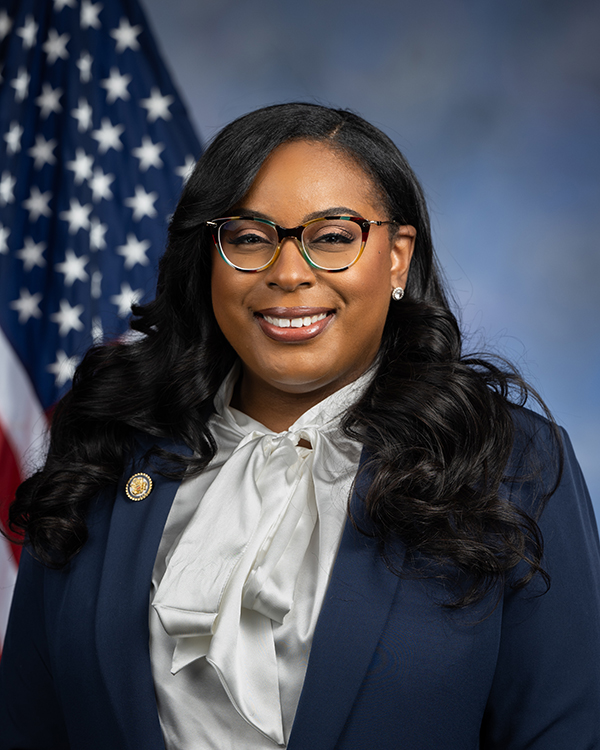
Rep. LaMonica McIver
Sponsored bills
Maddy summaryThis bill renames a U.S. Postal Service facility at 514 Frelinghuysen Avenue in Newark, New Jersey, as the "Mildred Joyce Coleman Crump Post Office Building." All official references in federal documents, maps, or records to this specific post office location will now use the new name. The bill directly affects the Newark postal facility and its official documentation. (Procedural naming resolution; no policy changes.)
Give Kids a Chance Act of 2025 This bill expands the Food and Drug Administration’s (FDA’s) authority with respect to research on rare pediatric diseases, including by permitting the FDA to take enforcement action against drug sponsors that fail to satisfy pediatric study requirements and by reauthorizing programs that support pediatric research. Specifically, the bill modifies requirements relating to molecularly targeted pediatric cancer investigations to permit research on new drugs in combination with active ingredients that have already been approved, provided certain conditions are met; permits the FDA to take enforcement action against drug sponsors that fail to comply with pediatric study requirements, if such sponsors demonstrated a lack of due diligence in satisfying the requirement; renews the FDA’s authority to award priority review vouchers to sponsors of new products intended to treat rare pediatric diseases through September 30, 2029; and reauthorizes through FY2027 certain funding for the National Institutes of Health to support priority pediatric research. The bill also provides statutory authority for the FDA’s interpretation of the orphan drug exclusivity period. The bill specifies, consistent with FDA regulations, that the seven-year market exclusivity period for drugs for rare diseases or conditions (i.e., orphan drugs) prohibits the approval of the same drug for the same approved use or indication with respect to the disease or condition. (In Catalyst Pharmaceuticals, Inc. v. Becerra , a court rejected the FDA’s interpretation and held that orphan drug exclusivity extends to all uses or indications for the disease or condition.)

Maddy summaryHR 5570, the Rail Passenger Fairness Act, allows Amtrak to directly sue host railroads in federal court to enforce its statutory right to priority over freight trains on shared rail networks. This bill amends existing law (49 U.S.C. § 24308(c)) to give Amtrak, not just the Attorney General, the legal right to seek court orders ensuring passenger trains receive priority as required by the 1973 Amtrak Improvement Act. The key provision removes the sole reliance on the Attorney General for enforcement - a mechanism used only once since Amtrak's founding - and enables Amtrak to pursue legal action directly. This change aims to address chronic delays caused by host railroads prioritizing freight, which contributed to over 3.2 million minutes of passenger train delays in 2019. The bill focuses solely on altering the enforcement mechanism, not on prescribing new service standards or funding.
Maddy summaryHR 6305, the High-skilled Immigration Reform for Employment Act, expands opportunities for U.S. employers to hire foreign workers in specialty occupations by increasing the annual H-1B visa cap from 65,000 to 130,000 and adjusting employer thresholds to make it easier for larger companies to qualify for H-1B visas. It also creates a new $25 million annual grant program (2026-2030) to fund states and schools that strengthen K-12 and higher education in science, math, engineering, and technology fields. The bill directly affects U.S. employers seeking H-1B workers and schools receiving STEM education grants. Key mechanisms include raising the H-1B cap, modifying employer size thresholds for H-1B-dependent status, and authorizing federal grants for STEM education programs.
Maddy summaryHR 6255, the Affordable Insulin Now Act, requires health insurance plans (including employer-sponsored and individual plans) to cover specific insulin products starting in 2026. It caps out-of-pocket costs for these insulin products at $35 per 30-day supply or 25% of the negotiated price, whichever is lower, with no deductibles applied. The bill defines "selected insulin products" to include at least one of each dosage form (like vials or pumps) and type (such as rapid-acting or long-acting) available from the plan. This directly affects people with diabetes who rely on insulin, ensuring more predictable and affordable access to essential medications under their health coverage.
Maddy summaryHRES 899 is a symbolic House resolution recognizing the Transgender Day of Remembrance and memorializing transgender people killed by violence in 2024-2025. It directly affects transgender individuals, particularly transgender women of color, by acknowledging the epidemic of violence against them - citing 27 U.S. victims (including names like Rick Alastor Newman and Kyla Jane Walker) and 241 global cases in 2025. The resolution’s key provisions include formally recognizing the violence epidemic, memorializing specific lives lost, and affirming the need for solutions to protect transgender people. It does not create new laws but expresses congressional support for addressing systemic violence and discrimination faced by transgender communities.
Maddy summaryHR 6215, the Small Business RELIEF Act, exempts small businesses from import duties imposed under Executive Order 14257 (90 Fed. Reg. 15041) for goods they import or use. It requires the President to refund duties paid by small businesses within 90 days of the bill's enactment. The bill defines "small business concern" using the standard Small Business Act criteria (15 U.S.C. 632). This directly affects small businesses importing goods, providing immediate cost relief by removing a specific tariff and refunding past payments.
Maddy summaryThe End Child Poverty Act (HR 6235) establishes a universal child assistance program providing monthly payments to children under 19 who are U.S. citizens, nationals, or qualified aliens residing in the U.S. Payments equal 1/12 of the annual poverty guideline difference between a two-person household and a single individual, adjusted annually using federal poverty guidelines. The Social Security Administration’s new Office of Universal Child Assistance will automatically identify eligible children via IRS data sharing (with an opt-out option) and issue payments starting in 2026, including reconciliation payments when updated poverty guidelines are published. The bill also terminates the Child Tax Credit and Earned Income Tax Credit after 2025, replacing them with new refundable tax credits for adult dependents and families.
Maddy summaryThe BOOST Act of 2025 establishes a new monthly $250 payment program for qualifying adults aged 19 to 67 who are U.S. citizens, nationals, or certain qualified immigrants residing in the U.S. These payments, adjusted annually for inflation, are funded by a new 2.5% supplemental tax on adjusted gross income exceeding $60,000 for joint filers (or $30,000 for individuals). The tax applies to all taxable income above these thresholds with no deductions or credits allowed, and the payments are excluded from income calculations for other federal benefits. The Social Security Administration’s new Office of Universal Adult Assistance will administer the program, including eligibility verification and annual reporting to Congress.