

Maddy summaryThis bill (HR 5947) designates the U.S. Postal Service facility at 1201 Calvert Street in Lincoln, Nebraska, as the "Commodore Dixie Kiefer Memorial Post Office Building." It directly affects the Lincoln, Nebraska post office by changing its official name to honor Commodore Dixie Kiefer. The bill requires all official U.S. government references - such as laws, maps, and documents - to use the new name moving forward. This is a commemorative naming bill with no policy changes or financial impact.
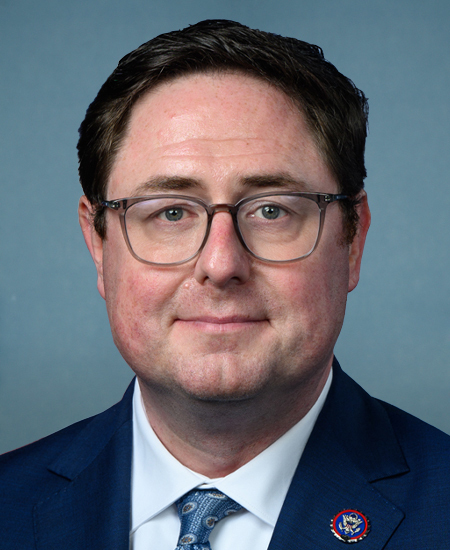
Rep. Mike Flood
Sponsored bills
Maddy summaryThis bill requires adding the names of 74 crew members of the USS Frank E. Evans (killed in a 1969 incident) to the Vietnam Veterans Memorial Wall within one year of enactment. It directly affects the memorial's inscription and honors the families of those lost. The Secretary of Defense must consult on placement due to space limits and is exempt from standard memorial rules under the Commemorative Works Act.
Maddy summaryThis bill requires the Transportation Secretary to prioritize highway projects that support national defense. It mandates a biennial list of the top 3 defense-focused highway projects in each state (developed with FEMA), and directs that projects designated for defense under existing law receive priority in federal funding decisions. States must ensure defense-designated projects get priority for both discretionary grants and apportioned highway funds under Title 23. The law updates existing highway funding rules to integrate civil defense planning into transportation project selection.
Maddy summaryThe HOME Reform Act of 2025 updates the HOME Investment Partnerships program by changing eligibility criteria for affordable housing assistance. It replaces "low-income" with a specific definition requiring household income not to exceed 100% of the area median family income, and creates a new definition for "infill housing projects" that must be on previously disturbed land within developed areas. The bill allows funds to be used for infrastructure improvements like water and sewer lines adjacent to affordable housing, and streamlines environmental reviews for certain housing projects to reduce bureaucratic delays. These changes affect local governments and housing organizations administering the HOME program, making it easier to develop affordable housing in existing neighborhoods.
Maddy summaryThe HOME Reform Act of 2025 updates the HOME Investment Partnerships Program to improve affordable housing access. It redefines eligibility by requiring household income to not exceed 100% of the area median family income (replacing vague "low-income" terms), expands infrastructure funding for nonentitlement areas to support housing-related utilities, and adds new definitions for "infill housing projects" (e.g., projects on previously disturbed land within developed areas). Key provisions include exceptions for military members and heirs of deceased homeowners to maintain affordability, streamlined environmental reviews for certain projects, and removal of a 24-month deadline for unused funds. The bill directly affects low-income families, housing developers, and local jurisdictions administering HOME funds.
Maddy summaryThis bill adds Medicare coverage for multi-cancer early detection screening tests (blood or biological tests analyzing cell-free DNA) starting January 1, 2028. It directly affects Medicare beneficiaries aged 68 and older (starting in 2028, with the age limit increasing by 1 year annually), requiring tests to be FDA-cleared and deemed reasonable/necessary by the Secretary for early cancer detection across multiple organ sites. Payment will initially match current stool DNA test rates before 2031, then shift to a lower rate or new payment system after 2031, with limits preventing more than one test per year. The bill explicitly states it does not alter coverage for existing cancer screenings like breast, colorectal, or prostate cancer tests.
Maddy summaryThis bill would require all states to recognize valid concealed carry permits issued by other states, allowing permit holders to carry concealed handguns (excluding machine guns) in any state that either issues such permits or doesn't prohibit concealed carry. It directly affects law-abiding gun owners with valid permits from their home state, ensuring they can carry in states with similar permit systems or no prohibitions. Key provisions include treating valid permit documents as proof of legal carry (reducing officer stops), shifting the burden of proof to prosecutors if challenged, and allowing civil lawsuits for violations with attorney's fee awards. The bill does not override state laws restricting firearms on private property or government land, nor does it affect federal gun restrictions like those in section 922(q).
Maddy summaryThis bill changes how federal homeless assistance funds are distributed. It prevents the government from blocking grants to programs that require supportive services (like job training or addiction treatment) for residents, or that set occupancy conditions (such as sobriety requirements), and protects faith-based organizations from exclusion. At least 50% of funds must go to grantees offering wraparound services, and the government must report annually to Congress on compliance. It directly affects homeless assistance providers receiving McKinney-Vento funds. The bill focuses on funding rules, not new services or outcomes.
Maddy summaryHR 5580, the Charlie Kirk Commemorative Coin Act, authorizes the U.S. Mint to produce 400,000 $1 silver coins in 2026 to honor Charlie Kirk, founder of Turning Point USA, who died in 2025. The coins must feature Kirk's image on the obverse and "well done, good and faithful servant" on the reverse, with standard minting specifications. They will be sold at face value plus production costs to collectors, with no net cost to the government. This bill has no policy impact beyond commemoration; it affects only the U.S. Mint and coin collectors.
Maddy summaryHRES 719 is a House resolution honoring Charles "Charlie" James Kirk, the founder of Turning Point USA who was assassinated on September 10, 2025. The resolution condemns his assassination and all political violence, extends condolences to his family, and calls on Americans to reject violence while promoting civil discourse. It specifically recognizes Kirk's legacy as a defender of constitutional principles and his role in inspiring youth through free speech and faith-based civic engagement. As a commemorative resolution, it does not enact policy changes but formally expresses the House's stance on honoring his life and legacy.