

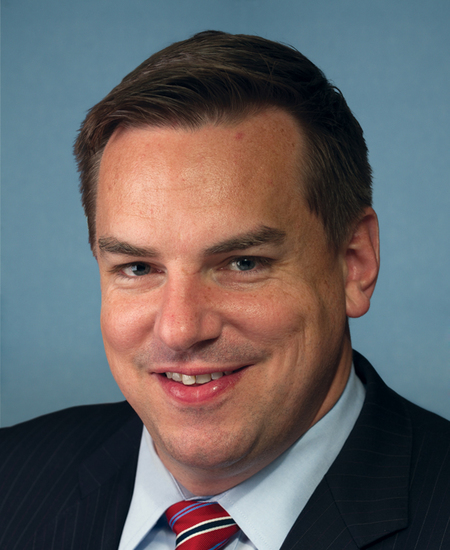
This resolution condemns any calls made by a Member of the House of Representatives to defund the police and expresses the sense of the House of Representatives that any member who advocates for such defunding should not be permitted to use federal funds to contract with a private entity for security personnel support.
Rep. Richard Hudson
Sponsored bills
Stop Fentanyl Border Crossings Act This bill authorizes the Department of Health and Human Services (HHS) to restrict migration and imports from foreign countries to prevent the introduction of illicit drugs into the United States. Current law authorizes HHS to restrict migration and imports from foreign countries to prevent the introduction of communicable diseases. Under this bill, HHS may also restrict migration and imports from a country if HHS determines that the existence of substantial illicit drug smuggling from that country poses a risk to public health.
Designates the facility of the United States Postal Service located at 33 Coxe Avenue, in Asheville, North Carolina, as the "Dorothy Hansine Andersen Post Office."
This resolution supports the preservation of the stepped-up basis tax rule that allows recipients of inherited assets such as land, equipment, or buildings to adjust the cost basis of the assets to reflect their fair market value. The resolution opposes any efforts to impose new taxes on family farms or small businesses and recognizes the importance of generational transfers of farm and family-owned businesses.
This resolution honors the life and legacy of the late Representative Don Young and directs the Sergeant at Arms to designate a Don Young Reserved Seat on the floor of the chamber of the House of Representatives.
Emergency Community Care Notification Time Adjustment Act of 2022 This bill modifies the Veterans Community Care Program by requiring the Department of Veterans Affairs (VA) to deem as authorized emergency care or services provided by a non-VA provider to a covered veteran if the veteran (or an individual acting on the veteran's behalf) submits an application for such authorization by a deadline determined appropriate by the VA, which may not be earlier than 72 hours following the veteran's discharge from the facility. Covered veterans are those who are enrolled in the VA health care system or those who are not enrolled but are eligible for care due to a service-connected disability.
COI Elimination Act This bill limits U.S. contributions to the United Nations pertaining to the U.N. Independent International Commission of Inquiry on the Occupied Palestinian Territory, including East Jerusalem, and Israel. Current law imposes a cap on the annual U.S. contribution to the U.N. budget. The bill lowers that cap by 25% of the amount budgeted for the commission. The bill also states that it shall be U.S. policy to seek the abolition of the commission and combat systemic anti-Israel bias in international bodies.
School Resource Officers Save Lives Act This bill reauthorizes through FY2023 grants available to states and Indian tribes to address the opioid crisis. It also establishes a demonstration grant program for school districts to train school resource officers, security personnel, and school nurses to administer Narcan kits (Narcan is an opioid antagonist that temporarily reverses and blocks the effects, including overdoses, of other opioids).
Ensuring Sound Guidance Act This bill generally requires investment advisors and fiduciaries of employer-sponsored retirement plans to make investment decisions based only on pecuniary factors (i.e., factors that a fiduciary prudently determines are expected to have a material effect on the risk and return of an investment based on appropriate investment horizons consistent with the plan's policies and objectives). The bill allows nonpecuniary factors to be considered in certain situations, such as when a customer specifically requests that these factors be considered or when selecting investment options for certain participant-directed retirement plans.
Small Scale LNG Access Act of 2022 This bill expedites the approval of applications for the exportation of natural gas that do not exceed 51.75 billion cubic feet per year. Specifically, the bill deems such applications to be consistent with the public interest and requires the Federal Energy Regulatory Commission to grant the applications without modification or delay. However, applications for exportation of natural gas to any nation subject to sanctions imposed by the United States may not be expedited.