

Maddy summaryThis bill requires colleges participating in federal financial aid programs to provide standardized, easy-to-understand financial aid offers to enrolled and prospective students. It mandates that these offers clearly separate direct costs (tuition, fees, required expenses) from indirect costs (housing, books, transportation), show out-of-pocket costs after grants/scholarships, and prohibit labeling loans as reducing costs. The offers must use plain language, disclose that grants don't need repayment while loans do, and include key details like median graduate earnings. This directly affects all students applying for federal financial aid at participating colleges, ensuring they receive consistent, transparent information to make informed decisions about college costs.
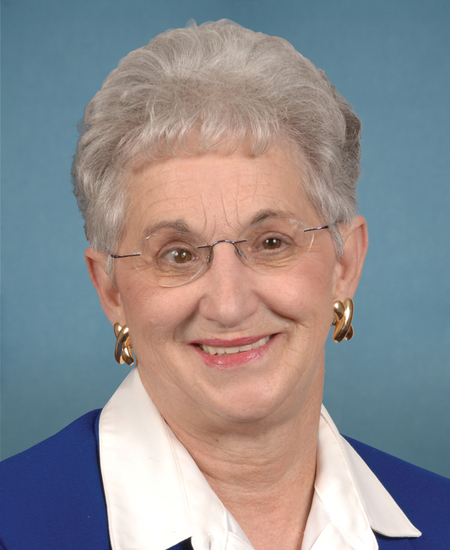
Rep. Virginia Foxx
Sponsored bills
Maddy summaryThis bill designates seven specific creeks in North Carolina with new names honoring individuals (Noah Styron Creek, Hunter Parks Creek, etc.), including their exact geographic coordinates. It updates all federal references in laws, maps, and documents to use these new names. The bill has no policy impact beyond renaming geographic features and affects no groups or programs. As a purely procedural naming resolution, it does not alter laws or regulations.
Maddy summaryHR 356, the Unleashing American Energy Act, requires the federal government to hold annual offshore oil and gas lease sales in specific Gulf of Mexico regions and Alaska starting in 2023. It mandates that all unleased areas (not restricted by law) be included in these sales, following existing federal leasing rules. The bill also amends federal law to prevent the President from delaying or blocking these leasing processes without explicit congressional approval, creating a rebuttable presumption that such actions are unreasonable. This directly affects federal energy leasing programs and companies seeking offshore drilling rights.
Ordering Authentication in The House's Swearing-in Act or the OATHS Act This bill modifies procedures related to the oath of office that is taken by Members of the House of Representatives. First, the bill eliminates the statutory requirement that the oath of office be administered at the first session of Congress after every general election of Representatives. Second, the bill requires that the Clerk of the House of Representatives provide Members with two printed copies of the oath of office to sign before the first session of Congress rather than on the first day of that session. Generally, a Member shall be deemed to have taken the oath of office when they return the signed oath to the clerk for filing in official records. However, if a Member returns the signed oath before noon on the first day of the first session, the signed oath is effective at noon on the first day of that session.
Maddy summaryHJRES 24 is a congressional disapproval resolution targeting a District of Columbia law. It formally rejects the D.C. Council's approval of the "Local Resident Voting Rights Amendment Act of 2022" (D.C. Act 24-640), which would have granted voting rights to D.C. residents in local elections. The resolution prevents this D.C. law from taking effect by disapproving the Council's action under the District of Columbia Home Rule Act. This is a procedural measure affecting D.C. residents' local voting rights, not a new federal policy.
Maddy summaryThis resolution allocates $19,066,789 in total funding for the Committee on Education and the Workforce's operations during the 118th Congress, covering staff salaries and related expenses. It specifies $9,255,723 for the 2023 period (January 3, 2023-January 3, 2024) and $9,811,066 for the 2024 period (January 3, 2024-January 3, 2025). Payments are made via vouchers signed by the committee chairman and approved by the House Administration Committee, in line with existing House regulations. As a procedural funding resolution, it directly affects the committee's ability to function but does not create new policy.
This resolution expresses the sense of the House of Representatives that (1) for purposes of federal law, a person's sex means the person's biological sex at birth; and (2) distinctions between the sexes are justified in certain settings, laws, and policies.
Maddy summaryHCONRES 9 is a symbolic resolution passed by the U.S. House of Representatives that formally denounces socialism as incompatible with American values, citing historical examples of socialist regimes causing widespread suffering and authoritarian rule. It states Congress opposes the implementation of socialist policies in the United States. This resolution has no legal effect, does not change any laws, and serves solely as a non-binding statement of congressional opinion. It directly affects no individuals or policies, as it is purely a declarative position.
Maddy summaryHCONRES 13 is a concurrent resolution expressing Congress's support for maintaining the current policy that prohibits imposing new fees on local radio stations for playing music. It states that Congress should not impose any performance fee, tax, royalty, or charge on local radio stations for broadcasting sound recordings over the air, or on businesses like bars and restaurants that play music publicly. The resolution argues that such fees would harm local radio stations - critical sources for emergency information and community programming - and jeopardize the economic model that has supported both radio and the music industry for decades. This resolution does not create new law but formally opposes potential legislative changes to the existing fee structure.
Maddy summaryThe Standing with Moms Act requires the Department of Health and Human Services to create a public website (life.gov) and interactive portal within one year of enactment, providing pregnant women with tailored information on local resources. It mandates comprehensive listings of services including mental health support, alternatives to abortion, abortion risk details, child development resources, and practical assistance like childcare and housing. The portal uses a question-based system to match users with ZIP code-specific services, while requiring states to recommend vetted providers (excluding abortion-focused organizations) and ensuring multilingual access. The bill also integrates the Maternal Mental Health Hotline to promote the portal and requires an annual report on user feedback and service gaps.