

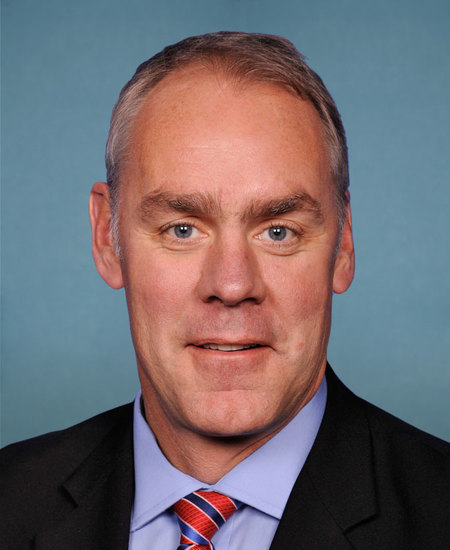
Photo of Ryan K. Zinke
R United States House · District 1 · Montana

Rep. Ryan K. Zinke

Compare
Total votes
1,879
all sessions
Attendance
97%
47 missed
Near the chamber average
With party
94%
of cast votes
Near the chamber average
Bipartisan score
3%
crosses aisle rarely
Near the chamber average
Sponsored
415
bills & resolutions
Lower than 84% of chamber peers
Committees
7
assignments
415 bills and resolutions

Sponsored bills

Total
415
Primary
31
Co-sponsor
384
This page
415
matching current filters
Co-sponsor HR 764
Passed · Indiana House · Co-sponsor
Trust the Science Act

Maddy summaryHR 764, the "Trust the Science Act," requires the Secretary of the Interior to reissue a specific 2020 rule removing gray wolves from the endangered species list within 60 days of the bill's enactment. This directly affects gray wolf populations by changing their federal conservation status. The bill's key provision mandates that this reissuance cannot be challenged in court, eliminating judicial review of the decision. The bill focuses solely on procedural implementation of a prior rule, not broader scientific policy.

Passed May 1, 2024 1 co-sponsor
Co-sponsor HR 615
Passed · Indiana House · Co-sponsor
Protecting Access for Hunters and Anglers Act of 2023

Maddy summaryHR 615, the Protecting Access for Hunters and Anglers Act of 2023, prevents federal agencies from banning lead ammunition or tackle on public lands and waters managed for hunting or fishing, except in specific cases. The bill allows exceptions only if a state wildlife department confirms lead use is harming local wildlife, and the federal action aligns with state law or state agency approval. It directly affects hunters and anglers using federal lands and waters, ensuring they can continue using lead products unless a state verifies a local wildlife issue requiring a ban. The law requires federal agencies to justify any exception with state data and policy compliance in official notices.

Passed May 1, 2024 1 co-sponsor
Co-sponsor HR 8160
In committee · Indiana House · Co-sponsor
Breaking Irresponsible Energy and Commercial Habits Act

Maddy summaryHR 8160, the Breaking Irresponsible Energy and Commercial Habits Act (BREACH Act), prohibits the Secretary of the Army from breaching federally operated dams under specific conditions. It blocks dam breaches that would increase carbon emissions by over 10%, reduce commercial navigability of the waterway, or raise prices for shipped goods (including agriculture) by at least 10%. The bill requires the Army Secretary to consult with the Energy, Transportation, Agriculture, Commerce, and state agencies before making such decisions. This directly affects federal dam management decisions and commercial shipping interests reliant on waterways managed by federally operated dams.

In committee Apr 30, 2024 1 co-sponsor
Co-sponsor HR 8158
In committee · Indiana House · Co-sponsor
Pinniped Predator Deterrence Act

Maddy summaryThis bill directs the U.S. Army Corps of Engineers (through the Chief of Engineers) to acquire and install acoustic sound technology at Bonneville Dam to deter seals and sea lions (pinnipeds) from gathering there. It specifically prohibits using underwater firecrackers or similar methods and authorizes $400,000 for this purpose. The law aims to prevent pinnipeds from recolonizing the dam area, directly affecting dam operations and local wildlife management. It focuses on a specific technological solution for a localized wildlife management issue at the Columbia River dam.

In committee Apr 30, 2024 1 co-sponsor
Co-sponsor HR 8159
In committee · Indiana House · Co-sponsor
ACRES Act

Maddy summaryThe ACRES Act (HR 8159) prohibits the U.S. Army Corps of Engineers from breaching any federally operated dam if the replacement energy project would require at least 5% more land area than the dam itself occupies. It directly affects federal dam management decisions and energy projects seeking to replace dam operations. The key provision requires the Army Secretary, in coordination with the Interior Secretary, to conduct a study analyzing the land area occupied by the dam before considering any breach. This law aims to prevent dam removals that would significantly expand the land footprint of replacement energy infrastructure.

In committee Apr 30, 2024 1 co-sponsor
Co-sponsor HRES 1176
In committee · Indiana House · Co-sponsor
Expressing disapproval of the Columbia Basin Restoration Initiative entered into by the Biden administration.

Maddy summaryHRES 1176 is a House resolution expressing disapproval of the Biden administration's Columbia Basin Restoration Initiative, formalized in a December 14, 2023, memorandum of understanding (MoU) with multiple stakeholders. The resolution cites the 4 Lower Snake River dams' critical role in providing carbon-free energy for 1.8 million homes, generating over 1,000 megawatts of power, supporting 40-60% of U.S. wheat exports, and moving 50-60 million tons of annual cargo. It argues the dams should not be breached, disapproves of the administration's commitments in the MoU, and states those commitments depend on unsecured congressional funding. This resolution does not alter policy but formally opposes the initiative through a statement of congressional disapproval.

In committee Apr 29, 2024 1 co-sponsor
Co-sponsor HR 8156
In committee · Indiana House · Co-sponsor
To direct the Comptroller General of the United States to submit to Congress an updated report on the roles, responsibilities, and practices of the Council on Environmental Quality.

Maddy summaryHR 8156 requires the Government Accountability Office (GAO) to submit to Congress an updated report on the Council on Environmental Quality (CEQ) within 120 days of the bill's enactment. The report must specifically address the CEQ's role in the Lower Snake River dams litigation case, including whether it meets its legal duties under environmental law and whether its functions could be handled by another agency. It also mandates details on the CEQ's use of outside contractors, its reliance on non-governmental organizations, and staff connections to groups involved in environmental cases. This procedural bill directly affects Congress, which will receive the report to inform oversight of the CEQ's operations.

In committee Apr 29, 2024 1 co-sponsor
Co-sponsor HR 8155
In committee · Indiana House · Co-sponsor
Ratepayer Funding Alternative Act

Maddy summaryHR 8155, the Ratepayer Funding Alternative Act, requires the Secretary of Energy to develop alternative funding methods for the Bonneville Power Administration's fish and wildlife program that avoid passing these costs to ratepayers (electricity customers). The Secretary must consult with other federal agencies and submit a report detailing these alternatives to Congress within six months of the bill's enactment. This bill directly affects Bonneville Power Administration ratepayers, who currently pay for the program through their electricity bills. The legislation mandates the creation of funding alternatives and a report but does not change current funding practices.

In committee Apr 29, 2024 1 co-sponsor
Co-sponsor HR 8147
In committee · Indiana House · Co-sponsor
Repealing Big Brother Overreach Act

Maddy summaryHR 8147 repeals the Corporate Transparency Act, which required certain businesses (typically those with more than 20 employees) to report beneficial ownership details to the Treasury Department. This bill eliminates the requirement for companies to disclose who ultimately owns or controls them, directly affecting business owners and financial institutions that previously submitted this information. The bill also makes minor technical changes to Title 31 of the U.S. Code to remove references to the repealed provisions. The repeal would end the existing financial transparency reporting obligation for covered entities.

In committee Apr 29, 2024 1 co-sponsor
Co-sponsor HR 8104
In committee · Indiana House · Co-sponsor
Habitat Connectivity on Working Lands Act

Maddy summaryThis bill amends USDA conservation programs to prioritize habitat connectivity for native wildlife, particularly big game species like deer, elk, and moose. It allows ranchers with grasslands enrolled in the Conservation Reserve Program to receive cost-share payments for practices that restore wildlife migration corridors and habitat connectivity, while preserving emergency grazing access. The bill increases payment limits for conservation programs and requires incorporating nonstructural methods like virtual fencing into conservation standards. It also directs research funding to study virtual fencing technology's effects on sensitive habitats and big game corridors. These changes directly affect agricultural landowners participating in USDA conservation programs.

In committee Apr 20, 2024 1 co-sponsor
Showing 251 to 260 of 415 bills
Previous 1 … 25 26 27 … 42 Next