Emergency Child and Adult Nutrition Assistance Act of 2021 This bill provides funding for and extends through June 2021 programs that, during the COVID-19 emergency, reimburse certain operational costs of child and adult care food programs and school meals programs. Under the bill, funding allocated to states remains available through FY2022.
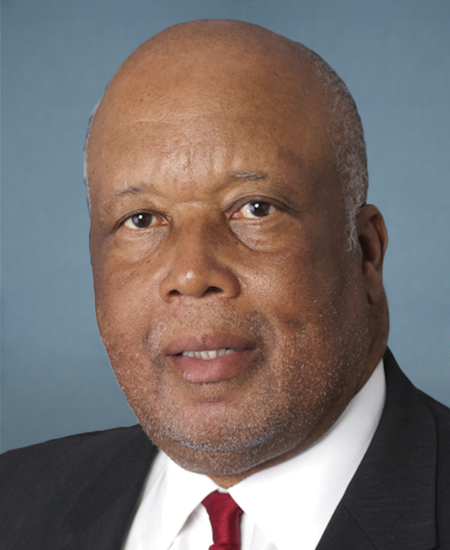
Rep. Bennie G. Thompson
Sponsored bills
Rescinding DHS' Waiver Authority for Border Wall Act This bill rescinds the authority of the Department of Homeland Security to waive legal requirements in order to ensure the expeditious construction of barriers and roads in the vicinity of the U.S. border.
Domestic Workers Bill of Rights Act This bill provides rights and protections for domestic workers (e.g., housekeepers, nannies, caretakers, personal assistants, and chauffeurs), including pay and leave rights, and health and safety protections. Specifically, the bill repeals the exemption of domestic live-in employees from certain minimum wage and maximum hour requirements. Employers must provide written notice of termination and provide at least 30 days of lodging and two weeks of severance pay to terminated live-in employees. Live-in employees also must be provided with reasonable access to telephone and internet service during their employment. The bill requires employers to provide domestic workers with a written agreement covering wages, sick leave, benefits, and other matters. Further, domestic workers may request and be granted changes to work schedules due to personal events. The bill also provides domestic workers with certain privacy rights, extends to domestic workers protections against discrimination in employment, and increases the federal medical assistance percentage (FMAP) for certain Medicaid-funded medical services provided by domestic workers. The Department of Labor must (1) award grants for a domestic worker national hotline for reporting emergencies, training on hazards facing domestic workers, and workforce investment activities for domestic workers; and (2) establish a Domestic Worker Wage and Standards Board to investigate standards in the domestic workers industry. Labor must publish online a document that describes the rights and protections for domestic workers under this bill.

Protecting Renters from Evictions Act of 2021 This bill extends through December 31, 2021, the order issued by the Centers for Disease Control and Prevention titled Temporary Halt in Residential Evictions To Prevent the Further Spread of COVID–19 and published on September 4, 2020.
Andrew J. Young Safeguarding the Mississippi River Together Act or the Andrew J. Young SMRT Act or Andy's Mississippi River Bill or Andy's Bill. This bill establishes a National Mississippi River Program for the preservation of the Mississippi River Corridor. The Environmental Protection Agency, coordinating with specified federal departments, may enter into agreements with a state or local government to develop a National Mississippi River Program Office, provide grants, assistance, studies, coordination, and essential restoration and protection of the Mississippi River Corridor to sustain essential environmental services; maintain the ecological integrity, health, and biodiversity of federal lands as well as lands managed under federal programs; protect critical national infrastructure, habitat, fish and wildlife resources; and support the major U.S. economies that depend on the Mississippi River. The Program Office shall develop a comprehensive Mississippi River Restoration Plan to guide implementation of projects to sustain the corridor. In order to support the plan and for other purposes, the bill establishes a series of ongoing studies and investigations to sustain the corridor. Once every five years the Program Office shall complete an updated economic profile of the corridor.
Mississippi River Restoration and Resilience Initiative Act or the MRRRI Act This bill establishes the Mississippi River Restoration and Resilience Initiative to protect and restore the Mississippi River Corridor. The Environmental Protection Agency (EPA) must establish the initiative and the Mississippi River National Program Office to carry out the initiative. The office must (1) coordinate agency actions to protect and restore the Mississippi River Corridor; (2) develop, implement, and update the initiative, actionable goals, and an action plan required by the bill; (3) make updates and information available on a public website; and (4) submit annual reports to Congress. Additionally, the bill outlines the focus areas that each project carried out under the initiative must address, such as improving water quality and protecting wildlife habitat. The office may make grants to certain nonfederal entities to carry out eligible projects. The bill directs the EPA to include the initiative as a separate budget line item in its annual budget submission. Next, the bill directs the Department of the Interior to coordinate with the office to establish four Mississippi River Corridor research centers within the U.S. Geological Survey (USGS). These research centers must, among other duties, conduct scientific research on the focus areas of the initiative. The bill also directs the USGS to host a science forum to share current science and identify data gaps related to the ecological health of the Mississippi River Corridor. The USGS must, within two years of the forum, develop a science plan for the initiative.
Medicaid Saves Lives Act This bill requires and provides funds for the Department of Health and Human Services to establish a program that provides health benefits to the Medicaid expansion population in states that have not expanded Medicaid. Specifically, the program must provide coverage for individuals who are newly eligible for Medicaid under the Patient Protection and Affordable Care Act (i.e., the Medicaid expansion population) without premiums and in accordance with Medicaid cost-sharing and other requirements. The bill also extends and increases the temporarily enhanced Federal Medical Assistance Percentage (i.e., federal matching rate) for states that elect to participate in Medicaid expansion if they have not already done so.
Averting Loss of Life and Injury by Expediting SIVs Act of 2021 or the Allies Act of 2021 This bill increases the number of special immigrant visas available to qualified Afghan nationals who worked for the U.S. government or the North Atlantic Treaty Organization (NATO) missions in Afghanistan. The bill also relaxes certain qualifications for such visas. Specifically, this bill makes available an additional 8,000 visas for principal aliens under this special visa program, to be available until all such visas have been issued. (The numerical limitations in this program apply only to the principal alien who applies for the visa, not to any accompanying spouse or child.) Under this bill, an alien may qualify based on a credible basis for concern about the possibility of an ongoing serious threat in Afghanistan due to their work with the U.S. government or a NATO mission, where currently the alien must have experienced such a threat. The bill also eliminates a requirement for each applicant to submit a credible sworn statement describing that threat. Furthermore, for an applicant qualifying for a visa by performing duties for U.S. military personnel stationed with a NATO mission, this bill eliminates a requirement that the duties performed qualify as sensitive and trusted duties. If an alien submits a visa application that included an accompanying spouse or child but the alien passes away before the application is granted, the surviving spouse or child shall remain eligible to receive a visa under that application. Currently, a surviving spouse or child retains eligibility only if the application was approved before the alien passed away.
Universal School Meals Program Act of 2021 This bill revises requirements under the food and nutrition programs of the Department of Agriculture, such as the school lunch and breakfast programs. For example, the bill permanently provides free meals to all school children regardless of income. The bill increases the reimbursement rate for school food authorities participating in the food and nutrition programs. The bill also prohibits school food authorities from (1) physically segregating or otherwise discriminating against any child participating in the free breakfast program, or (2) overtly identifying a child participating in the program with a special token or announcement. Additionally, the bill expands the summer food service program by making all children eligible for participation in the program. Further, the bill revises eligibility determinations for measuring poverty to include runaway or homeless youth, foster children, migratory children, and children participating in specified programs (e.g., Head Start).
Domains Critical to Homeland Security Act This bill authorizes the Department of Homeland Security (DHS) to conduct research and development to identify U.S. critical domains for economic and homeland security and evaluate the extent to which disruption, corruption, exploitation, or dysfunction of any such domain poses a substantial threat to homeland security. The bill defines United States critical domains for economic security as the critical infrastructure and other associated industries, technologies, and intellectual property, or any combination thereof, that are essential to U.S. economic security. DHS may conduct additional research into high-risk critical domains under specified circumstances.