

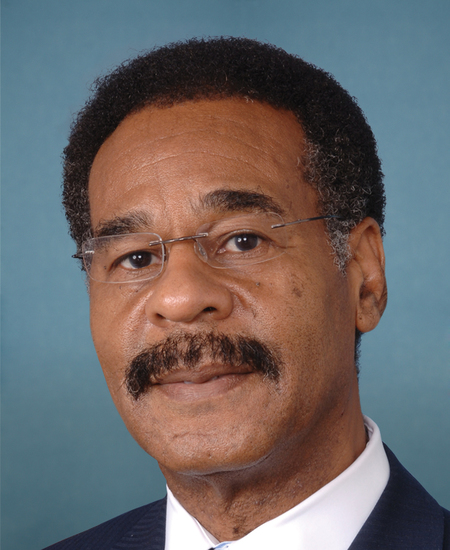
Photo of Emanuel Cleaver
D United States House · District 5 · Missouri On the 2026 ballot

Rep. Emanuel Cleaver

Compare
Total votes
2,837
all sessions
Attendance
91%
246 missed
Lower than 76% of chamber peers
With party
98%
of cast votes
Higher than 95% of chamber peers
Bipartisan score
1%
crosses aisle rarely
Lower than 95% of chamber peers
Sponsored
1,654
bills & resolutions
Higher than 82% of chamber peers
Committees
3
assignments
1,654 bills and resolutions

Sponsored bills

Total
1,654
Primary
79
Co-sponsor
1,575
This page
1,654
matching current filters
Co-sponsor HR 5253
In committee · Indiana House · Co-sponsor
Fossil Free Finance Act

Fossil Free Finance Act This bill requires large bank holding companies to develop and implement emission reduction plans. Such a plan must include strategies for a company to equitably reduce and eventually eliminate financed greenhouse gas emissions by January 1, 2050, and to discontinue specified fossil fuel projects and financing. The bill also prohibits the use of carbon offsets in such a plan, sets forth technological requirements for reductions, and requires the prioritization of specified social impacts. Plans must be submitted to the Board of Governors of the Federal Reserve System for approval every two years.

In committee Sep 14, 2021 1 co-sponsor
Primary HR 5208
In committee · Indiana House · Lead sponsor
Freedom’s Frontier National Heritage Area Reauthorization Act

Freedom's Frontier National Heritage Area Reauthorization Act This bill extends the authority of the Department of the Interior to provide any assistance for the Freedom's Frontier National Heritage Area in Kansas and Missouri for another 15 year period.

In committee Sep 14, 2021 0 co-sponsors
Co-sponsor HR 4
Passed · Indiana House · Co-sponsor
John R. Lewis Voting Rights Advancement Act of 2021

John R. Lewis Voting Rights Advancement Act of 2021 This bill establishes new criteria for determining which states and political subdivisions must obtain preclearance before changes to voting practices may take effect. Preclearance is the process of receiving preapproval from the Department of Justice (DOJ) or the U.S. District Court for the District of Columbia before making legal changes that would affect voting rights. A state and all of its political subdivisions shall be subject to preclearance of voting practice changes for a 10-year period if 15 or more voting rights violations occurred in the state during the previous 25 years; 10 or more violations occurred during the previous 25 years, at least 1 of which was committed by the state itself; or 3 or more violations occurred during the previous 25 years and the state administers the elections. A political subdivision as a separate unit shall also be subject to preclearance for a 10-year period if three or more voting rights violations occurred there during the previous 25 years. States and political subdivisions that meet certain thresholds regarding minority groups must preclear covered practices before implementation, such as changes to methods of election and redistricting. Further, states and political subdivisions must notify the public of changes to voting practices. Next, the bill authorizes DOJ to require states or political subdivisions to provide certain documents or answers to questions for enforcing voting rights. The bill also outlines factors courts must consider when hearing challenges to voting practices, such as the extent of any history of official voting discrimination in the state or political subdivision.

Passed Sep 14, 2021 1 co-sponsor
Co-sponsor HR 5218
In committee · Indiana House · Co-sponsor
Collaborate in an Orderly and Cohesive Manner Act

Collaborate in an Orderly and Cohesive Manner Act This bill requires the Department of Health and Human Services (HHS) to award grants for implementing and evaluating specified models of care that integrate the delivery of behavioral health and primary care services. Specifically, HHS must award grants to primary care providers for the initial costs (e.g., hiring staff) of implementing such models. In awarding the grants, HHS must prioritize recipients that provide care to medically underserved populations and in areas where the prevalence of behavioral health conditions exceeds the national average. HHS must also provide additional incentive payments to recipients that use appropriate billing codes and quality measures for behavioral health services. In addition, HHS must award grants to national and regional organizations for providing technical assistance to health care providers and systems to improve implementation of integrated behavioral health and primary care models. Furthermore, HHS may direct its agencies to expand efforts to evaluate current and emerging integrated behavioral health and primary care models.

In committee Sep 13, 2021 1 co-sponsor
Co-sponsor HR 4811
In committee · Indiana House · Co-sponsor
Medicare Negotiation and Competitive Licensing Act of 2021

Medicare Negotiation and Competitive Licensing Act of 2021 This bill establishes several requirements relating to the prices of prescription drugs. Specifically, the bill requires the Centers for Medicare & Medicaid Services (CMS) to negotiate with pharmaceutical companies regarding prices for drugs covered under Medicare. (Current law prohibits the CMS from doing so.) If the CMS is unable to negotiate the price of a drug, such drug is subject to competitive licensing in order to further its sale under health insurance programs, notwithstanding existing government-granted exclusivities. The negotiated prices also apply to other federal health care programs, private health insurance, and the uninsured; pharmacies that charge more than the negotiated price for uninsured individuals are subject to civil penalties. Manufacturers must also comply with specified reporting requirements relating to prices and licensing, subject to civil penalties. The bill also institutes an excise tax on drugs for which the price spikes beyond a certain limit, subject to specified exemptions, as well as on drugs for which the price exceeds the negotiated price.

In committee Sep 8, 2021 1 co-sponsor
Co-sponsor HR 4450
In committee · Indiana House · Co-sponsor
Access to Infertility Treatment and Care Act

Access to Infertility Treatment and Care Act This bill requires private health insurance plans to cover (1) specified infertility treatments (e.g., in vitro fertilization), if the plan also covers obstetrical services; and (2) fertility preservation services for individuals who undergo medically necessary treatment that may cause impairment of fertility. Private health insurance plans must apply cost sharing for such services that does not exceed the amount for similar services covered by the plan. Further, plans are prohibited from (1) providing incentives for plan holders to forego infertility treatment, or (2) reducing the reimbursement rate to providers of such treatments. The bill also extends infertility treatment and fertility preservation coverage to Medicaid enrollees, federal employees, members of the military, and veterans.

In committee Sep 7, 2021 1 co-sponsor
Co-sponsor HR 5165
In committee · Indiana House · Co-sponsor
Improving Medicare Coverage Act

Improving Medicare Coverage Act This bill temporarily expands eligibility for Medicare. It also temporarily establishes a premium and cost-sharing assistance program for low-income beneficiaries. Specifically, the bill lowers the age of eligibility for Medicare from 65 to 60. The Centers for Medicare & Medicaid Services must establish procedures to provide for automatic enrollment of qualifying individuals. Enrollment must be completed within 11 months of the bill's enactment. The bill also establishes a program under Medicare to assist low-income Medicare beneficiaries with premiums, coinsurance, deductibles, and other costs. Currently, such assistance is provided through Medicare Savings Programs, which are administered by state Medicaid programs. The bill also establishes a related special enrollment period under Medicare, expands eligibility for assistance to beneficiaries with income up to 200% of the federal poverty line, and provides for joint eligibility determinations with respect to the bill's program and the low-income subsidy program under the Medicare prescription drug benefit. The bill's provisions generally take effect six months after the bill's enactment and terminate five years later.

In committee Sep 6, 2021 1 co-sponsor
Co-sponsor HR 2328
In committee · Indiana House · Co-sponsor
Prohibition of Medicaid Funding for Conversion Therapy Act

Prohibition of Medicaid Funding for Conversion Therapy Act This bill prohibits state Medicaid programs from covering conversion therapy. The bill defines conversion therapy as any practice or treatment that seeks to change a person's sexual orientation or gender identity in exchange for monetary compensation.

In committee Sep 2, 2021 1 co-sponsor
Showing 1,361 to 1,370 of 1,654 bills