

Jaime's Law This bill establishes background check requirements for the sale and transfer of ammunition. Specifically, the bill prohibits a licensed importer, manufacturer, or dealer from transferring ammunition to an unlicensed individual prior to submitting a background check through the National Instant Criminal Background Check System. It also establishes penalties for violations. (Currently, background checks are required under these circumstances for the transfer of firearms, but not for ammunition.) Additionally, it prohibits an ammunition transfer between private parties (i.e., unlicensed individuals) unless a licensed importer, manufacturer, or dealer first takes possession of the ammunition to conduct a background check. However, this prohibition does not apply to certain ammunition transfers, such as a gift between spouses in good faith.
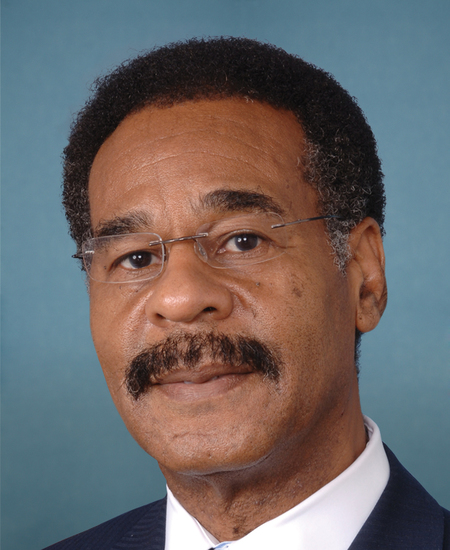
Rep. Emanuel Cleaver
Sponsored bills
Honoring Our Fallen TSA Officers Act This bill extends public safety officers' death benefits to Transportation Security Administration employees performing official duties related to protecting the nation's transportation systems.
Maddy summaryHR 2584, the Judiciary Act of 2021, would change the structure of the U.S. Supreme Court by increasing the number of associate justices from eight to twelve. This bill directly affects the Supreme Court's composition and operations, requiring a quorum of eight justices instead of six to conduct business. The key provision amends Title 28 of the U.S. Code to reflect these numerical changes to the Court's membership and quorum requirements. This is a procedural change to the Court's statutory structure, not a policy affecting the public.
Defending Each and Every Person from False Appearances by Keeping Exploitation Subject to Accountability Act of 2021 or the DEEP FAKES Accountability Act This bill establishes requirements for advanced technological false personation records (i.e., deep fakes) and establishes criminal penalties for related violations. Specifically, it requires producers of deep fakes to generally comply with certain digital watermark and disclosure requirements (e.g., verbal and written statements). It establishes new criminal offenses related to (1) the production of deep fakes which do not comply with related watermark or disclosure requirements, and (2) the alteration of deep fakes to remove or meaningfully obscure such required disclosures. A violator is subject to a fine, up to five years in prison, or both. It also establishes civil penalties and permits individuals to bring civil actions for damages. Additionally, it revises the criminal offense of fraud in connection with certain identification documents to include deep fakes. The bill also directs the Department of Justice to take certain actions, such as publishing a report related to deep fakes that includes a description of the efforts of Russia and China to use technology to impact elections. Software manufacturers who reasonably believe software will be used to produce deep fakes must ensure it has the technical capability to insert watermarks and disclosures. Finally, the bill directs the Department of Homeland Security to establish a task force to, among other things, advance efforts of the federal government to combat the national security implications of deep fakes.
Healthcare Workforce Resilience Act This bill makes previously unused immigrant visas available to nurses and physicians who petition for such a visa before the date that is 90 days after the end of the declared national emergency relating to the COVID-19 (i.e., coronavirus disease 2019) outbreak. The number of visas available shall be the total number of unused employment-based immigrant visas from FY1992-FY2020, up to 40,000. Of such visas, 25,000 shall be reserved for nurses and 15,000 for physicians. Certain family members may accompany the principal beneficiary of a visa provided under this bill, and visas for such family members shall (1) be made available from the unused visas from FY1992-FY2020, and (2) not be counted against the 40,000 cap. Visas provided under this bill shall be exempt from per-country limitations.
Dignity for Detained Immigrants Act of 2021 This bill directs the Department of Homeland Security (DHS) to establish standards for facilities holding aliens in its custody, phases out using non-DHS facilities for such purposes, and contains other related provisions. The standards shall comply with the American Bar Association's Civil Immigration Detention Standards. The DHS Office of Inspector General (OIG) shall conduct periodic unannounced inspections of each facility and shall take various actions against noncompliant facilities, including imposing fines, cancelling contracts, and closing facilities. DHS shall report to Congress any death of an alien in its custody within 24 hours and conduct an investigation within 30 days that identifies policy changes that could reduce the likelihood of such a death. DHS is prohibited from entering into contracts for third parties to operate detention facilities or alternatives to detention programs and shall terminate existing contracts within three years of the bill's enactment. The bill establishes that OIG facility inspection reports and contracts for an outside entity to operate a detention facility are records available to the public under the Freedom of Information Act. DHS shall maintain certain information relating to detained aliens, including the alien's location and whether the alien was separated from family. The bill provides for various requirements and procedures related to detaining aliens, including (1) prohibiting DHS from detaining children, (2) imposing a presumption that an alien should be released, and (3) establishing that aliens in custody shall be subject to the least restrictive conditions. The bill also abolishes mandatory detention for asylum seekers.
Equal Access to Abortion Coverage in Health Insurance Act of 2021 or the EACH Act of 2021 This bill requires federal health care programs to provide coverage for abortion services and requires federal facilities to provide access to those services. The bill also permits qualified health plans to use funds attributable to premium tax credits and reduced cost sharing assistance to pay for abortion services.
Cybersecurity Opportunity Act This bill requires the Department of Homeland Security to establish a grant program to promote cybersecurity training and education at institutions of higher education with an enrollment of needy students, historically Black colleges and universities, and minority-serving institutions.
Reducing Waste in National Parks Act This bill directs the National Park Service to establish a program for the National Park System to reduce disposable plastic products and, if applicable, eliminate the sale and distribution of disposable plastic products. Each regional office of the National Park Service must eliminate the sale of water in disposable plastic products and the sale and distribution of other disposable plastic products after consideration of several specified factors (e.g., the costs and benefits to overall operations). Each regional office must develop a proactive visitor education strategy to address visitor expectations of water availability and explain the rationale for the program and its implementation.
Reconciliation in Place Names Act This bill directs the Department of the Interior to establish the Advisory Committee on Reconciliation in Place Names to advise the Board on Geographic Names with regard to renaming geographic features with offensive place names. The board shall rename a geographic feature with an offensive name in accordance with a recommendation of the committee unless the board determines that (1) there is a compelling reason and substantial public interest in rejecting the recommendation, or (2) approving the recommendation would violate federal law. The board shall accept or reject a recommendation within three years of receiving the recommendation.