

Securing the Homeland from International Entrants with Life-threatening Diseases Act or the SHIELD Act This bill suspends for one year the admission and parole into the United States of certain categories of individuals who are from or were recently in a country that fails to meet certain criteria related to COVID-19. This restriction applies to certain individuals entering the United States from Mexico or Canada through a port of entry or U.S. Border Patrol station and (1) whose country of origin has not been categorized by the Centers for Disease Control and Prevention as a low-risk country for COVID-19, or (2) who was in such a country at any time in the 30 days before arriving in the United States. The bill exempts certain individuals from this restriction, including U.S. citizens and lawful permanent residents, members of the Armed Forces, and persons from a foreign country who arrive at a designated port of entry with valid travel documents. The Department of Homeland Security shall transport barred individuals to a foreign location, such as an individual's country of origin, to the extent practicable.
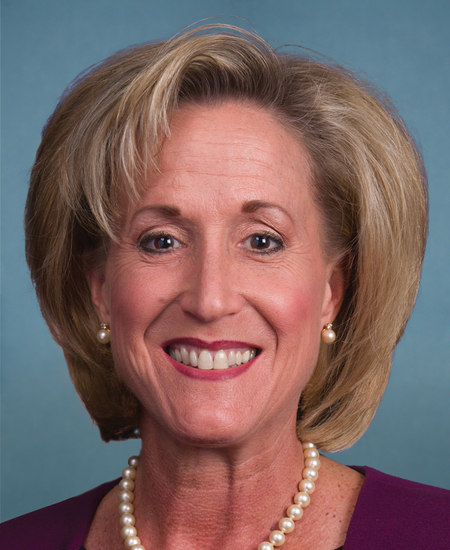
Rep. Ann Wagner
Sponsored bills
Study To Observe and Prevent (STOP) Human Trafficking Act of 2021 This bill directs the Department of Justice, in coordination with the President's Interagency Task Force to Monitor and Combat Trafficking in Persons, to study and report on the prevalence and instances of human trafficking at adult entertainment clubs in the United States.
Empowering Law Enforcement To Fight Sex Trafficking Demand Act of 2021 This bill allows grants under the Edward Byrne Memorial Justice Assistance Grant program to be used for programs to combat human trafficking.
H-2B Returning Worker Exception Act of 2021 This bill modifies the H-2B (temporary nonagricultural workers) nonimmigrant visa program, including by exempting certain workers from an annual numerical limit on such visas and requiring civil penalties for program violations. Under this bill, if a worker seeking a H-2B visa has been counted toward the 66,000 annual cap on such visas in one of the three preceding fiscal years, that worker shall not be counted against the cap again. Furthermore, the Department of Homeland Security (DHS) must impose a civil monetary penalty on an employer for (1) failing to meet requirements related to an H-2B visa petition, or (2) making a willful misrepresentation of material fact in such a petition. DHS must also ensure the establishment of an electronic platform (1) for employers to submit and request approval of an H-2B petition, and (2) to act as a single point of access for applicants and the relevant government agencies. The Department of Labor must maintain a publicly available online database of all job orders by H-2B employers. Furthermore, Labor may take certain actions to enforce program requirements, such as imposing penalties and seeking injunctions. The bill provides statutory authority for the current practice of limiting the program to workers who are nationals of countries approved by DHS. DHS may make exceptions to this limitation in individual cases if it is in the U.S. interest to do so. DHS shall select approved countries based on various factors, such as the rate of overstay by H-2B visa holders from each country.
Preventing Anti-Semitic Hate Crimes Act This bill requires a designated officer or employee of the Department of Justice (DOJ) to facilitate the expedited review of anti-Semitic hate crimes and reports of anti-Semitic hate crimes. Further, the bill requires DOJ to issue guidance for state, local, and tribal law enforcement agencies on expanding public education campaigns to raise awareness of anti-Semitic hate crimes. Finally, the bill increases the statutory maximum prison term for an individual who is convicted of a federal hate crime offense after a prior conviction for a hate crime offense under federal law or a hate crime felony under state law.
Global Malnutrition Prevention and Treatment Act of 2021 This act sets out programs and otherwise directs the U.S. Agency for International Development (USAID) to carry out activities to prevent and treat malnutrition globally. Specifically, USAID may leverage resources to address malnutrition through the Global Nutrition Coordination Plan (an interagency effort to strengthen the impact of U.S. investments in nutrition) and its role on the board of directors of the U.S. International Development Finance Corporation. USAID must also select countries based on specified malnutrition-related indicators for purposes of targeting malnutrition prevention and treatment programs and update the selection within five years. Additionally, USAID may establish the Nutrition Leadership Council to coordinate federal government activities to prevent and treat malnutrition; and target resources and nutrition interventions to the populations most susceptible to severe malnutrition and otherwise support efforts to prevent and treat malnutrition globally. The act also requires USAID to provide to Congress an implementation plan and annual reports concerning its programs for treating and preventing malnutrition. The act's provisions terminate seven years after its enactment.
Global Food Security Reauthorization Act of 2022 This bill reauthorizes through FY2028 activities to implement the Global Food Security Strategy, a whole-of-government strategy to promote global food security, resilience, and nutrition. The bill also modifies aspects of the strategy, such as requiring the strategy to seek to improve the efficiency and resilience of agricultural production. The bill also reauthorizes through FY2028 activities related to the Emergency Food Security Program, an international market-based assistance program.
Combating the Persecution of Religious Groups in China Act This bill expresses the sense of Congress that the United States should promote religious freedom in China and makes statements of policy related to such freedom. In particular, the bill states that it is U.S. policy to consider senior Chinese government officials who are responsible for the persecution of Christians or other religious minorities in China to have committed (1) a gross violation of internationally recognized human rights for the purpose of imposing certain sanctions, and (2) a particularly severe violation of religious freedom for the purpose of determining whether such an individual is admissible into the United States.
Stop Our Scourge Act of 2022 or the SOS Act of 2022 This bill directs the Department of Homeland Security to designate illicit fentanyl as a weapon of mass destruction and requires the Office of National Drug Control Policy to conduct an assessment regarding that substance. Specifically, the office must assess foreign manufacturing of illicit fentanyl, the tools and capabilities across federal agencies to address trafficking of that substance, the capabilities of the Mexican military to conduct counterdrug missions with respect to that substance, the capacities and willingness of China to take specified actions with respect to that substance, and illicit fentanyl being trafficked into the United States from Mexico.
Russia and Belarus SDR Exchange Prohibition Act of 2022 This act prohibits the Department of the Treasury from engaging in any transaction involving the exchange of Special Drawing Rights (SDRs) held by Russia or Belarus and requires Treasury to take actions to oppose financial assistance to Russia or Belarus. The SDR is an international reserve asset maintained by the International Monetary Fund (IMF) based on contributions from IMF member countries. SDRs may be exchanged between member countries and may also be exchanged for currencies. Treasury must also (1) vigorously advocate for IMF member countries to prohibit transactions involving the exchange of SDRs held by Russia or Belarus, and (2) direct U.S. representatives to each international financial institution to oppose providing financial assistance to Russia or Belarus except to address the basic human needs of their civilian populations. The act's provisions shall be in effect until the earlier of (1) five years after this act's enactment, or (2) 30 days after the President reports to Congress that the governments of Russia and Belarus have ceased destabilizing activities directed at Ukraine's sovereignty and territorial integrity. The President may also waive the provisions upon reporting to Congress that doing so is in the national interest of the United States.