

Maddy summaryHR 53 (FIND Act) requires federal contractors to certify they do not refuse to work with firearm manufacturers, dealers, ammunition sellers, or related safety device companies based on bias. It prohibits main contractors from awarding subcontracts exceeding 10% of a contract’s value to entities that fail to make this certification, and bans efforts to circumvent the rule through complex subcontract tiers. The law applies to all federal procurement contracts, directly affecting businesses bidding on government work. Violations risk contract termination and suspension from future government contracts.
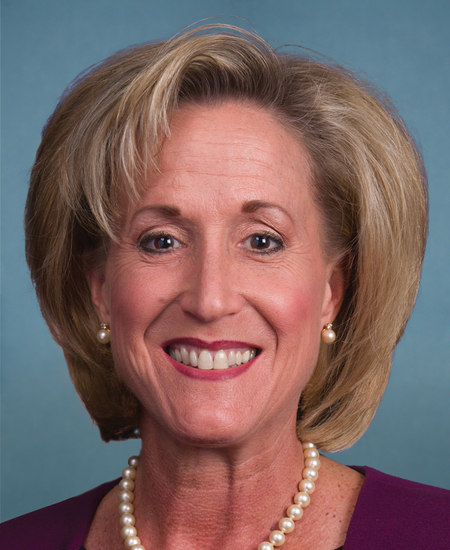
Rep. Ann Wagner
Sponsored bills
War Crimes Rewards Expansion Act This act expands the Department of State's rewards program to authorize rewards for providing information leading to the arrest, conviction, or transfer of a foreign national accused of war crimes, crimes against humanity, or genocide as such crimes are defined under the law of an international criminal tribunal, the applicable country, or the United States. Currently, rewards are authorized for information leading to the arrest, conviction, or transfer of a foreign national accused of such crimes only as defined under the statutes of the relevant tribunal.
Uyghur Forced Labor Prevention Act This bill imposes various restrictions related to China's Xinjiang Uyghur Autonomous Region, including by prohibiting certain imports from Xinjiang and imposing sanctions on those responsible for human rights violations there. Goods manufactured or produced in Xinjiang shall not be entitled to entry into the United States unless U.S. Customs and Border Protection (1) determines that the goods were not manufactured by convict labor, forced labor, or indentured labor under penal sanctions; and (2) reports such a determination to Congress and to the public. The President shall periodically report to Congress a list of foreign entities and individuals knowingly facilitating (1) the forced labor of Uyghurs, Kazakhs, Kyrgyz, and members of other Muslim minority groups in Xinjiang; and (2) efforts to contravene U.S. laws regarding the importation of forced labor goods from Xinjiang. The President shall impose property-blocking sanctions on the listed individuals and entities and impose visa-blocking sanctions on the listed individuals. Securities issuers required to file annual or quarterly reports with the Securities Exchange Commission shall disclose in such reports instances in which the issuer knowingly engaged in certain activities related to Xinjiang, such as working with an entity building detention facilities or surveillance systems there. After such a disclosure, the President shall determine whether to investigate if sanctions or criminal charges are warranted. The Forced Labor Enforcement Task Force and the Department of State shall report to Congress strategies to address forced labor in Xinjiang or any other part of China. The State Department shall also report to Congress a determination of whether the treatment of Muslim groups in Xinjiang constitutes crimes against humanity or genocide under U.S. law.
Cardiovascular Advances in Research and Opportunities Legacy Act This act addresses research, education, and awareness concerning valvular heart disease and its treatment. This disease is caused by damage to or disease affecting any valve that controls blood flow in the heart. The National Institutes of Health may conduct or support research on the disease in consultation with the National Heart, Lung, and Blood Institute (NHLBI). The NHLBI must also conduct a workshop on mitral valve prolapse, which occurs when the valve between the chambers of the left side of the heart seals improperly. The Department of Health and Human Services (HHS) must develop best practices to treat valvular heart disease. HHS may also carry out other projects to increase education and awareness of the disease.
This resolution states that the House of Representatives holds the Russian government responsible for the illegal kidnapping of children from Ukraine and condemns these actions. The resolution also (1) declares that illegal adoptions are contrary to the Genocide Convention (the 1948 Convention on the Prevention and Punishment of the Crime of Genocide); (2) claims that Russia is attempting to wipe out a generation of Ukrainian children; and (3) asserts that Russia's invasion of Ukraine has increased the risks of children being exposed to human trafficking, exploitation, child labor, gender-based violence, hunger, injury, trauma, deprivation of education and shelter, and death.
SEC Regulatory Accountability Act This bill direct the Securities and Exchange Commission (SEC) to make specified considerations before issuing securities regulations. Specifically, the SEC must identify the nature and source of the problem that the proposed regulation is designed to address; adopt a regulation only upon a reasoned determination that its benefits justify its costs; identify and assess available alternatives to any regulation; and ensure that any regulation is accessible, consistent, written in plain language, and easy to understand. In determining the costs and benefits of a proposed regulation, the SEC must consider its impact on investors, market liquidity, small businesses, and competition. In addition, the SEC must periodically review its existing regulations to determine if they are outmoded, ineffective, insufficient, or excessively burdensome and review, modify, streamline, expand, or repeal them accordingly. Whenever it adopts or amends a major rule, the SEC must state (1) the regulation's purposes and intended consequences, (2) metrics for measuring the regulation's economic impact, (3) the assessment plan to be used to assess whether the regulation has achieved its stated purposes, and (4) any foreseeable unintended or negative consequences of the regulation.
This bill prohibits the use of federal funds to allow an individual who is not a U.S. citizen to vote in any election in the District of Columbia (DC). Further, DC must certify that it does not allow noncitizens to vote in elections as a condition of receiving any federal funds. Federal law bars noncitizens from voting in federal elections; however, the DC Council passed a bill on October 18, 2022, that allows noncitizens who meet residency and other requirements to vote in local elections.
This concurrent resolution commends the bravery, courage, and resolve of the women and men of Iran who are (1) participating in the current protests to defend their fundamental human rights, and (2) risking their safety to speak out against the human rights abuses committed by the Iranian regime. The resolution condemns (1) the brutal beating and death of Mahsa Amini; and (2) the violent suppression by the Iranian regime of women and men participating in the current demonstrations, including children, and calls for transparent accountability for all killings of protesters by Iranian security forces. Finally, the resolution encourages continued efforts by the Biden Administration to respond to the protests, including the recent sanctioning of the Iranian morality police.
Providing Appropriate Recognition and Treatment Needed to Enhance Relations with ASEAN Act or the PARTNER with ASEAN Act This bill establishes that the Association of Southeast Asian Nations (ASEAN) shall be covered by the International Organizations Immunities Act, which provides immunities and privileges to certain international organizations, such as immunity from certain lawsuits and exemption from property taxes. (ASEAN is Southeast Asia's primary multilateral organization. It has 10 member nations, including Brunei, Indonesia, Singapore, and Vietnam.)
The Jackie Walorski Maternal and Child Home Visiting Reauthorization Act of 2022 This bill reauthorizes through FY2027, increases funding for, and modifies the Maternal, Infant, and Early Childhood Home Visiting Program. This program supports home visits for expectant and new parents who live in communities that are at-risk for poor maternal and child health outcomes. Changes to the program include setting out requirements for allocating program funds; increasing the percentage of funds reserved for tribal entities; establishing a publicly available dashboard that reports program outcomes; requiring activities to reduce unnecessary data collection, reporting, and other administrative requirements of the program; and allowing for virtual home visits (provided certain conditions are met). The bill also reduces funding for the Medicare Improvement Fund.