

Wildfire Prevention and Drought Mitigation Act of 2021 This bill categorically excludes forest management activities carried out on specified public lands from requirements to conduct environmental assessments and environmental impact statements. In order to be excluded from environmental review, the primary purposes of such activities must be to protect a municipal or tribal water source from damage caused by wildfire; improve watershed or habitat conditions; improve, maintain, or restore water yield or quality; improve, maintain, or restore snowpack; or adapt the forest landscape to an increased threat of drought. The bill limits the categorical exclusion to activities that manage up to 10,000 acres of land. However, activities that manage up to 30,000 acres of land may be categorically excluded from environmental review if the activities are located in areas that (1) are in a severe, extreme, or exceptional drought; or (2) have been in such droughts in the previous five years.
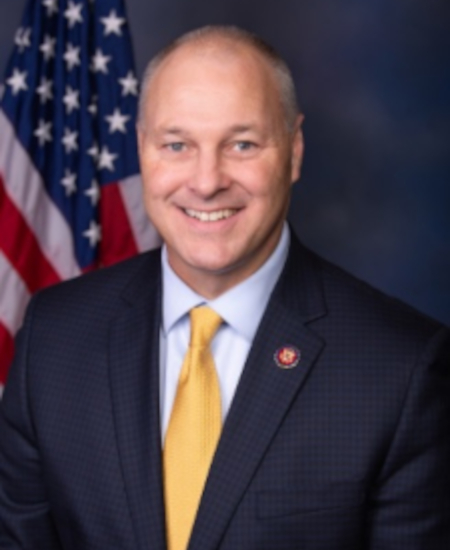
Rep. Pete Stauber
Sponsored bills
This resolution expresses support for the designation of Journeyman Lineworkers Recognition Day. (A journeyman lineworker is a person who builds and maintains electrical power systems.)
Energy Poverty Prevention and Accountability Act This bill addresses energy poverty (i.e., insufficient access to affordable energy) in at-risk communities. An at-risk community is a community that is low-income, minority, rural, elderly, or Native American. The Department of the Interior must report on (1) barriers to the ability of at-risk communities that live on or near federal land or tribal land to access reliable and affordable energy, including how the presence of adequate energy transmission infrastructure affects such access; and (2) actions that it and the Forest Service may take to reduce such barriers. In addition, certain executive actions may not be carried out until Interior conducts energy poverty studies for such actions. The Congressional Budget Office must report on how a bill or resolution will affect the cost of energy for at-risk communities. The Government Accountability Office must (1) analyze federal energy and environmental laws and regulations, and state renewable portfolio standards, to determine how such laws, regulations, and standards affected electricity prices, home heating prices, gasoline prices, motor vehicle prices, natural gas prices, and household appliance prices in at-risk communities; and (2) develop criteria to determine whether an at-risk community is experiencing energy poverty. The Office of Management and Budget must review and publish each applicable energy regulation to determine if any regulation imposes, relative to the general population, disproportionate costs on at-risk communities.
Public Land Renewable Energy Development Act of 2021 This bill sets forth provisions regarding development of geothermal, solar, or wind energy on public lands. The Department of the Interior shall establish priority areas on its land for geothermal, solar, and wind energy projects, consistent with the principles of multiple use and the renewable energy permitting goal. Among applications for a given renewable energy source, proposed projects located in priority areas for that renewable energy source shall be given the highest priority for incentivizing deployment, and be offered the opportunity to participate in any regional mitigation plan developed for the relevant priority areas. The bill provides for the disposition of revenues from the development of wind or solar energy. The bill establishes the Renewable Energy Resource Conservation Fund to make funds available to federal, state, and tribal agencies for distribution in regions in which renewable energy projects are located on federal land for (1) restoring and protecting natural water bodies and fish and wildlife habitat and corridors, and (2) preserving and improving recreational access to federal land and water in an affected region.
Law Enforcement Officer Recreation Pass Act This bill directs the Department of Agriculture and the Department of the Interior to make the National Parks and Federal Recreational Lands Pass available, without charge and for the lifetime of the passholder, to law enforcement officers.
30 x 30 Termination Act This bill limits federal acquisition of land or declaration of a national monument in certain areas and nullifies a provision of an executive order related to conservation. In a state or county where 15% or more of the land is managed by a federal agency (1) federal funds may not be used to acquire nonfederal land unless the agency proposing the acquisition disposes of an equal amount of federal land within the state or county, and (2) a declaration of a national monument shall not apply. The bill prohibits from having the force and effect of law a provision of Executive Order 14008 (86 Fed. Reg. 7619), titled Tackling the Climate Crisis at Home and Abroad , that requires the Department of the Interior to recommend steps to achieve the goal of conserving at least 30% of U.S. lands and waters by 2030. No federal funds may be used to implement, administer, enforce, or carry out any report or program substantially similar to such provision. No federal funds may be used to implement, administer, enforce, or carry out any action on federal land that results in a net-loss of multiple use or any principal or major use, unless such action has been authorized by federal statute.
End Zuckerbucks Act This bill prohibits tax-exempt charitable organizations from providing direct funding to official election organizations.
This resolution calls on the Russian government to immediately release Trevor Reed, a U.S. citizen, and all other political prisoners. It also condemns the Russian government's use of politically motivated imprisonment.
Essential Caregivers Act of 2021 This bill requires skilled nursing facilities, nursing facilities, intermediate care facilities for the intellectually disabled, and nearby inpatient rehabilitation facilities to establish an essential caregivers program during a public health emergency. Under the program, facilities must allow each resident to select up to two essential caregivers to provide daily living assistance, emotional support, or companionship during the emergency. Facilities must afford such caregivers 12 hours of access to residents each day (or unlimited access for end-of-life care), and caregivers must agree to follow facility protocols for staff safety. Facilities may deny access to caregivers who violate protocols, subject to certain notification requirements; the Centers for Medicare & Medicaid Services must establish an appeals process relating to such decisions and may take specified enforcement actions against facilities that violate the bill's requirements.
Pandemic Unemployment Assistance Fraud Protection Act This bill creates several requirements for states to address fraudulent claims for Pandemic Unemployment Assistance (PUA), temporarily increases penalties for fraud related to PUA, and requires each state to establish a hotline for victims of unemployment fraud. Specifically, the bill requires states to cross reference PUA claims with federal and state prison records and E-Verify to ensure that claimants are eligible for PUA, submit to the Department of Labor plans to recover fraudulently obtained PUA, develop an anti-fraud task force to investigate and recover fraudulently obtained PUA, make restitution to Labor for the amount of any overpayment of PUA made by the state, and establish a hotline designed to encourage individuals who are victims of unemployment fraud and have received an incorrect statement of unemployment compensation to report that fraud. The bill also temporarily enhances the maximum penalty for fraud related to PUA through December 31, 2021, so that the offense is classified as fraud in relation to a presidentially declared major disaster or emergency and punishable by up to 30 years imprisonment, a fine of up to $1,000,000, or both.