

Historic Tax Credit Growth and Opportunity Act of 2021 This bill increases the rehabilitation tax credit and modifies certain requirements for the credit. The bill increases the rate of the credit for qualified rehabilitation expenditures in taxable years beginning after December 31, 2019, and before January 1, 2027, after which the rate reverts to 20%. The bill increases the rate of the credit to 30% for certain small projects whose qualified rehabilitation expenditures do not exceed $2.5 million. The bill also expands the types of buildings eligible for rehabilitation by decreasing the rehabilitation threshold from 100% to 50% of project expenses. It also eliminates the basis adjustment requirement for the credit and modifies rules relating to tax-exempt use property eligible for the credit.
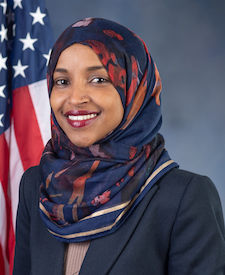
Rep. Ilhan Omar
Sponsored bills
Equitable Data Collection and Disclosure on COVID-19 Act of 2021 This bill expands data collection and reporting on demographic information and disparities related to COVID-19 (i.e., coronavirus disease 2019). During the COVID-19 emergency, the Centers for Disease Control and Prevention (CDC) and the Centers for Medicare & Medicaid Services must publish data on COVID-19 testing, treatment, vaccinations, and outcomes on the CDC website. They must update the data daily and disaggregate it by race, ethnicity, and other demographic factors. In addition, the Indian Health Service must consult with tribal nations about COVID-19 data collection and reporting. The Department of Health and Human Services must make a summary of final statistics related to COVID-19 publicly available and report specified information to Congress within 60 days of the end of the COVID-19 emergency. The bill also establishes the Commission on Ensuring Data for Health Equity. The commission must determine approaches to using data to reduce disparities in health outcomes, including specifically with respect to COVID-19. In addition, it must provide recommendations to improve demographic data collection and use in future public health emergencies.
This joint resolution nullifies the final rule issued by the Office of the Comptroller of the Currency titled National Banks and Federal Savings Associations as Lenders and published on October 30, 2020. The rule requires that to be considered a lender, a national bank or federal saving association must, as of the date of origination of the loan (1) be named as the lender in the loan agreement, or (2) fund the loan.
Willie O'Ree Congressional Gold Medal Act This bill provides for the award of a Congressional Gold Medal to Willie O'Ree or, if unavailable, to a member of his family, in recognition of his contributions and commitment to hockey, inclusion, and recreational opportunity.
This bill requires the Joint Committee on the Library to enter into an agreement to obtain a statue of Shirley Chisholm, the first African American woman elected to Congress. The committee shall place the statue in a permanent public location in the U.S. Capitol.
Ending Punitive, Unfair, School-based Harm that is Overt and Unresponsive to Trauma Act of 2021 or the Ending PUSHOUT Act of 2021 This bill requires the Department of Education (ED) to award grants to local educational agencies and nonprofit organizations for the purpose of reducing suspension and expulsion of students (i.e., exclusionary disciplinary practices). The bill requires ED to collect data on exclusionary discipline in schools. It also establishes a joint task force to end school pushout.
Investing in Cures Before Missiles Act of 2021 or the ICBM Act This bill addresses the transfer and use of funds intended for defense programs. Specifically, the bill requires the Department of Defense (DOD) to transfer $1 billion of unobligated balances intended for its ground-based strategic deterrent program to the National Institute of Allergy and Infectious Disease for research on the development of a universal coronavirus vaccine. Next, the bill requires the Department of Energy to transfer unobligated balances for the W87-1 warhead modification program administered by the National Nuclear Security Administration to the Centers for Disease Control and Prevention to research and combat emerging and zoonotic infectious diseases. The bill prohibits the use of funds authorized for FY2022 for the ground-based strategic deterrent program or the W87-1 warhead modification program. Finally, the bill requires DOD to enter into a contract with the National Academy of Sciences to study extending to 2050 the life of Minuteman III intercontinental ballistic missiles.
Emmett Till and Mamie Till-Mobley Congressional Gold Medal Act of 2021 This bill provides for the posthumous presentation of a Congressional Gold Medal in commemoration of Emmett Till and Mamie Till-Mobley. After the award the medal shall be given to the National Museum of African American History and Culture.
This resolution declares that decreasing the spread of COVID-19 (i.e., coronavirus disease 2019) in Africa is in the national interest of the United States, commends the work of Africa's frontline health workers, and calls on the United States and the international community to support African countries' responses to the pandemic.
Affordable and Safe Prescription Drug Importation Act This bill allows expanded importation of eligible prescription drugs and addresses related issues. Current law allows the Department of Health and Human Services (HHS) to authorize the importation of certain eligible prescription drugs from Canada if HHS certifies to Congress that doing so would pose no additional risk to public health and safety and would result in significant cost savings for consumers. The bill removes this certification requirement and requires HHS to issue regulations that permit the importation of qualifying prescription drugs from Canada. After a certain amount of time, HHS may authorize importation from certain other countries if it determines that importation from Canada has resulted in cost savings for consumers and increased access to safe medication. The bill also expands the types of prescription drugs eligible for importation to include, for example, biologics such as insulin. Furthermore, the bill allows individuals to use an eligible licensed foreign pharmacy to fill a U.S.-issued prescription for a qualifying drug for personal use. Currently, an individual seeking to import a prescription drug generally must acquire a waiver from HHS. The bill imposes various requirements related to certification of foreign sellers, labeling of imported drugs, and supply chain security. The bill also (1) prohibits certain acts that discriminate against foreign sellers, such as charging higher prices to foreign sellers than to other sellers in the same country; and (2) imposes criminal penalties for online websites that sell counterfeit drugs or dispense drugs without a required prescription.