

Protection of Saudi Dissidents Act of 2021 This bill imposes temporary limits on arms sales to Saudi Arabia and requires various reports and actions related to the death of Saudi Arabian journalist Jamal Khashoggi. The President may not transfer or authorize for export certain defense articles or services to Saudi Arabia for 120 days after this bill's enactment. The prohibition shall remain in effect for up to three years unless the President periodically certifies to Congress that Saudi Arabia has not conducted (1) forced repatriation, intimidation, or killing of dissidents in other countries; (2) unjust imprisonment in Saudi Arabia of U.S. citizens or lawful aliens; or (3) torture of detainees in custody of the government of Saudi Arabia. The President shall certify to Congress that individuals with Saudi diplomatic credentials are not using such credentials to track or harass Saudi nationals in the United States. If the President does not make such a certification, the President shall close at least one Saudi diplomatic or consular facility in the United States until the certification is made. The bill requires reports to Congress on (1) whether any Saudi officials have engaged in a consistent pattern of harassment against any individual in the United States, and (2) whether the intelligence community fulfilled its duty to warn Khashoggi of the threats to his life.
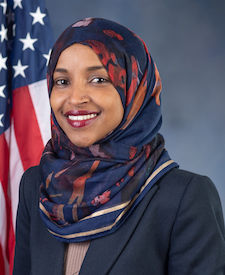
Rep. Ilhan Omar
Sponsored bills
National Origin-Based Antidiscrimination for Nonimmigrants Act or the NO BAN Act This bill imposes limitations on the President's authority to suspend or restrict aliens from entering the United States. It also prohibits religious discrimination in various immigration-related decisions, such as whether to issue an immigrant or nonimmigrant visa, unless there is a statutory basis for such discrimination. The President may temporarily restrict the entry of any aliens or class of aliens after the Department of State determines that the restriction would address specific and credible facts that threaten U.S. interests such as security or public safety. The bill also imposes limitations on such restrictions, such as requiring the President, State Department, and the Department of Homeland Security (DHS) to (1) only issue a restriction when required to address a compelling government interest, and (2) narrowly tailor the suspension to use the least restrictive means to achieve such an interest. Before imposing a restriction, the State Department and DHS shall consult with Congress. The State Department and DHS shall report to Congress about the restriction within 48 hours of the restriction's imposition. If such a report is not made, the restriction shall immediately terminate. Individuals or entities present in the United States and unlawfully harmed by such a restriction may sue in federal court. DHS may suspend the entry of aliens traveling to the United States on a commercial airline that failed to comply with regulations related to detecting fraudulent travel documents.
Washington, D.C. Admission Act This bill provides for admission into the United States of the state of Washington, Douglass Commonwealth, composed of most of the territory of the District of Columbia. The commonwealth shall be admitted to the Union on an equal footing with the other states. The Mayor of the District of Columbia shall issue a proclamation for the first elections to Congress of two Senators and one Representative of the commonwealth. The bill applies current District laws to the commonwealth and continues pending judicial proceedings. The commonwealth (1) shall consist of all District territory, with specified exclusions for federal buildings and monuments, including the principal federal monuments, the White House, the Capitol Building, the U.S. Supreme Court Building, and the federal executive, legislative, and judicial office buildings located adjacent to the Mall and the Capitol Building; and (2) may not impose taxes on federal property except as Congress permits. District territory excluded from the commonwealth shall be known as the Capital and shall be the seat of the federal government. The bill maintains the federal government's authority over military lands and specified other property. The bill provides for expedited consideration of a joint resolution repealing the Twenty-third Amendment to the Constitution, which provides for the appointment of electors of the President and Vice President. The bill continues certain federal authorities and responsibilities, including regarding employee benefits, agencies, courts, and college tuition assistance, until the commonwealth certifies that it is prepared to take over the authorities and responsibilities. The bill establishes the Statehood Transition Commission to advise the President, Congress, and District and commonwealth leaders on the transition.
Tax on Wall Street Speculation Act This bill imposes an excise tax on the transfer of ownership in certain securities (covered transaction), including any share of stock in a corporation; any partnership or beneficial interest in a partnership or trust; any note, bond, debenture, or other evidence of indebtedness (excluding tax-exempt municipal bonds); and derivative financial instruments. The bill includes exceptions for initial issues, certain traded short-term indebtedness, and securities lending arrangements. The bill also (1) imposes a penalty on taxpayers who fail to include a covered transaction on their tax return or information statement, and (2) allows an individual taxpayer whose modified adjusted gross income does not exceed $50,000 ($75,000 for married taxpayers filing joint returns) a tax credit for the amount of tax paid on covered transactions.
College for All Act of 2021 This bill establishes measures to expand access to higher education, including by eliminating tuition and required fees for eligible students, revising the Federal Pell Grant program, and reauthorizing certain programs to assist students from disadvantaged backgrounds. Specifically, the bill provides funding to eliminate tuition and required fees for (1) all students at community colleges and two-year tribal colleges and universities; (2) working- and middle-class students at four-year public institutions of higher education (IHEs) and tribal colleges and universities; and (3) eligible students at private, nonprofit historically Black colleges and universities (HBCUs) and minority-serving institutions. The bill permanently reauthorizes and otherwise revises the Federal Pell Grant program by providing funding to increase the maximum award for each eligible student, increasing the duration limit for the use of Pell Grants, and allowing students to use their awards to cover living and non-tuition expenses. Next, the bill makes Dreamer students (i.e., students who have been granted Deferred Action for Childhood Arrivals status) who entered the United States before the age of 16 and who meet certain educational criteria eligible for federal financial aid. Further, the bill requires the Department of Education to award grants to underfunded IHEs, HBCUs, and minority-serving institutions for investing in support programs to improve student outcomes (e.g., graduation rates). The bill also reauthorizes through FY2031 the Federal TRIO Programs and reauthorizes through FY2025 the Gaining Early Awareness and Readiness for Undergraduate Programs.
Access to Contraception for Servicemembers and Dependents Act of 2021 This bill addresses Department of Defense (DOD) contraceptive care and family planning services. Specifically, the bill prohibits cost-sharing with respect to TRICARE beneficiaries for specified prescription contraceptives. Additionally, the bill prohibits cost-sharing for TRICARE Select and TRICARE Prime beneficiaries in relation to any in-network method of contraception or contraceptive care (including with respect to insertion, removal, and follow-up), any sterilization procedure, or any related patient education or counseling service. The bill requires DOD to provide information on all methods of emergency contraception and care to sexual assault survivors at its medical treatment facilities. Upon request by a sexual assault survivor, DOD must provide such emergency contraception or a prescription for emergency contraception. Finally, DOD must establish a uniform standard curriculum for education programs on family planning for all members of the Armed Forces. Such education programs must be provided to service members during their first year of service and at other appropriate times, as determined by each military department.
Civilian Climate Corps for Jobs and Justice Act This bill establishes a Civilian Climate Corps Program and generally revises benefits provided to national service program participants. The bill establishes a Civilian Climate Corps to operate (1) a national climate service program; and (2) a national climate service grant program to help communities respond to climate change and transition to a clean economy, including through reducing carbon emissions. The bill also provides for allowances for participants in certain national service programs, including the Volunteers in Service to America (VISTA) program and the National Civilian Community Corps. The bill expands the exclusion from gross income, for income tax purposes, to exclude amounts received as educational awards or benefits and income attributable to discharges of student loan debt under the National and Community Service Act of 1990.
Chiropractic Medicare Coverage Modernization Act of 2021 This bill expands Medicare coverage of chiropractic services to include all services provided by chiropractors, rather than only subluxation corrections through manual manipulation of the spine.
Green New Deal for Public Housing Act This bill addresses energy efficiency and workforce development in the context of public housing. Specifically, the Department of Housing and Urban Development (HUD) must award grants to public housing agencies (PHAs) and other eligible entities under a variety of new programs, including programs for facilitating workforce development and high-income employment transition; conducting physical needs assessments and subsequent energy efficiency retrofits; and making upgrades, replacements, and improvements for energy efficiency, building electrification, and water quality upgrades. Recipients of these grants must provide relocation assistance for residents who are displaced during construction and must ensure that they can return to their homes once retrofitting is completed. A certain percentage of the employment positions generated by these grant programs and other specified federal grant programs must be filled by low-income individuals, and a specified percentage of certain contracts associated with these programs must be awarded to businesses owned by residents of public housing. The bill also repeals a provision that prohibits a PHA from using HUD funds to construct or operate new public housing units if doing so would result in the PHA owning or operating more units than it did on October 1, 1999.
Workplace Violence Prevention for Health Care and Social Service Workers Act This bill requires the Department of Labor to address workplace violence in health care, social service, and other sectors. Specifically, Labor must issue an interim occupational safety and health standard that requires certain employers to take actions to protect workers and other personnel from workplace violence. The standard applies to employers in the health care sector, in the social service sector, and in sectors that conduct activities similar to those in the health care and social service sectors. In addition, Labor must promulgate a final standard within a specified time line.