

Maddy summaryHR 5904, the Deepavali Day Act, would add "Deepavali Day" to the list of recognized days in federal law, specifically amending the U.S. Code section that lists federal holidays. It recognizes Deepavali - a festival celebrated by over six million Americans, including Hindu, Buddhist, Sikh, Jain, and Indo-Caribbean communities - as a day symbolizing the victory of light over darkness. The bill does not create a paid holiday or change government operations; it simply adds Deepavali Day to the existing federal holiday schedule. This recognition aligns with Congress's acknowledgment of Deepavali's cultural significance and its shared values with U.S. democratic principles.
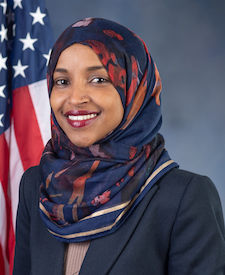
Rep. Ilhan Omar
Sponsored bills
Burial Equity for Guards and Reserves Act of 2021 This bill prohibits the Department of Veterans Affairs (VA) from establishing a condition for a cemetery grant that restricts the ability of a state to inter certain reservists (or their spouses and children) at a state-owned veterans' cemetery solely because such individuals are ineligible for burial in an open national cemetery. Specifically, as a condition for grants, the VA cannot restrict the ability of a state to inter a member of a reserve component whose service was terminated under honorable conditions; member of the Army National Guard or Air National Guard whose service was terminated under honorable conditions; member of the Reserve Officers' Training Corps of the Army, Navy, or Air Force who died under honorable conditions while a member; and spouse, minor child, or unmarried adult child of any member described above. The VA is prohibited from (1) denying an application for a grant solely on the basis that the recipient state may use funds to expand, improve, operate, or maintain a veterans' cemetery to allow for the internment of the specified individuals; and (2) enforcing certain conditions on grants for state veterans' cemeteries that were established before the date of enactment of this bill. The bill also provides for plot allowances for the individuals listed in the bill.
Ending the Monopoly of Power Over Workplace Harassment through Education and Reporting Act or the EMPOWER Act This bill makes it an unlawful labor practice for an employer to enter into, or attempt to enforce, a contract with an employee or job applicant that contains a nondisparagement or nondisclosure clause that covers workplace or sexual harassment, including retaliation for participating in a workplace harassment proceeding. The bill exempts certain settlement or separation agreements from such prohibition. The bill also requires the Securities and Exchange Commission to promulgate a regulation that requires any issuer of securities to submit a report for the most recent five-year period with respect to workplace and sexual harassment. The commission must provide for the development and dissemination of training programs and information regarding workplace and sexual harassment. The bill denies a tax deduction for amounts related to judgments and expenses in connection with litigation related to workplace or sexual harassment. It also excludes from gross income, for income tax purposes, any amount received in connection with a claim or settlement related to workplace or sexual harassment, or other unlawful discrimination.
Arms Sale Oversight Act This bill revises House of Representatives procedures for considering joint resolutions related to weapons and defense services sales to foreign countries, export licenses for such weapons and services, and technical assistance or manufacturing agreements with foreign countries. Currently, the President must provide certification supporting such an action, which can go forward unless Congress enacts a joint resolution opposing it. The bill provides for rules such as who may make a motion to discharge the resolution from committee and time limits on debate.
This resolution expresses that the House of Representatives applauds the Biden administration for reaffirming the U.S. commitment to the Paris Agreement on climate change and to our collective responsibility to globally combat climate change; encourages the Biden administration to implement measures to ensure global climate change remains a top priority for this and future administrations and to cement the United States as a global leader in the fight to mitigate its most severe consequences; voices strong commitment as legislators toward achieving the climate goals of the Paris Agreement, fulfilling the forthcoming pledges from the COP26 in Glasgow, Scotland, and advancing other international efforts to keep global warming to no more than 1.5 degrees Celsius and realize global net-zero carbon emissions by 2050 using a whole-of-government approach; and recognizes the critical responsibility of the United States and other developed nations to ensure all societies have the capabilities to transition to a clean energy economy, the resources to protect against climate-induced disasters, and the necessary assistance to endure climate-related challenges to food security, regional migration, and public health.
Young African Leaders Initiative Act of 2021 or the YALI Act of 2021 This bill provides statutory authority for the Young African Leaders Initiative (YALI), which seeks to build the capacity of young African leaders in sub-Saharan Africa in the areas of business, civic engagement, or public administration. The YALI program must support the participation of fellows from Africa in the Mandela Washington Fellowships for Young African Leaders and offer training through regional leadership centers in sub-Saharan Africa to individuals who have demonstrated strong capabilities in entrepreneurship, innovation, public service and leadership, and peace building and conflict resolution. The Department of State must oversee all U.S.-based activities carried out under the program, and the United States should continue to support program initiatives in sub-Saharan Africa. The State Department must also submit a plan for implementing the program and annual reports on program progress and recommendations for improvements or changes to the program.
Social Security 2100: A Sacred Trust This bill makes changes to Social Security benefits, taxes, and other aspects of the program, including by raising the primary insurance amount, increasing the maximum taxable earnings that are subject to Social Security payroll taxes, and requiring Social Security account statements to be mailed unless the individual recipient opts for electronic delivery.
Public Service Freedom to Negotiate Act of 20 21 This bill provides minimum collective bargaining rights and procedures for public employees and prohibits strikes by certain public safety workers. The Federal Labor Relations Authority (FLRA) shall determine for each state whether the laws of such state substantially provide for each of the minimum standard collective bargaining rights and procedures specified by this bill, including the right of public employees and supervisory employees to self-organize, form or join a labor organization, or collectively bargain. The FLRA must issue rules and take actions to establish and administer bargaining rights and procedures for those states that do not substantially provide for them. No employers, emergency services employees, or law enforcement officers may engage in a lockout, strike, or any other organized job action that is likely to result in a measurable disruption of the delivery of emergency or public safety services. Furthermore, no labor organization may be the cause of a violation of such prohibition.
Prince Congressional Gold Medal Act This bill provides for the award, posthumously, of a Congressional Gold Medal to Prince Rogers Nelson, better known as Prince, in recognition of his achievements as a musician and contributions to American culture.
Student Food Security Act of 2021 This bill expands the Supplemental Nutrition Assistance Program (SNAP) and establishes programs to address food insecurity among college students. Specifically, the bill permanently modifies the eligibility requirements to allow additional college students to receive SNAP benefits, and it establishes a demonstration program to allow college students to use SNAP benefits on college campuses instead of meal plans.