Global Criminal Justice Act This bill states that there should be an Office of Global Criminal Justice established in the Department of State. If such an office is established, it shall be led by an Ambassador-at-Large for Global Criminal Justice.
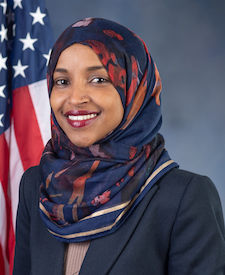
Rep. Ilhan Omar
Sponsored bills
Repeal Hague Invasion Act This bill repeals the American Servicemembers' Protection Act of 2002, which (1) generally prohibits U.S. cooperation with the International Criminal Court (ICC), and (2) prohibits participation by members of the Armed Forces in certain U.N. operations unless the President certifies that U.S. national interests justify such participation or that the members are not at risk of ICC prosecution.
Time Off to Vote Act This bill requires an employer, upon the request of an employee, to provide the employee with a minimum of two consecutive hours of paid leave in order to vote in a federal election. The employer may determine the two-hour period, excluding any lunch break or other break. Taking such leave shall not result in the employee losing accrued employment benefits. The bill makes it unlawful for an employer to interfere with the right to take such leave or for an employer to discriminate against an employee for taking such leave. Further, the bill makes it unlawful for any employer to retaliate against an employee for (1) opposing any practice made unlawful by this bill; (2) filing a charge, or instituting or causing to be instituted any proceeding, under or related to this bill; or (3) testifying or preparing to testify in an inquiry or proceeding relating to such leave. The bill specifies penalties for employers who violate these provisions.
Targeting Resources for Equitable Access to Treatment for Long COVID Act or the TREAT Long COVID Act This bill requires the Department of Health and Human Services to award competitive grants to create or expand the capacity of clinics that treat patients with persistent, long-term symptoms following recovery from acute COVID-19 (i.e., Long COVID). Eligible recipients include federally qualified health centers, rural health clinics, urban Indian health centers, and state and local health departments.
Energy Security and Independence Act of 2022 This bill addresses domestic industrial base and manufacturing capabilities for specified energy-efficiency and renewable energy systems and technologies (e.g., electric transportation systems), including by establishing a program to provide financial assistance for the construction of new facilities that manufacture components of specified energy-efficiency and renewable energy systems and technologies (or to retool, retrofit, or expand such facilities).
Maddy summaryThis non-binding resolution (HRES 1050) encourages Congress to adopt the Black Women Best (BWB) framework in policymaking to address systemic disparities affecting Black women. It does not create new laws but recommends using this framework - based on the Congressional Caucus on Black Women and Girls' "An Economy for All" report - to center Black women's lived experiences in legislative decisions. Key issues highlighted include severe wealth gaps (Black women’s median wealth at $1,700 vs. $81,200 for White women), labor market discrimination, healthcare inequities, and housing barriers. The resolution specifically urges policymakers to prioritize frameworks like the BWB to develop more inclusive policies, without mandating any concrete legislative changes.
Maddy summaryHR 7477, the CERTS Tax Exemption Act, ensures that grants provided under the Coronavirus Economic Relief for Transportation Services Act are tax-free for eligible transportation service providers. The bill directly affects companies and organizations providing transportation services that receive these specific federal grants. Key provisions state that grant amounts cannot be counted as taxable income, deductions related to grant-funded costs cannot be denied, and tax attributes (like basis increases) must be treated as tax-free for partnerships and S corporations. This change simplifies tax treatment for recipients by preventing unintended tax liabilities on relief funds.
Burma Unified through Rigorous Military Accountability Act of 2022 or the BURMA Act of 2022 This bill imposes sanctions pertaining to Burma (Myanmar) and addresses related issues. The President must impose property- and visa-blocking sanctions on certain foreign persons (i.e., an individual or entity), including those that (1) knowingly operate in Burma's defense sector, (2) are responsible for or complicit in undermining Burma's democratic processes, or (3) are senior leaders in Burma's military or government. The Department of the Treasury must prohibit or impose strict conditions on certain accounts used to facilitate transactions for such sanctioned persons. The President may impose sanctions on Myanma Oil and Gas Enterprise if such sanctions would support certain objectives, including reducing the Burmese military's ability to undermine democracy in Burma. Before removing certain foreign persons from a list of specially designated nationals and blocked persons (commonly known as the SDN list), the President must certify to Congress that the person in question has not knowingly engaged in certain activities, such as supporting terrorism. The bill authorizes Department of State and U.S. Agency for International Development activities in Burma and the surrounding region to support democracy activists, humanitarian assistance, and reconciliation efforts. The State Department may (1) continue to assist organizations supporting political prisoners in Burma, and (2) provide assistance to entities investigating crimes against humanity. The President must direct U.S. representatives to the United Nations to vote and advocate for certain actions related to Burma, such as cutting off assistance to Burma's government.

Supportive Services Enhancement Act This bill expands the definition of supportive services under the Workforce Innovation and Opportunity Act to include mental health care, substance use disorder treatment, and affordable internet connection. It also requires local one-stop centers to provide such services to adults and dislocated workers.
Ensuring Lasting Smiles Act This bill requires private health insurance plans to cover diagnosis and treatment of congenital anomalies and birth defects, such as reconstructive services and items. Coverage must include services and items that functionally improve, repair, or restore any body part that is medically necessary for normal bodily functions or appearance, as determined by the treating physician. Coverage limits and cost-sharing requirements for such services and items may not be more restrictive than those applicable to all medical and surgical benefits under the plan.