

United States Innovation and Competition Act of 2021 This bill addresses U.S. technology and communications, foreign relations and national security, domestic manufacturing, education, trade, and other matters. Among other provisions, the bill provides funding for FY2022-FY2026 to support U.S. semiconductor manufacturing, research and development, and supply chain security; provides funding for wireless supply chain innovation; establishes a Directorate for Technology and Innovation in the National Science Foundation; extends through 2025 the authority of the National Aeronautics and Space Administration (NASA) to lease its non-excess real property and related personal property; authorizes various programs and policies related to space exploration; authorizes various international affairs programs and activities, including foreign assistance for the Indo-Pacific region; requires federal infrastructure programs to provide for the use of materials produced in the United States; imposes sanctions on China for cybersecurity and human rights abuses; requires the Department of Health and Human Services to consider national security risks associated with sensitive genetic information; includes initiatives related to elementary and secondary education, including those to increase computer science education; contains provisions related to higher education, including those reauthorizing through FY2027 international education programs and addressing China's influence on institutions of higher education; modifies and expands the schedule for graduated merger filing fees; prohibits federal funding for the Wuhan Institute of Virology; requires the U.S. Trade Representative to take certain actions related to digital trade and censorship practices; and extends through 2027 the Generalized System of Preferences.
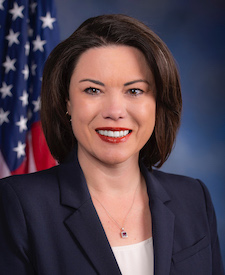
Rep. Angie Craig
Sponsored bills
Pride in Mental Health Act This bill expands programs that prevent and treat child abuse and neglect to address issues facing youth who are lesbian, gay, bisexual, transgender, queer or questioning, nonbinary, or gender-variant members of indigenous communities (e.g., Two Spirit). Specifically, these programs include (1) research and reporting requirements, (2) providing technical assistance, (3) grants to states and local agencies to train child-welfare personnel, and (4) community-based prevention-service grants. The bill also establishes a grant program to provide mental and behavioral health resources for such youth, including trauma-informed care.
This resolution celebrates the contributions of small businesses in every U.S. community and supports the designation of National Small Business Week. Further, it supports efforts to provide small businesses with aid and assistance through certain programs and initiatives.
Robocall Trace Back Enhancement Act This bill provides liability protection for specified information-sharing activities undertaken to trace the origins of unlawful robocalls. Specifically, the bill protects a designated consortium that conducts private-led efforts to trace unlawful robocalls from liability for receiving, sharing, or publishing information about illegal calls, including their origin or source. The bill also applies liability protection to a voice service provider (i.e., a provider of any service that enables real-time, two-way voice communications) or other entity or person that shares information with the consortium.
SCORE for Small Business Act of 2022 This bill reauthorizes through FY2023 the Service Corps of Retired Executives (SCORE) program, outlines the duties of the SCORE Association, and requires the Small Business Administration (SBA) to cooperate with the association to carry out the program. Specifically, the bill requires the association to manage nationwide chapters of the program to enable volunteers participating in the program to provide personal, cost-free business expertise and facilitate education workshops to small businesses. The association must also offer online counseling through web-based platforms to small businesses. In consultation with the association, the SBA must ensure that the program (1) recruits diverse volunteers for each chapter of the program, and (2) provides services to rural and underserved communities.
Plain Prescription Prices Act This bill requires the Centers for Medicare & Medicaid Services to issue a rule requiring direct-to-consumer television advertisements for prescription drugs that are covered by Medicare or Medicaid to include a textual statement of the drug's list price.
Public Health and Border Security Act of 2022 This bill requires the Department of Health and Human Services (HHS) to meet conditions related to notification and planning before terminating certain restrictions on imports and individuals entering the United States. Current law authorizes HHS to restrict entries and imports from foreign countries to prevent the introduction of communicable diseases. HHS exercised this authority as part of its COVID-19 response, including to allow for the expulsion of undocumented migrants at the border without any asylum processing. Under this bill, HHS may not terminate the restrictions for (1) at least 60 days after it notifies Congress of the end of the COVID-19 emergency, and (2) at least 30 days after it submits to Congress a plan for addressing the possible influx of migrants or imports resulting from lifting the restrictions.
Maddy summaryHR 7477, the CERTS Tax Exemption Act, ensures that grants provided under the Coronavirus Economic Relief for Transportation Services Act are tax-free for eligible transportation service providers. The bill directly affects companies and organizations providing transportation services that receive these specific federal grants. Key provisions state that grant amounts cannot be counted as taxable income, deductions related to grant-funded costs cannot be denied, and tax attributes (like basis increases) must be treated as tax-free for partnerships and S corporations. This change simplifies tax treatment for recipients by preventing unintended tax liabilities on relief funds.
Protection from Abusive Passengers Act This bill addresses the banning of abusive passengers from commercial aircraft flights. Abusive passenger is defined as any individual who engages in behavior that results in a civil penalty or conviction for assaulting, threatening, or intimidating a crew member or passenger on an aircraft flight, or who takes any action to interfere with security screening personnel or any security system related to civil aviation security. It requires the Federal Aviation Administration or the Attorney General to provide the identity, including the full name and date of birth, and gender of all abusive passengers to the Transportation Security Administration (TSA). The TSA must maintain a list of abusive passengers and develop and make publicly available policies and procedures for handling individuals included on the list. Any individual on the list shall be prohibited from boarding any commercial aircraft flight until the individual is removed from such list. Additionally, all abusive passengers shall be permanently ineligible to participate in the TSA PreCheck or the U.S. Customs and Border Protection's Global Entry programs, with specified exceptions.
Volunteer Driver Tax Appreciation Act of 2022 This bill increases the mileage rate for the charitable use of an automobile (14 cents per mile) to the standard business mileage rate (58.5 cents per mile in 2022).