

Maddy summaryThe International Human Rights Defense Act of 2023 creates a permanent Special Envoy at the State Department to coordinate U.S. efforts against discrimination and violence targeting LGBTQI+ people globally. The bill requires the development of an annual global strategy to address criminalization, discrimination, and violence based on sexual orientation, gender identity, or sex characteristics. It also mandates that U.S. country reports on human rights practices include detailed information about laws and practices affecting LGBTQI+ communities. The legislation authorizes U.S. foreign assistance programs to support LGBTQI+ rights through health services, legal protections, and community capacity building. This bill aims to strengthen U.S. diplomatic engagement on LGBTQI+ rights as part of broader human rights policy.
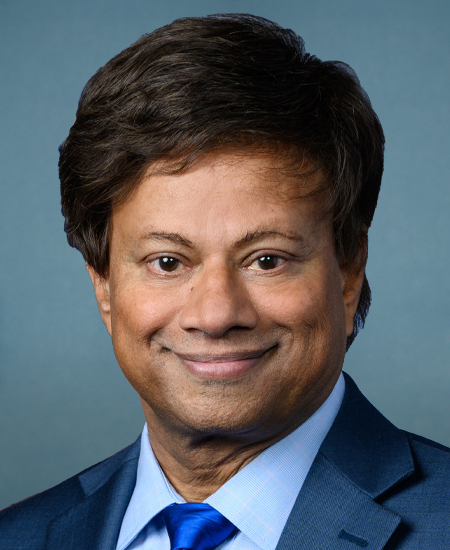
Rep. Shri Thanedar
Sponsored bills
Maddy summaryThis bill establishes new salary thresholds for white-collar workers to qualify for overtime pay, starting at $45,000 annually in 2023 and increasing to $75,000 by 2026. It requires automatic annual adjustments based on the 55th percentile of full-time salaried workers' earnings, as tracked by the Bureau of Labor Statistics. The bill also limits non-exempt duties to no more than 20% of a worker's time. These changes would make more salaried employees eligible for overtime pay, reversing a long-term decline in coverage.
Maddy summaryHR 1139, the GUARD VA Benefits Act, amends federal law to strengthen penalties for individuals or organizations charging veterans unauthorized fees when helping with VA benefit claims. It directly affects veterans seeking assistance with VA claims and the representatives (like advocates or attorneys) who might charge them fees. The bill adds a new provision making it a violation to solicit, charge, or receive any fee for preparing, presenting, or prosecuting VA claims, punishable by fines under Title 18. This change specifically targets unauthorized fee-charging while excluding fees covered under existing exceptions in sections 5904 or 1984 of the law.
Maddy summaryHR 1831 would award Billie Jean King a Congressional Gold Medal to honor her lifelong advocacy for equal rights in sports and society. The bill directs the Secretary of the Treasury to strike the medal and have it presented by congressional leaders, recognizing her pivotal role in advancing women's equality through tennis (including founding the Women’s Tennis Association and securing equal prize money) and her broader impact on society through initiatives like Title IX advocacy.
Maddy summaryHR 1794 authorizes the minting of commemorative coins to honor the 2028 Los Angeles Olympic and Paralympic Games. It specifies four coin types ($5 gold, $1 silver, half-dollar clad, and proof silver $1) with defined weights, sizes, and mintage limits (e.g., up to 100,000 gold coins). A surcharge is added to each coin sale (e.g., $35 for gold coins), with all surcharge funds directed to the U.S. Olympic and Paralympic Properties to support legacy programs and the Games' operations. The coins must be issued only during 2028 and are legal tender, though the bill focuses solely on commemorative coinage, not policy changes.
Maddy summaryHR 1777 establishes a $50 million annual fund (2024-2028) for collaborative defense research between the U.S. and Israel in emerging technologies like artificial intelligence, cybersecurity, directed energy, and automation. The bill directly supports U.S. and Israeli military forces by enabling joint development of new warfare capabilities to address current and future defense challenges. Key provisions include authorizing $50 million per year for collaborative projects, building on existing U.S.-Israel defense partnerships like counter-tunnel and counter-drone systems. This funding aims to strengthen bilateral defense innovation without altering existing military aid structures.
Maddy summaryThis bill creates a new visa category for temporary workers in mobile entertainment, such as carnival and circus staff who travel across the U.S. It directly affects carnival operators, seasonal workers, and food/concession vendors at fairs and festivals. The key provision requires Department of Labor certification to ensure U.S. workers are not displaced and that hiring foreign workers won’t lower wages or working conditions. It defines "mobile entertainment provider" to include traveling carnivals, circuses, and affiliated seasonal services like food concessions at local events.
Maddy summaryHRES 243 (March 22, 2023) is a non-binding House resolution expressing the sense of Congress that the U.S. President and Secretary of State should work with Canada to prevent permanent nuclear waste storage in the Great Lakes Basin. It specifically addresses Canada’s plan to build a deep geological repository for high-level nuclear waste near Lake Huron in South Bruce, Ontario, which could threaten the shared water resources used by over 40 million people. The resolution urges U.S. officials to take diplomatic action to ensure nuclear waste storage does not occur in the basin, citing environmental risks and the importance of protecting the Great Lakes, which are vital for drinking water, ecosystems, and treaty rights. It does not create new laws but formally states congressional concern about the proposed Canadian project.
American Families United Act This bill authorizes the Department of Homeland Security (DHS) or the Department of Justice (DOJ) to exercise discretion in certain immigration cases. Under this bill, DOJ or DHS may, on a case-by-case basis, exercise discretion by declining to remove a non-U.S. national ( alien under federal law) or bar an alien from entering the United States to prevent hardship for the alien's U.S. citizen spouse, parent, or child. This discretion may also be exercised if the alien is the spouse or child of a deceased U.S. citizen. For the purposes of this bill, it shall be presumed that family separation constitutes hardship. However, DOJ or DHS may not exercise this discretion if the alien is removable or inadmissible due to certain grounds, including specified crime- and security-related grounds. This exercise of discretion may be applied to an alien who was ordered removed or denied entry prior to this bill's enactment if the alien files a motion to reopen or reconsider within two years of this bill's enactment.
Maddy summaryThe Food Deserts Act creates a federal grant program to help establish grocery stores in underserved communities by funding state revolving funds. States receive capitalization grants (up to $150 million for FY2022) to provide low-interest loans to grocery stores that meet specific criteria, such as selling unprocessed, affordable healthy foods and matching 20% of the loan with non-federal funds. Priority is given to stores hiring local workers, offering nutrition education, sourcing from local farms, and having established supply chains. The program directly supports grocery store operators in areas with limited access to fresh food, aiming to improve community health outcomes through increased access to nutritious options.