

Maddy summaryHR 3422, the Judiciary Act of 2023, would amend the structure of the U.S. Supreme Court by increasing the number of associate justices from eight to twelve. It would also raise the required quorum for court proceedings from six to eight justices. This bill directly affects the Supreme Court's operational structure and composition. The change is purely procedural, altering the Court's size and voting requirements without impacting other legal processes or specific groups of people.
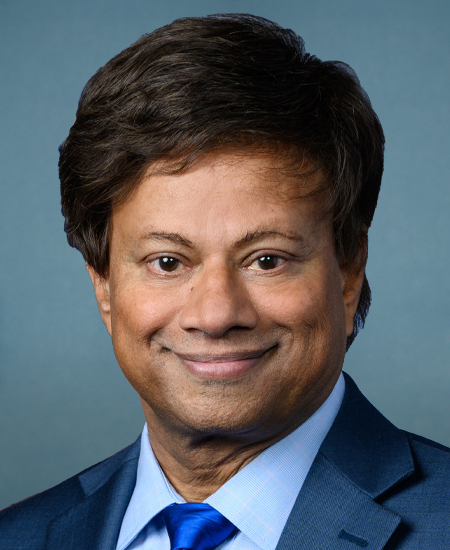
Rep. Shri Thanedar
Sponsored bills
Enhancing COPS Hiring Program Grants for Local Law Enforcement Act This bill allows funds under the Community Oriented Policing Services grant program to be used to provide bonuses for the recruitment and retention of law enforcement officers or career law enforcement officers.
Maddy summaryThe Early STEAM Achievement Act (HR 3374) creates a federal grant program to support early childhood education programs serving children from birth through age eight. It authorizes the Secretary of Health and Human Services to award competitive grants for STEAM (science, technology, engineering, art, and mathematics) activities, prioritizing rural communities (at least one-third of funds) and nonprofit organizations (at least one-quarter of funds). Grants must fund specific activities like teacher training, educational materials, or partnerships with colleges and arts organizations. The program is authorized for fiscal years 2024 through 2028.
National Law Enforcement Officers Remembrance, Support and Community Outreach Act This bill directs the Department of Justice (DOJ) to establish a National Law Enforcement Officers Remembrance, Support, and Community Outreach Program. The bill further directs DOJ to award a grant under the program to the National Law Enforcement Officers Memorial Fund for the expenses associated with community outreach, public education, and officer safety and wellness programs operated by the of the National Law Enforcement Officers Memorial Fund and National Law Enforcement Museum.
Maddy summaryHRES 319 is a symbolic resolution passed by the U.S. House of Representatives on April 24, 2023, recognizing the federal government's duty to develop a Green New Deal. It states the House believes the government should create a comprehensive plan to address climate change and economic inequality through a 10-year national mobilization. The resolution outlines goals like achieving net-zero emissions by 2050, creating high-wage union jobs, upgrading infrastructure, and prioritizing frontline communities, but it does not establish binding policy or funding mechanisms. As a non-binding resolution, it serves as a statement of legislative intent rather than a law.
Maddy summaryHRES 289 is a resolution recognizing the week of April 11-17, 2023, as the sixth annual "Black Maternal Health Week" to raise awareness about maternal health disparities. It highlights that Black women in the U.S. face disproportionately high rates of pregnancy-related deaths (2.6 times more likely than White women) and complications, driven by systemic inequities. The resolution urges national attention on these issues and supports policy solutions like the Black Maternal Health Momnibus Act to address racial gaps in maternal care. As a non-binding recognition, it does not enact new laws but aims to amplify community-driven efforts to improve outcomes.
Maddy summaryHR 3336, the Diwali Day Act, would add "Diwali Day" to the list of federal holidays recognized in Title 5 of the U.S. Code, specifically placing it after Columbus Day. This bill does not create new government programs or change existing laws; it solely recognizes Diwali as a day for federal employees to observe. The bill's "sense of Congress" section describes Diwali as a significant cultural celebration for millions of Americans across multiple religious communities. As a procedural measure, it directly affects federal government operations by adding a recognized holiday for federal employees.
Maddy summaryThe FIGHT Act (HR 2742) amends the Animal Welfare Act to specifically target animal fighting events, such as cockfighting, by defining "rooster" as any male chicken over six months old and banning the live broadcasting (simulcasting) of such events. It prohibits using the postal service or interstate transport to move roosters for animal fighting purposes and adds civil enforcement tools allowing citizens to sue violators after a 60-day notice period. Fines up to $5,000 per violation may be imposed, and property used in animal fighting ventures can be seized. These changes strengthen enforcement against animal fighting by expanding legal remedies for the public and authorities.
Maddy summaryHRES 372 is a non-binding House resolution expressing support for designating May 2023 as "Mental Health Awareness Month." It does not create new laws or allocate funds but formally urges the nation to recognize mental health as a priority. The resolution supports reducing stigma around mental illness, expanding access to mental health services, and emphasizing that mental well-being is as important as physical health. It highlights the need for greater awareness and resources, particularly for youth, veterans, and communities of color facing mental health disparities, but does not mandate any specific policy changes.
Maddy summaryThis bill creates a new federal grant program to help nursing schools address faculty and clinical preceptor shortages. Schools of nursing with documented shortages can apply for funds to recruit and retain faculty/preceptors through hiring, improved pay, partnerships with healthcare facilities, or diversity-focused initiatives. Priority is given to schools that can't accept all qualified applicants due to shortages, serve underserved areas, or prioritize diverse faculty. Grantees must report annually on outcomes like faculty hired, student enrollment changes, and demographic data. The program aims to expand nursing education capacity by supporting schools directly affected by staffing gaps.