

Maddy summaryThe Universal School Meals Program Act of 2023 would establish a universal school meals program providing free breakfast and lunch to all children enrolled in participating schools, regardless of family income. Key provisions include eliminating income-based eligibility requirements for school breakfast and lunch programs, setting specific reimbursement rates ($2.80 for breakfast and $4.63 for lunch with annual inflation adjustments), and prohibiting schools from collecting debt for unpaid meals or "shaming" students. The bill also replaces references to "free or reduced price" with "economically disadvantaged students" in related laws and establishes new methods for identifying children from low-income backgrounds. This legislation would directly affect all public schools participating in the National School Lunch Program and School Breakfast Program.
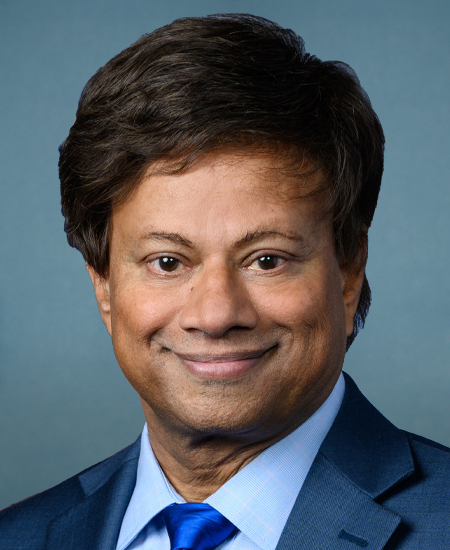
Rep. Shri Thanedar
Sponsored bills
Maddy summaryThis bill removes a barrier for college students seeking food assistance by amending the SNAP program rules. It directly affects students enrolled at least half-time in recognized colleges or training programs, who were previously automatically ineligible unless they met separate requirements. The key change eliminates the prior restriction (in section 6(e)) that barred most higher education students from SNAP, allowing them to qualify under the new provision in section 3(m)(5)(F). The changes take effect January 2, 2024.
Maddy summaryThis bill amends the Supplemental Nutrition Assistance Program (SNAP) to exclude income earned through specific job training programs from being counted toward household income limits. It adds a new provision (paragraph 20) that excludes earnings from vocational rehabilitation programs, refugee employment programs, and other defined training initiatives. This change directly affects SNAP households where members participate in these programs, as the income from such participation will no longer reduce their food assistance benefits. The policy update simplifies eligibility by ensuring these earnings do not trigger benefit reductions under SNAP rules.
Maddy summaryThis bill amends the definition of "accredited investor" under securities law to create a new pathway for individuals to qualify. It requires the SEC to establish a free, publicly available certification exam within 180 days of enactment, testing knowledge of private investment risks and regulations. The exam would cover specific areas like types of securities, disclosure requirements, financial statements, and key risks associated with private investments (such as limited liquidity, information asymmetry, and valuation methods). Individuals passing this exam would qualify as accredited investors, directly affecting those seeking to invest in private companies or private funds without meeting traditional income/net worth thresholds. The exam must be administered by a registered securities association and designed to assess financial sophistication.
Maddy summaryHR 3752, the Parity Enforcement Act of 2023, strengthens enforcement of mental health and substance use disorder parity requirements in health insurance. It amends ERISA to expand civil penalties for group health plans and insurance issuers that fail to meet parity standards, specifically adding "parity in mental health and substance use disorder benefits" to existing violation categories. The bill clarifies that plan administrators and issuers can be held accountable for violations under Section 712 of the law, and adjusts enforcement procedures to ensure parity violations are addressed separately. These changes apply to health plans for years starting one year after the bill's enactment.
Maddy summaryHRES 434 is a non-binding resolution declaring a mental health crisis among U.S. youth, citing statistics like 49.5% of adolescents experiencing mental health disorders and a 30% rise in emergency visits for youth during the pandemic. It urges states and schools to improve educator training, expand on-campus mental health resources, remove harmful practices (such as risk assessment teams disproportionately affecting students of color), and address barriers for undocumented and low-income students. The resolution also emphasizes combating stigma, integrating mental and physical health care, and reaching high-risk communities with better resources. As a declaration - not a law - it expresses congressional support for historic federal investments in youth mental health care but does not create new policy.
Enhancing Questions to Understand Intentions for Pregnancy Act of 2023 or the EQUIP Act of 2023 This bill requires the Centers for Disease Control and Prevention to provide eligible health organizations with demonstration program grants to implement routine screenings about people's pregnancy intentions in order to provide better contraceptive and prepregnancy care.
Maddy summaryHR 3680, the Stop Mental Health Stigma in Our Communities Act, targets mental health disparities affecting Asian American, Native Hawaiian, and Pacific Islander (AANHPI) communities. It requires the Health and Human Services Secretary to develop a national outreach strategy (Section 4) to create culturally appropriate mental health resources and reduce stigma, with annual reports on outcomes. The bill also mandates two studies: one on AANHPI youth mental health and suicide rates (Section 5), and another on AANHPI mental health workforce shortages (Section 6), both requiring disaggregated data by race, language, and other factors. Funding of $3 million annually (2024-2028) supports the strategy, while $1.5 million each funds the studies.
Maddy summaryThe Real Education and Access for Healthy Youth Act of 2023 would provide federal grants to support comprehensive sex education and sexual health services for young people ages 10-29, with specific focus on marginalized communities including Black, Indigenous, Latine, Asian American, Native Hawaiian, Pacific Islander, and LGBTQ+ youth. The bill authorizes $100 million annually for 2024-2029 to fund programs through grants for elementary/secondary schools (section 4), colleges (section 5), educator training (section 6), and youth-friendly sexual health services for marginalized young people (section 7). These programs must be evidence-informed, medically accurate, culturally responsive, age-appropriate, and trauma-informed, while addressing racial and gender inequities in current sex education approaches. The bill also repeals the "abstinence-only-until-marriage" program and redirects its funding to support this comprehensive approach, requiring grantees to report on implementation and impact.
Maddy summaryHRES 439 is a non-binding resolution expressing the House of Representatives' support for keeping the U.S. Postal Service (USPS) as an independent federal agency, not subject to privatization. It highlights USPS's constitutional role, self-sustaining nature (relying on service revenue, not taxpayer funds), and its importance to rural communities, e-commerce, and over 600,000 employees. The resolution urges Congress to take action to preserve USPS's independence, emphasizing that privatization could raise prices, reduce services, and harm the nation's mail infrastructure. As a procedural resolution, it does not change law but formally states the House's position.