

Maddy summaryThis bill establishes an Interagency Task Force on Black Women and Girls, requiring the Attorney General and Health Secretary to create a group within 180 days of enactment. The Task Force will examine systemic issues affecting Black women and girls - including school discipline, economic opportunities, healthcare access, justice system involvement, and housing - and make policy recommendations across these areas. It mandates the U.S. Commission on Civil Rights to annually study specific disparities like maternal mortality rates, the school-to-prison pipeline, and housing barriers, then report findings to Congress. The bill directly targets policies impacting Black women and girls as defined in the legislation, with recommendations due within two years.
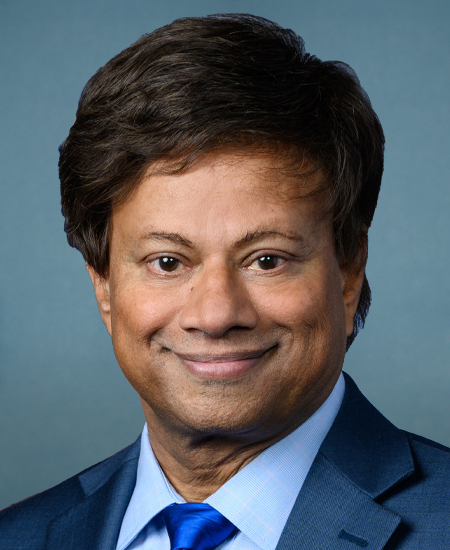
Rep. Shri Thanedar
Sponsored bills
Maddy summaryThis resolution (HRES 1018) commemorates the life and service of Captain Claude A. Rowe, Jr., a Michigan native and Tuskegee Airman who uniquely flew for both the U.S. Army Air Corps and the Royal Canadian Air Force during World War II. It formally recognizes his role as the only known Tuskegee Airman authorized to earn pilot wings from two Allied nations, his 21-year U.S. Air Force career, and his post-military community service. The resolution has no policy impact - it solely honors his legacy through ceremonial acknowledgment. It was introduced by Rep. Thanedar on February 15, 2024, and referred to the House Armed Services Committee.
Maddy summaryHR 7401, the Contract Our Veterans Act of 2024, requires the Department of Defense to set annual contracting goals for small businesses owned and controlled by veterans (including service-disabled veterans) in defense procurement. It mandates that these goals match the existing governmentwide targets for service-disabled veteran-owned businesses under the Small Business Act. The bill allows contracting officers to use sole-source awards or restricted competition for these businesses if they meet specific criteria, such as being listed in a federal database and offering best value to the government. This directly affects Department of Defense contractors and veteran-owned small businesses seeking federal contracts.
Maddy summaryHR 7378, the Frederick Douglass Congressional Gold Medal Act, authorizes Congress to posthumously award a gold medal to honor Frederick Douglass's legacy as a pivotal abolitionist, writer, and advocate for civil rights. The medal, designed by the Treasury Secretary, will be presented to the National Museum of African American History and Culture for display, with bronze duplicates available for sale to cover costs. This ceremonial bill does not create new laws or affect current policies - it solely commemorates Douglass's historical contributions to ending slavery and advancing equality.
Maddy summaryHRES 966 is a symbolic resolution condemning alleged sexual violence committed by Hamas during its October 7, 2023, attack on Israel. It specifically references eyewitness accounts, forensic evidence, and Hamas fighters' admissions of ordering gang rape, sexual mutilation, and assault against Israeli civilians. The resolution calls for international condemnation of such acts as weapons of war, urges nations to criminalize sexual violence, and supports investigations into Hamas' actions. As a non-binding resolution, it does not create new laws or directly affect any individuals but formally expresses the House's position on the issue.
Maddy summaryHR 7257, the GLRI Act of 2024, reauthorizes federal funding for the Great Lakes Restoration Initiative. It specifically adds $500 million annually for fiscal years 2027 through 2031 to the existing program under the Federal Water Pollution Control Act. This funding directly supports ongoing environmental restoration projects in the Great Lakes region, including pollution cleanup, habitat restoration, and invasive species management. The bill extends current funding levels for the next five years without altering program requirements or eligibility.
Maddy summaryThis bill expands Medicare-certified community behavioral health clinics (CCBHCs) to include peer-led community centers ("clubhouses") and housing support as eligible services. It updates certification standards to require clinics to offer comprehensive care like job training, social support, and patient-centered planning focused on daily functioning and recovery. Clinics must now track new data on patient outcomes, including loneliness, quality of life, and access to community resources. These changes directly affect Medicare-covered patients with serious mental illness and clinics seeking CCBHC certification under federal demonstration programs.
Maddy summaryThe Community TEAMS Act of 2024 creates a new federal grant program to support medical student training in rural and medically underserved communities. It provides funding for 1-5 years to partnerships between medical schools and community health providers (such as rural clinics, Federally Qualified Health Centers, or facilities in underserved areas) to expand outpatient clinical rotations. The goal is to help train physicians who will practice long-term in high-need communities by increasing access to community-based training. Grant applicants must include detailed project plans, sustainability strategies, and evaluation methods in their proposals.
Maddy summaryHRES 1003 is a symbolic resolution recognizing the contributions of Vietnamese Americans. It acknowledges that approximately 800,000 Vietnamese refugees resettled in the U.S. after the Vietnam War and that over 1.7 million Vietnamese Americans now live in the U.S., forming the fourth largest Asian American group. The resolution highlights their achievements in fields like business, education, the military, and public service, as well as their support for democracy and cultural diversity. As a non-binding resolution, it has no legal effect or direct impact on policy or individuals.
Maddy summaryHRES 1002 is a symbolic House resolution recognizing the cultural and historical significance of Lunar New Year (celebrated as the Year of the Dragon in 2024). It acknowledges the holiday's 4,000-year history in China, its celebration across Asia (including Seollal and Tết), and its significance to Asian Americans and others in the U.S. The resolution expresses respect for those observing the holiday and wishes them a happy new year, but it does not create new laws, policies, or funding. As a ceremonial resolution, it has no direct effect on legislation or constituents.