

Maddy summaryHRES 1331 is a non-binding House resolution supporting Immigrant Heritage Month by recognizing immigrants' economic, cultural, and military contributions to the United States. It cites data showing immigrants contributed $1.9 trillion to the economy in 2021, made up 20% of entrepreneurs, and serve in critical roles like healthcare and agriculture. The resolution calls on elected officials, educators, and the executive branch to counter anti-immigrant rhetoric, educate the public about immigrant contributions, and protect immigrant communities. It does not create new legal obligations but aims to raise awareness and promote inclusion.
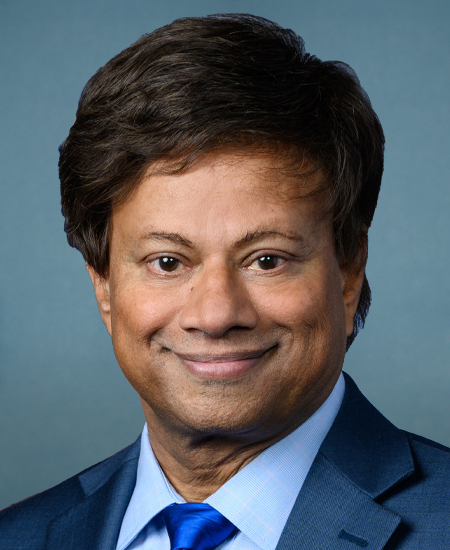
Rep. Shri Thanedar
Sponsored bills
Maddy summaryHRES 1330 is a non-binding resolution supporting Alzheimer’s and Brain Awareness Month in June. It recognizes the significant impact of Alzheimer’s disease on millions of Americans, including high prevalence among women and racial/ethnic minorities. The resolution encourages the public to educate themselves about Alzheimer’s, advocate for research and support services, and offer assistance to affected individuals, families, and caregivers. It does not create new programs, funding, or legal obligations. The resolution is directed at raising public awareness and fostering community support during the designated month.
Maddy summaryHR 8911, the Worker Rights and Support Act, requires most employers to provide specific breaks to employees under the Fair Labor Standards Act. It mandates 30-minute meal breaks after 6 hours of work (unpaid unless work continues), 10-minute rest breaks every 4 hours (paid), and medical breaks (up to 20 minutes per need, paid) for documented health conditions. The bill ensures breaks are paid if employees aren't fully relieved of work duties or can't leave the premises. It does not override collective bargaining agreements or stricter state laws, and adds enforcement penalties for violations of these break requirements.
Maddy summaryHR 8901, the Cannabis Research Act, directs the National Institutes of Health (NIH) to create a national research agenda on cannabis within one year of enactment. This agenda will examine medical benefits (like pain management and epilepsy treatment), effects on vulnerable groups (children, pregnant people, older adults), public safety concerns (youth access, impaired driving), and optimal dosing. The bill also establishes federally funded "Centers of Excellence in Cannabis Research" at universities, authorizing $50 million annually (2026-2030) for these institutions to conduct interdisciplinary research and clinical trials. Additionally, it modifies federal law to allow research institutions to legally test cannabis products under state law for research purposes, without triggering Controlled Substances Act penalties.
Maddy summaryThe CHARTER Act prohibits charter schools receiving federal education funds under the Elementary and Secondary Education Act (ESEA) or Individuals with Disabilities Education Act (IDEA) from contracting with for-profit entities to manage school operations - including curriculum, budgets, or staff decisions. It directly affects public charter schools and their charter management organizations that receive these federal funds. The bill allows contracts with for-profits for specific services like food, payroll, or facilities maintenance but bans profit-driven management arrangements. The law takes effect 3 years after enactment and applies only to new or renewed contracts after that date, closing a loophole identified in a 2006 court case where for-profit schools reorganized as nonprofits to retain federal funding.
Maddy summaryThe SAFES Act creates a federal tax credit for individuals who purchase gun safes, allowing them to deduct 90% of the cost, up to $500 per person or $1,000 for joint returns. For purchases made before 2030, any qualifying gun safe qualifies; after 2029, only safes meeting standards set by the Secretary of Health and Human Services (HHS) will be eligible, based on an HHS report required within five years of enactment. The bill prohibits requiring taxpayers to disclose firearm ownership details to claim the credit. This policy directly affects individual firearm owners seeking to reduce tax liability through safe storage purchases.
Maddy summaryThis bill creates a federal framework for "extreme risk protection orders" (ERPOs) that temporarily remove firearms from individuals who pose a risk of harming themselves or others. Family members or law enforcement officers can petition a federal court for a temporary order (up to 14 days) based on probable cause, followed by a hearing within 72 hours to determine if a longer-term order (up to 180 days) is warranted. The bill requires clear and convincing evidence of risk at the hearing and mandates respondents to surrender firearms to law enforcement within 48 hours. It also includes provisions for reporting, training law enforcement on ERPOs, and a federal grant program to support state ERPO implementation, without preempting state laws.
Maddy summaryHRES 901 is a U.S. House resolution expressing support for democracy and human rights in Pakistan. It calls on the U.S. President and Secretary of State to collaborate with Pakistan to uphold democratic processes, human rights, and the rule of law. The resolution urges Pakistan to protect freedoms of speech, assembly, and press, and to avoid arbitrary detention or suppression of political participation. It also condemns efforts to undermine Pakistan's electoral or judicial systems, including harassment of citizens during protests or interference with elections.
Maddy summaryThis resolution, introduced around World Refugee Day, expresses congressional support for U.S. efforts to protect refugees and displaced persons globally and within the United States. It highlights that over 117 million people are displaced worldwide, references the U.S. resettling 60,000 refugees in fiscal year 2024, and calls on federal agencies to maintain the Refugee Admissions Program, uphold asylum protections, and support host countries. The resolution does not create new laws but reaffirms existing commitments to refugee resettlement, safety, and integration through current programs.
Maddy summaryThis resolution recognizes June 19, 2024, as Juneteenth Independence Day, acknowledging its historical significance as the anniversary of the end of slavery in the U.S. (specifically referencing Union soldiers' announcement in Galveston, Texas, on June 19, 1865). It does not create new policy but formally encourages all Americans to observe the day through ceremonies and educational activities. The resolution emphasizes Juneteenth's role in honoring African American freedom and its importance to U.S. history and cultural heritage. It follows the 2022 law that established Juneteenth as a federal holiday, focusing solely on symbolic recognition and annual observance.