

Maddy summaryThis bill establishes a federal program under the EPA to improve indoor air quality in schools and childcare facilities, directly affecting local educational agencies and covered childcare providers. It requires the EPA to develop science-based guidelines for harmful indoor contaminants (like mold, radon, and chemicals), conduct a national assessment of school air quality within three years, and provide technical assistance to schools. The bill also creates voluntary certification programs for buildings meeting high indoor air quality standards and authorizes $100 million annually for implementation. Key mechanisms include mandatory assessments, updated ventilation standards, and funding for schools to reduce exposure to air contaminants.
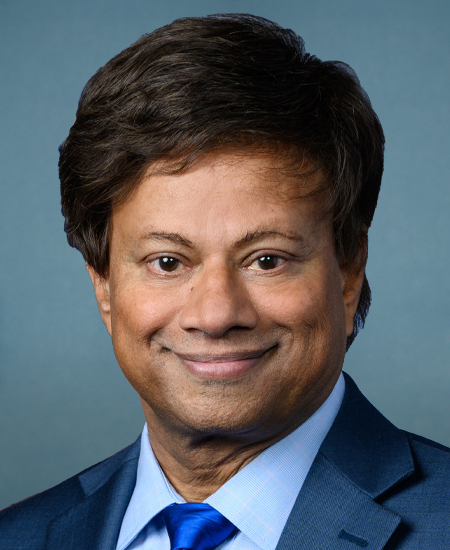
Rep. Shri Thanedar
Sponsored bills
Maddy summaryThis bill names a U.S. Postal Service facility at 24837 Goddard Road in Taylor, Michigan, as the "Technical Sergeant E. Huston James Memorial Post Office Building" to honor a military veteran. It updates all official references (laws, maps, documents) to the location to reflect this new name. The bill has no policy or funding impact - it solely commemorates Technical Sergeant E. Huston James.
Maddy summaryThe LET'S Protect Workers Act increases civil penalties for employers who violate labor and workplace safety laws. It significantly raises fines for child labor violations (up to $700,000 for serious injuries/deaths), wage and hour violations (up to $50,000 per violation for repeated/willful violations), and workplace safety violations (up to $800,000). The bill also increases penalties for farmworker protections (to $30,000), mine safety violations, and unfair labor practices (up to $100,000). New provisions require employers to pay penalties, with withdrawal orders for mines that fail to pay fines. These changes apply to violations occurring on or after January 1, 2025, with some provisions taking effect immediately.
Maddy summaryHR 9176, the LIONs Act of 2024, increases the maximum loan amount available through the Small Business Administration's 7(a) loan program. It amends the Small Business Act to raise the cap from $3.75 million (or $5 million if exceeding) to $7.5 million (or $10 million if exceeding) for eligible small business loans. This change directly affects small businesses seeking SBA 7(a) loans by allowing them to access larger funding for operations, equipment, or expansion. The key mechanism is updating the statutory loan limit to support more significant business financing needs within the existing program framework.
Maddy summaryThe National Quantum Initiative Reauthorization Act (HR 6213) reauthorizes and expands federal efforts to advance quantum information science, engineering, and technology in the United States. It establishes new programs including National Quantum Centers, Quantum Testbeds, and a Quantum Reskilling and Workforce Coordination Hub to develop domestic talent and infrastructure. The bill creates an International Quantum Cooperation Strategy to build partnerships with allies while restricting collaboration with "foreign countries of concern" as defined in the legislation. It provides funding for research, workforce development, and commercialization of quantum technologies across government agencies, universities, and industry. The act aims to strengthen U.S. leadership in quantum technology through coordinated federal investment and international collaboration.
Maddy summaryH.J. Res. 193 proposes a constitutional amendment to eliminate legal immunity for federal officials, including the President, from criminal prosecution for actions taken while performing official duties. It also prohibits the President from granting a pardon to themselves. The amendment would apply to all federal officers (such as the President, Vice President, and members of Congress) except for Congress members acting in their legislative role as defined in the Constitution. If ratified by 38 states, this change would become part of the U.S. Constitution, requiring no further congressional action.
Maddy summaryHRES 1381 is a symbolic resolution that commemorates the United States Olympic and Paralympic Teams' historical achievements, including over 5,300 total medals across past Games. It expresses congressional support for U.S. athletes competing in the 2024 Summer Olympics and Paralympics in Paris, France, and commends the Government of France for hosting the events. The resolution also commits to ensuring a safe environment for the 2028 Los Angeles Olympic and Paralympic Games. As a non-binding expression of support, it does not create new laws or allocate funds.
Maddy summaryHRES 1375 is a non-binding resolution recognizing extreme weather as a critical threat to children's health and well-being, emphasizing that children face unique vulnerabilities due to their developing bodies, higher exposure to pollutants, and heightened risks during events like heatwaves, wildfires, and poor air quality. It expresses Congress's view that solutions must be developed and deployed rapidly and equitably, with specific attention to children's physical and mental health needs. The resolution suggests concrete measures such as improved air filtration in schools, accessible public alerts for extreme heat, expanded cooling centers, and better infrastructure for child-friendly emergency spaces, though it does not create new laws or mandates.
Maddy summaryHR 9104, the Access to Birth Control Act, requires pharmacies that normally stock contraception to provide birth control or related medications without delay if in stock, or immediately offer alternatives like referrals to other pharmacies or expedited orders if unavailable. It prohibits pharmacists from intimidating customers, misrepresenting availability, breaching confidentiality, or refusing to fill valid prescriptions for birth control. Pharmacies violating these rules face civil penalties up to $1,000 per day or private lawsuits. The law specifically applies to pharmacies that routinely carry contraception and excludes cases where a valid prescription is missing or payment cannot be made. It aims to address documented refusals to dispense birth control, particularly following the Dobbs decision.
Maddy summaryThis bill requires the U.S. Postal Service (USPS) to meet specific on-time delivery performance standards for periodicals (newspapers and magazines) before the Postal Regulatory Commission can approve new rate increases for those services. It mandates annual public reports tracking USPS's on-time delivery performance for both in-county and out-of-county newspaper mail, with requirements for data collection if individual mail tracking isn't feasible. The bill also directs the Government Accountability Office (GAO) to study alternative pricing models for periodicals that don't cover their costs, with a report due within two years. These provisions directly affect USPS operations, newspaper publishers, and the postal rate-setting process, aiming to link service quality to financial decisions.