Stronger Communities through Better Transit Act This bill requires the Department of Transportation to establish a grant program to support operating projects for public transportation (e.g., service expansion) and related capital improvements, particularly in underserved communities and areas of persistent poverty.
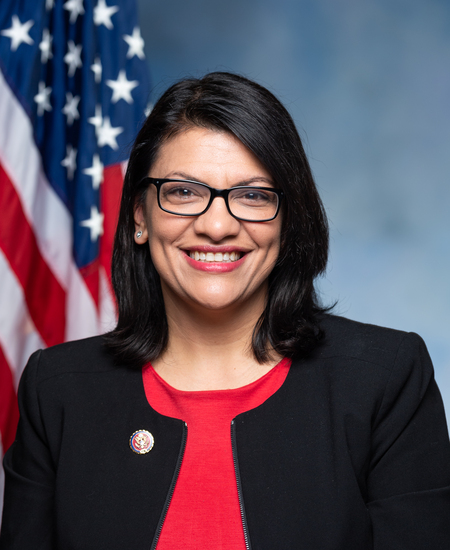
Rep. Rashida Tlaib
Sponsored bills
State-Based Universal Health Care Act of 20 21 This bill establishes the option for states, or groups of states, to apply to waive certain federal health insurance requirements and provide residents with health insurance benefits plans through a state-administered program. Such programs must cover 95% of the residents in the state within five years and plan benefits must be at least as comprehensive and affordable as the coverage under the equivalent federal program. State programs are supported with funds from the federal programs the state programs replace, which may include Medicare, Medicaid, the Children's Health Insurance Program, the Federal Employee Health Benefits program, certain federal tax credits, and premium-assistance funds, among others. The bill requires the Department of Health and Human Services to appoint an Independent Assessment Panel for Comprehensive Care to review and recommend whether to approve state applications. Each approved state program must be independently reviewed every five years to evaluate changes in health benefits access, quality, and coverage, including whether the state has met the 95% coverage requirement. The federal government must pay all health insurance costs for American Indians and Alaska Natives who enroll in a plan through a state insurance program.
Disability Employment Incentive Act This bill expands tax credits and deductions that are available for employers who hire and retain employees with disabilities. The bill expands the work opportunity tax credit to include the hiring of employees who receive Social Security Disability Insurance (SSDI) benefits. For employers who hire vocational rehabilitation referrals, Supplemental Security Income recipients, or SSDI recipients, the bill also (1) increases the amount of wages that may be taken into account for the credit, and (2) allows an additional credit for second-year wages. With respect to the tax credit for expenditures by eligible small businesses to provide access to disabled individuals, the bill increases the limits that apply to (1) the amount of expenditures that are eligible for the credit, and (2) the gross receipts and full-time employees of eligible small businesses. The bill also expands the tax deduction for expenditures to remove architectural and transportation barriers to the handicapped and elderly. The bill modifies the deduction to (1) increase the limitation on the amount of the deduction, and (2) allow the deduction to be used for certain improvements in the accessibility of internet or telecommunications services to handicapped and elderly individuals.
Environmental Justice in Recreation Permitting Act This bill requires the Department of the Interior and the Department of Agriculture to complete an interagency report on the use of special recreation permits by recreation service providers serving environmental justice communities. The bill defines an environmental justice community as a community with significant representation of communities of color, low-income communities, or tribal and indigenous communities, that experiences, or is at risk of experiencing, higher or more adverse human health or environmental effects than other communities. Interior and USDA shall contact all existing or prospective recreation service providers to request a voluntary estimate of the number of user days used by, or, in the case of a prospective recreation service provider, expected to be used by, individuals from environmental justice communities during the period covered by the report; request from recreation service providers and interested members of the public any other information required for the report; and not use the participation of, or the provision of information to the Secretaries by, a recreation service provider under this subsection as a condition of a special recreation permit.
Keep It in the Ground Act of 2021 This bill eliminates new fossil fuel production projects on federal public land and waters. Specifically, it prohibits the Bureau of Ocean Energy Management (BOEM) from issuing, renewing, reinstating, or extending any nonproducing lease, or issuing any authorization for the exploration or production of fossil fuel on the Outer Continental Shelf. BOEM must also cancel any lease issued in the Beaufort Sea, Cook Inlet, or Chukchi Sea (three of the five bodies of water that encompass the Alaska Outer Continental Shelf). Further, the Bureau of Land Management (BLM) may not issue, renew, reinstate, or extend any nonproducing lease for the exploration or production of any onshore fossil fuels on land subject to the Mineral Leasing Act. The bill provides for exceptions if there is an imminent national security threat that would be significantly reduced by granting an exception. In addition, BOEM and the BLM may allow a nonproducing lease to be renewed or extended if (1) the lease contract was signed before enactment of this bill, and (2) it is determined that giving effect to any provision of this bill is likely to lead to a judicial ruling that there was a material breach of the nonproducing lease contract.
Paycheck Fairness Act This bill addresses wage discrimination on the basis of sex, which is defined to include pregnancy, sexual orientation, gender identity, and sex characteristics. Specifically, it limits an employer's defense that a pay differential is based on a factor other than sex to only bona fide job-related factors in wage discrimination claims, enhances nonretaliation prohibitions, and makes it unlawful to require an employee to sign a contract or waiver prohibiting the employee from disclosing information about the employee's wages. The bill also increases civil penalties for violations of equal pay provisions. Additionally, the Equal Employment Opportunity Commission (EEOC) and the Office of Federal Contract Compliance Programs must train EEOC employees and other affected parties on wage discrimination. The bill directs the Department of Labor to (1) establish and carry out a grant program to provide training in negotiation skills related to compensation and equitable working conditions, (2) conduct studies to eliminate pay disparities between men and women, and (3) make available information on wage discrimination to assist the public in understanding and addressing such discrimination. The bill establishes the National Award for Pay Equity in the Workplace for an employer who has made a substantial effort to eliminate pay disparities between men and women. It also establishes the National Equal Pay Enforcement Task Force to address compliance, public education, and enforcement of equal pay laws. Finally, the bill requires the EEOC to issue regulations for collecting from employers compensation and other employment data according to the sex, race, and national origin of employees for use in enforcing laws prohibiting pay discrimination.
This resolution expresses the sense of the House of Representatives that the United States must establish (1) electricity as a basic human right; and (2) a publicly- and community-owned power system that is just, equitable, antiracist, and resilient to climate changes and disasters.
Clean Water Standards for PFAS Act of 2021 This bill directs the Environmental Protection Agency (EPA) to develop requirements and incentives to limit the discharge of perfluoroalkyl and polyfluoroalkyl substances (PFAS) into certain waters of the United States. PFAS are man-made and may have adverse human health effects. A variety of products contain the compounds, such as nonstick cookware or weatherproof clothing. Within two years, the EPA must publish water quality criteria for each measurable perfluoroalkyl substance, polyfluoroalkyl substance, and class of PFAS. The water quality criteria must determine how much of these substances can be present in water before it is likely to harm human health. Within four years, the EPA must publish a final rule that establishes, for each priority industry category specified in the bill, effluent limitations guidelines and standards for the discharge of each measurable perfluoroalkyl substance, polyfluoroalkyl substance, and class of PFAS. Under the Clean Water Act, effluent limitations restrict the quantities, rates, and concentrations of chemical, physical, biological, and other constituents which are discharged from point sources (e.g., a discernible source such as a pipe) into navigable waters, the ocean, or other specified waters. In addition, the EPA must award grants to owners and operators of publicly owned treatment works for implementing the effluent limitations guidelines and standards.

Algorithmic Justice and Online Platform Transparency Act This bill establishes requirements for certain commercial online platforms (e.g., social media sites) that withhold or promote content through algorithms and related computational processes that use personal information. The platforms must make disclosures about their collection and use of personal information and their content moderation practices; retain specified records that describe how the algorithms use personal information and assess whether the algorithms produce disparate outcomes based on race and other demographic factors in terms of access to housing, employment, financial services, and related matters; employ algorithms safely and effectively; and allow users to access and transfer their personal information. If a platform uses algorithms to publish or sell advertising, it must maintain a library of the advertisements. The Federal Trade Commission must also adopt rules concerning deceptive advertising. A platform's chief executive officer or other senior officer must certify compliance with disclosure requirements. Additionally, platforms may not (1) employ algorithms or other design features that result in discrimination or similar harms based on demographic or biometric factors, or (2) process information such that it impairs voting rights. Further, users of a platform may not violate civil rights laws using the platform's algorithms. The bill prohibits waivers or other methods that limit rights under the bill; provides whistleblower protections for individuals who report violations; and authorizes enforcement by specified federal agencies, states, and private individuals. The bill also provides funding for an interagency task force to study the discriminatory use of personal information by platforms' algorithms.
This resolution recognizes the importance of the Islamic faith and expresses deep respect for Muslims in the United States and worldwide in honor of Eid al-Fitr (the conclusion of Ramadan).