

Federal Retirement Fairness Act This bill modifies the federal civilian service that is creditable service under the Federal Employees Retirement System (FERS). Specifically, it expands the nondeduction service that may be creditable under FERS. Nondeduction service is federal service where an employee's pay is not subject to retirement deductions (e.g., service under a temporary appointment). Currently, nondeduction service performed before January 1, 1989, is creditable under FERS so long as a deposit is made into the retirement fund to cover the period of nondeduction service. This bill allows nondeduction service performed on or after January 1, 1989, to be creditable under FERS so long as a deposit is made into the retirement fund.
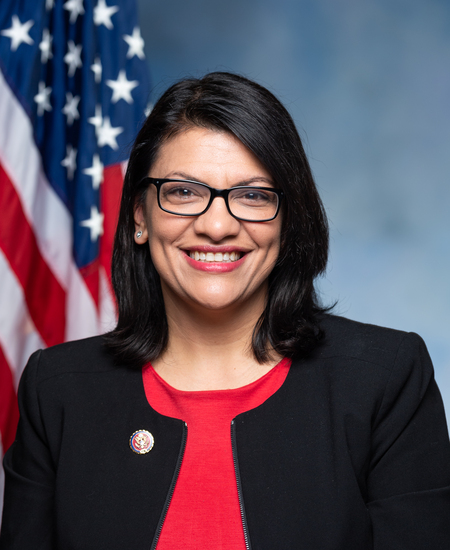
Rep. Rashida Tlaib
Sponsored bills
Audit the Pentagon Act of 2021 This bill requires defense spending reductions during any fiscal year after FY2022 where the Comptroller of the Department of Defense (DOD) fails to certify that a department, agency, or other element of DOD has achieved an unqualified opinion on its full financial statements. The amount of any reductions must be deposited in the General Fund of the Department of the Treasury and must be available for deficit reduction. The bill excludes from any reductions accounts related to military personnel, reserve personnel, National Guard personnel, and the Defense Health Program. The President may waive a reduction if the President certifies that a reduction would negatively affect (1) national security or members of the Armed Forces who are deployed in combat zones, or (2) the Defense Health Program account.
Fair Repair Act This bill requires an original equipment manufacturer (OEM) to make diagnostic, maintenance, and repair equipment available to independent repair providers. Specifically, for digital electronic equipment sold or used in the United States, an OEM shall make documentation, parts, and tools available to independent repair providers in a timely manner and on fair and reasonable terms. Further, if an OEM has made an express warranty for digital electronic equipment with a wholesale price of $100 or more, the OEM must provide such items at an equitable price and convenience of delivery to enable the repair of the equipment during the warranty period. The bill provides for enforcement of its provisions by the Federal Trade Commission and state attorneys general.
Tenant Empowerment Act of 2021 This bill generally expands the rights of tenants in federally assisted housing. Specifically, the bill allows tenants to place rent in an escrow account in the event that a housing project is found to be in violation of certain housing standards; seek judicial enforcement of specified housing agreements; and access information related to a housing project, including the ownership, specified reports, and contracts. The bill also provides for continuing rental assistance payments for tenants if the property is in foreclosure.
Low-Income Water Customer Assistance Programs Act of 2021 This bill directs the Environmental Protection Agency (EPA) to establish grant programs to assist low-income households in maintaining access to drinking water and wastewater services. Specifically, the EPA must establish a program to assist such households with paying drinking water bills. States and community water systems may apply for grants. In addition, the EPA must establish a program to assist such households with paying wastewater utility bills. States may apply for grants for small community-serving wastewater facilities. Certain municipalities may apply for grants for (1) treatment works for municipal waste, or (2) municipal separate storm sewer systems.
Better Care Better Jobs Act This bill establishes programs and provides funds for state Medicaid programs to improve home- and community-based services (HCBS), such as home health care, personal care, case management, and rehabilitative services. Specifically, the bill provides funds for the Centers for Medicare & Medicaid Services to award planning grants, develop quality measures, and provide technical assistance to states regarding specified HCBS improvements, particularly with respect to access, utilization, and the associated workforce. The bill also increases the Federal Medical Assistance Percentage (i.e., federal matching rate) for HCBS in states that develop plans and meet specified benchmarks for improvements. The bill also makes permanent (1) the Money Follows the Person Rebalancing Demonstration Program (a grant program to help states increase the use of HCBS for long-term care and decrease the use of institutional care), and (2) certain provisions regarding Medicaid eligibility that protect against spousal impoverishment for recipients of HCBS.
Therapeutic Fraud Prevention Act of 20 21 This bill prohibits commercial conversion therapy, which is a practice or treatment designed to change a person's sexual orientation or gender identity or otherwise change behaviors, thoughts, or expressions related to gender or sexual attraction. This prohibition does not apply to treatment that assists an individual undergoing a gender transition or facilitates identity exploration and development.
Insulin Access for All Act of 2021 This bill prohibits cost-sharing (e.g., copayments) under Medicaid and the Medicare prescription drug benefit for insulin and associated medical supplies.
Restoring Unfairly Impaired Credit and Protecting Consumers Act This bill revises requirements regarding consumer credit information included by a consumer reporting agency on a credit report, including by requiring removal of adverse information that resulted from specified fraudulent lending activity, shortening the time period adverse information stays on reports, and limiting the inclusion of certain medical debt on reports. The bill also requires a consumer reporting agency to provide free credit monitoring and identity theft protection services to certain consumers, including victims of fraud, active duty military, and those 65 years of age and older.
Saving Hazardous And Declining Environments Act or the SHADE Act This bill requires the Department of Housing and Urban Development to award grants for government entities and nonprofit organizations to plant trees in low-income communities and in communities meeting designated minority or limited English-proficiency thresholds.