

Consumer Protection and Recovery Act This bill authorizes the Federal Trade Commission (FTC) to seek monetary relief in federal court from businesses that engage in unlawful commercial practices such as false advertising, consumer fraud, and anticompetitive conduct. Specifically, the FTC may seek restitution in these cases for losses, rescission or reformation of contracts, refund of money, return of property, or disgorgement of unjust enrichment. On April 22, 2021, the Supreme Court held in AMG Capital Management, LLC v. Federal Trade Commission that the Federal Trade Commission Act does not authorize the FTC to seek, or a court to award, such relief.
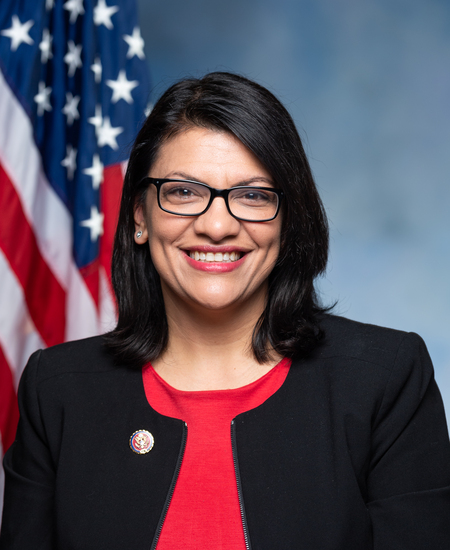
Rep. Rashida Tlaib
Sponsored bills
Refugee Sanitation Facility Safety Act of 2021 This bill directs the Department of State, when providing overseas assistance for refugees, to ensure the provision of safe and secure access to sanitation facilities, with a special emphasis on women, girls, and vulnerable populations.
This resolution supports the designation of a Muslim-American Heritage Month. The resolution also honors the contributions and integral role of Muslim Americans in the economy, culture, and identity of the United States.
This resolution reaffirms the House of Representatives' commitment to media diversity and expresses its pledge to eliminate barriers to such diversity.
Generating Resilient, Environmentally Exceptional National Streets Act or the GREEN Streets Act This bill establishes national goals to reduce carbon dioxide and other greenhouse gas emissions and improve the resilience of the transportation system. Specifically, the bill directs the Department of Transportation (DOT) to establish minimum standards for states to decrease greenhouse gas emissions and per capita vehicle miles traveled (VMTs) on the National Highway System; DOT to establish measures for states to assess and reduce carbon dioxide; states and metropolitan planning organizations (MPOs) to consider projects and strategies that reduce carbon dioxide and other greenhouse gas emissions and decrease per capita VMT's; states and MPOs to publish an analysis of the impact on per capita VMTs and mobile source greenhouse gas emissions for each project that adds new lanes or otherwise increases traffic capacity and costs more than $25 million; states that are out of compliance with the per capita VMT standards or carbon dioxide or greenhouse gas emission measures to dedicate federal highway funding to achieve compliance; and DOT to establish national transit access standards and performance measures for transit accessibility, transit stop distance, and transit mode share.
Reverse Transfer Efficiency Act of 2021 This bill allows the release of a transfer student's educational records from an institution of postsecondary education where a student earned credit for coursework to an institution of postsecondary education where the student was previously enrolled in order to apply the student's coursework and credits toward completion of a recognized postsecondary credential, such as an associate's degree. Specifically, the bill allows the Department of Education to provide funding to an institution of postsecondary education that releases a student's records of postsecondary coursework and credits without the consent of the student or the student's parents if the student provides written consent prior to receiving the credential.
Green New Deal for Public Schools Act of 2021 This bill provides environmental and educational resources to public elementary and secondary schools and Bureau of Indian Education (BIE) schools. Specifically, the bill requires the Department of Energy's (DOE's) Office of Energy Efficiency and Renewable Energy to provide climate capital facilities grants to eligible entities (e.g., public schools and BIE schools). Grant recipients must use these funds to construct new, or convert existing facilities into, healthy zero-carbon schools. Healthy zero-carbon school refers to a school with highly energy-efficient facilities that produce or procure sufficient carbon-free and pollution-free renewable energy to meet the school's needs. Next, the bill directs the Department of Education (ED) to award resource block grants to qualified local educational agencies (LEAs) to hire and retain educators and support staff in high-need schools. ED must award grants to eligible consortia of LEAs for educational equity planning and implementation. In addition, ED must establish the Climate Change Resiliency Program to increase the resiliency of public and BIE schools during climate change-related events, natural disasters, and public health crises. Further, ED must establish a related grant program for state educational agencies. Grant recipients must use these funds for certain activities (e.g., green infrastructure projects). The bill establishes the Office of Sustainable Schools within ED to (1) administer the resource block grant and educational equity grant programs, and (2) coordinate with DOE and the White House Office of Domestic Climate Policy on climate capital facilities grants and the Climate Change Resiliency Program.
National Infrastructure Development Bank Act of 2021 This bill establishes the National Infrastructure Development Bank as a government corporation to finance energy, environmental (e.g., drinking water or waste facilities), telecommunications, and transportation infrastructure projects. The bill establishes the National Infrastructure Development Bank Board, which must oversee the infrastructure projects. The board may make loans and loan guarantees to assist in financing infrastructure projects. Further, the board must establish an executive committee, a risk management committee, an audit committee, and a compliance office. To be eligible for financial assistance from the bank, an infrastructure project (1) must have a public benefit, as determined by the board; and (2) may not have a sole use or purpose that is private. An infrastructure project must use iron, steel, and manufactured products that are made in the United States. The bill also establishes accounting and reporting requirements. In particular, the Government Accountability Office must, within five years of this bill's enactment, submit a report to Congress evaluating the bank's activities.
National Green Alert Act of 2021 This bill establishes the Green Alert System Advisory and Support Committee to develop best practices and provide technical assistance to states for the implementation of green alert systems, which would be activated when a veteran with a history of mental health issues goes missing.
Veterans Agent Orange Exposure Equity Act This bill expands the presumption of service-connection for diseases associated with exposure to certain herbicide agents for veterans who served in Vietnam between January 9, 1962, and May 7, 1975. Under a presumption of service-connection, specific conditions diagnosed in certain veterans are presumed to have been caused by the circumstances of their military service. Health care benefits and disability compensation may then be awarded. Specifically, the bill expands the presumption to cover veterans who served in Thailand at a U.S. Army base or Royal Thai Air Force base between January 9, 1962, and May 7, 1975; at the Royal Thai Army Replacement Training Center, Pranburi Military Reservation between January 1, 1964, and April 30, 1964; in Laos between December 1, 1965, and September 30, 1969; or in Cambodia at Mimot or Krek, Kompon Cham Province between April 16, 1969, and April 30, 1969.