

Protecting Military Installations from Foreign Espionage Act This bill places restrictions on the purchase of certain property by a foreign person who is owned or controlled by, is acting for or on behalf of, or receives subsidies from Russia, China, Iran, or North Korea. Specifically, the Committee on Foreign Investment in the United States must review a purchase or lease by, or a concession to, any such foreign person of private or public real estate in the United States that is within (1) 100 miles of a military installation; or (2) 50 miles of a military training route, special use airspace, a controlled firing area, or a military operations area. Further, the Department of Defense and the Department of Transportation may not issue final determinations regarding specified projects (e.g., energy projects) that involve a transaction under review by the committee until the committee concludes its action.
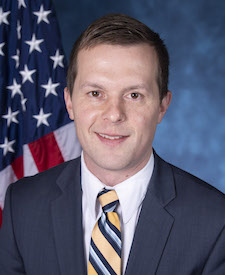
Rep. Jared F. Golden
Sponsored bills
Future in Logging Careers Act This bill allows individuals who are 16 or 17 years old to work at certain timber harvesting operations that are owned or operated by at least one parent or a person standing in place of a parent. The bill, therefore, exempts such employees from child labor laws.
Ban Corporate PACs Act This bill prohibits for-profit corporations from establishing or operating a separate segregated political fund (commonly known as a political action committee or PAC). Existing funds must terminate not later than one year after the date of enactment of this bill.
Ensuring Access to Counseling and Training for All Small Businesses Act of 2021 This bill prohibits a small business development center, women's business center, or Veteran Business Outreach Center from declining to provide services to an otherwise eligible small business solely because it is a cannabis-related legitimate business or service provider.
FDA Modernization Act of 2021 This bill allows an applicant for market approval for a new drug to use methods other than animal testing to establish the drug's safety and effectiveness. Under this bill, these alternative methods may include cell-based assays, organ chips and microphysiological systems, sophisticated computer modeling, and other human biology-based test methods.
Fire Fighters and EMS Employer-Employee Cooperation Act This bill requires the Federal Labor Relations Authority to determine whether a state substantially provides fire and emergency medical services (EMS) personnel the right to form and join a labor organization; recognition by fire and EMS employers of the employees' labor organization, agreement to bargain with the organization, and reduction of any agreements to writing in a contract or memorandum of understanding; the right to bargain over hours, wages, and terms and conditions of employment; and arbitration or other mechanisms to resolve an impasse in collective bargaining negotiations. The bill makes the authority responsible for (1) determining the appropriateness of units for labor representation; (2) supervising elections; (3) conducting hearings and resolving complaints of unfair labor practices; and (4) protecting the right of employees to form, join, or assist any labor organization, or to refrain from doing so. An employer, fire and EMS personnel, or labor organization may not engage in a lockout, sickout, work slowdown, strike, or any other organized job action that will measurably disrupt the delivery of emergency services and is designed to compel an employer, fire and EMS personnel, or labor organization to agree to the terms of a proposed contract.
Women Veterans Transitional Residence Utilizing Support and Treatment Act or the Women Veterans TRUST Act This bill requires the Department of Veterans Affairs (VA) to conduct a nationwide analysis of the need for women-specific VA programs that treat and rehabilitate women veterans with drug and alcohol dependency. Based on the findings of the analysis, the VA must implement a women-specific pilot program to treat and rehabilitate women veterans with drug and alcohol dependency.
Report and Educate About Campus Hazing Act or the REACH Act This bill requires institutions of higher education (IHEs) that participate in federal student-aid programs to report hazing incidents and implement hazing education programs. Specifically, the bill requires each IHE to disclose hazing incidents that were reported to campus security authorities or local police agencies in its annual security report. The bill defines the term hazing to mean any intentional, knowing, or reckless act committed by a student, or a former student, of an IHE against another student (regardless of that student's willingness to participate), that (1) is connected with an initiation into, an affiliation with, or the maintenance of membership in an organization that is affiliated with the IHE (e.g., an athletic team); and (2) contributes to a substantial risk of physical injury, mental harm, or degradation or causes physical injury, mental harm, or personal degradation. In addition, each IHE must implement a comprehensive program to prevent hazing, which must include information on hazing awareness, hazing prevention, and the IHE's policies on hazing.
Joint Consolidation Loan Separation Act This bill allows two borrowers, who had previously received a joint consolidation loan for their federal student loan debt, to submit a joint application to the Department of Education to sever their consolidated loan into two separate loans. One borrower may submit a separate application in the event that the individual is experiencing domestic or economic abuse from the other individual borrower or is unable to reasonably reach or access the loan information of the other borrower.
Protecting Access to Ground Ambulance Medical Services Act of 2021 This bill modifies Medicare payment of ground ambulance services in rural areas. Specifically, the bill extends the specialized rate increase for such services for an additional five years (until January 1, 2028). The bill also requires the Centers for Medicare & Medicaid Services to (1) allow an area that has 1,000 or fewer individuals per square mile to retain its status as a rural area even if it would otherwise no longer qualify, and (2) establish an appeals process for providers to seek reconsideration of a change in an area's status.