

Closing the Loophole on Interstate Firearm Sales Act This bill restricts the sale or transfer of shotguns and rifles across state lines. Specifically, it prohibits a licensed gun dealer, manufacturer, importer, or collector from selling or transferring a rifle or shotgun to an out-of-state resident. Current law allows such sales or transfers if both parties meet in person to conduct the transaction and if the transaction complies with the laws of both states.
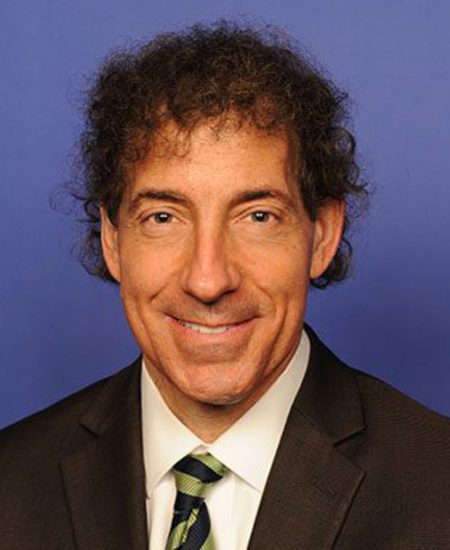
Rep. Jamie Raskin
Sponsored bills
Pandemic Treatment Access and Affordability Act of 2021 This bill imposes licensing and price restrictions on federally supported drugs and other medicines intended to address COVID-19 (i.e., coronavirus disease 2019) or other public health emergencies. With respect to a COVID-19 drug patent developed using certain types of federal support, any license granted by the federal government shall be open and nonexclusive. Similarly, a licensee or assignee for such a patent shall grant open nonexclusive licenses for the patent. An entity that receives a license shall pay reasonable royalties to (1) the patent holder, or (2) the owner of marketing exclusivity rights granted by the Food and Drug Administration (FDA) that were terminated under this bill. The bill requires that such drugs be offered at a fair and reasonable price based on certain considerations, such as access. If the Department of Health and Human Services (HHS) finds that the price of any drug to address a public health emergency is excessive, HHS must void any FDA-granted exclusivity for the drug and grant open and nonexclusive licenses to other manufacturers. Such licenses are subject to reasonable royalty requirements.
COVID-19 Justice and Accountability Act This bill provides a cause of action for harm suffered as a result of a violation of certain federal laws relating to COVID-19 (i.e., coronavirus disease 2019) and suspends certain predispute arbitration agreements and joint-action waivers during the COVID-19 public health emergency. Specifically, individuals may bring a cause of action in U.S. district court against any person for harm suffered as a result of a violation of, or a failure to comply with, the Coronavirus Aid, Relief, and Economic Security Act (CARES Act), the Families First Coronavirus Response Act, or the Coronavirus Response and Relief Supplemental Appropriations Act, 2021. Further, during the COVID-19 public health emergency period and 180 days thereafter, no predispute arbitration agreement or joint-action waiver (an agreement to waive the right to participate in a joint, class, or collective action) is valid or enforceable with respect to employment, consumer, antitrust, or civil rights disputes.
National Office of New Americans Act This bill establishes the National Office of New Americans (NONA) within the Executive Office of the President to promote and support the integration of immigrants and refugees into the social, cultural, economic, and civic life of the United States. The NONA shall also establish the Federal Initiative on New Americans. The initiative shall establish a coordinated federal program to respond effectively to immigrant and refugee integration issues such as language learning, adult education and workforce training, health care, and naturalization.
Improving Access to Mental Health Act of 2021 This bill increases the Medicare reimbursement rate for clinical social worker services. The bill excludes clinical social worker services from the prospective payment system in which predetermined amounts form the basis for payment under Medicare. Additionally, the bill alters the definition of clinical social worker services as it relates to Medicare. Under current law, such services (1) include services performed for the diagnosis and treatment of mental illnesses, and (2) exclude services furnished to an inpatient of a skilled nursing facility as a condition of the facility's participation in the Medicare program. The bill repeals these provisions and instead specifies that such services include certain types of health behavior assessment and intervention.
Better Utilizing Investments to Leverage Development and Generating Renewable Energy to Electrify the Nation's Infrastructure and Jobs Act or the BUILD GREEN Infrastructure and Jobs Act This bill directs the Department of Transportation (DOT) to establish a green transportation infrastructure program to provide competitive grants to states, local governments, and other entities for capital investments in electrified surface transportation infrastructure projects. DOT must select projects that maximize sustainability, including projects that (1) promote the electrification of all public transportation, (2) contribute to climate resilience and mitigation, (3) reduce air pollution and greenhouse gas emissions, and (4) achieve energy savings and reduce energy usage compared to other eligible projects. Additionally, DOT must prioritize projects that (1) serve a frontline, vulnerable, or disadvantaged community; (2) are located in an area that has experienced high adverse health and environmental impacts on minority and low-income populations; (3) require federal funds in order to complete an overall financing package; or (4) add a new green space or new state or local park units and outdoor recreational areas. Grants issued under the program may not be less than $2 million, with the exception of grants for project planning, preparation, or design, which are not subject to a minimum amount. The federal share of the cost of a project may not exceed 85% for planning, design, and construction purposes and 50% of the operation and maintenance costs of the project for its first 10 years.
Whole Milk for Healthy Kids Act of 2021 This bill revises requirements for milk provided by the National School Lunch Program of the Department of Agriculture (USDA). Currently, schools participating in the program must provide milk that is consistent with the most recent Dietary Guidelines for Americans; USDA regulations require milk to be fat-free or low-fat and allow only fat-free milk to be flavored. The bill removes these restrictions and instead permits schools to offer students whole, reduced-fat, low-fat, and fat-free flavored and unflavored milk.
Reading Early and Addressing Dyslexia Act or the READ Act This bill directs the Department of Education (ED) to establish an early literacy and dyslexia intervention pilot program to award grants to five state educational agencies to address early reading deficiencies and dyslexia. Under the program, ED must identify (1) evidence-based methods of screening students in grades K-3 for early reading deficiencies and dyslexia; (2) intensive interventions for these students, including phonological awareness and phonemic awareness, sound symbol recognition, and decoding skills; and (3) best practices to instruct educators on the science of reading and how to execute screenings and intensive interventions for these students. Each participating state educational agency must select at least two local educational agencies (LEAs) to participate in the program. Participating LEAs must provide intensive interventions identified by ED that develop basic reading skills and incorporate systematic phonics instruction to every student in grades K-3, screen each student in grades K-3 three times during each school year using the screening methods identified by ED, notify parents or guardians of screenings, and conduct diagnostic assessments and provide intensive interventions for each student suspected of having an early reading deficiency or dyslexia. The bill also directs ED to establish an online platform to provide educational agencies with resources, such as methods of targeting instruction for early reading deficiencies and dyslexia.
American Dream Employment Act of 2021 This bill establishes that, for the purposes of eligibility to be an officer or employee of an office of Congress, an individual shall be treated as a U.S. citizen if that individual has (1) employment authorization under the Deferred Action for Childhood Arrivals program, (2) employment authorization under a grant of deferred enforced departure, or (3) temporary protected status. (Generally, these programs and statuses allow eligible aliens to remain and work in the United States.)
Alice Cogswell and Anne Sullivan Macy Act This bill expands special education and related services for students who are deaf or hard of hearing, students with visual disabilities, and children and youth who are deaf-blind. The individualized education program for each child who is visually and/or hearing impaired must include specified components and must provide the child with instruction that meets the child's unique learning needs. In addition, a state's closure of a special school serving deaf or blind children shall count as a reduction of its financial support for special education and related services. Among other provisions, the bill authorizes support, including grants for training special education personnel, to be used in preparing individuals to become qualified teachers and early intervention specialists for children with hearing disabilities. The bill establishes within the Department of Education the Anne Sullivan Macy Center on Visual Disability and Educational Excellence to better support students with visual disabilities.