

Resident Physician Shortage Reduction Act of 2021 This bill increases the number of residency positions eligible for graduate medical education payments under Medicare for qualifying hospitals, including hospitals in rural areas and health professional shortage areas. Current law provides for an increase of up to 200 positions per fiscal year beginning in FY2023, with a total increase of 1,000 positions; each hospital may receive up to 25 additional positions. The bill provides for an additional increase of 2,000 positions per fiscal year from FY2023-FY2029; during this period, each hospital may receive up to 75 additional positions in total under the bill and current law. Additionally, one-third of the positions that are made available under the bill must be allocated to hospitals that are already operating above applicable resident limits. The bill also requires the Government Accountability Office to report on strategies to increase the diversity of the health professional workforce, including with respect to representation from rural, low-income, and minority communities.
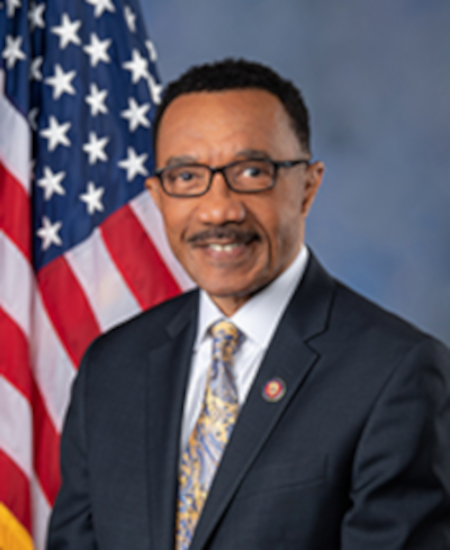
Rep. Kweisi Mfume
Sponsored bills
Willie O'Ree Congressional Gold Medal Act This bill provides for the award of a Congressional Gold Medal to Willie O'Ree or, if unavailable, to a member of his family, in recognition of his contributions and commitment to hockey, inclusion, and recreational opportunity.
This bill requires the Joint Committee on the Library to enter into an agreement to obtain a statue of Shirley Chisholm, the first African American woman elected to Congress. The committee shall place the statue in a permanent public location in the U.S. Capitol.
Delivering Envelopes Judiciously On-time Year-round Act or the DEJOY Act This bill requires the U.S. Postal Service (USPS) to maintain the service standards for first-class mail that were in effect on January 1, 2021. The Postmaster General proposed in March 2021 a 10-year restructuring plan for the USPS that would lengthen the permissible mail-delivery window.
Emmett Till and Mamie Till-Mobley Congressional Gold Medal Act of 2021 This bill provides for the posthumous presentation of a Congressional Gold Medal in commemoration of Emmett Till and Mamie Till-Mobley. After the award the medal shall be given to the National Museum of African American History and Culture.
Neighborhood Homes Investment Act This bill establishes a new business-related tax credit to finance home building and rehabilitation in neighborhoods that meet certain eligibility criteria relating to poverty rates, income, and home values. The credit is limited to 35% of the lesser of the qualified development cost (i.e., the cost of construction, substantial rehabilitation, demolition, and environmental remediation of residential properties) or 80% of the national median sale price for new homes. The credit applies to single family homes containing four or fewer residential units, condominiums, or houses or apartments owned by cooperative housing corporations.
Holistic Economic Aid for Low-Income Neighborhood Growth Act of 2021 or the HEALING Act of 2021 This bill directs the Department of Housing and Urban Development (HUD) to make grants to states, local governments, Indian tribes, insular areas, and other institutions serving or owned by minorities to carry out Community Development Block Grant activities and other assistance in low- and moderate-income areas. Additionally, HUD must carry out a Civil Unrest Business Recovery Program to provide compensation to certain for-profit entities for damages from social and civil unrest during 2020 and to support business-led economic development.
Ethan's Law This bill establishes a framework to regulate the storage of firearms on residential premises at the federal, state, and tribal levels. At the federal level, the bill establishes statutory requirements for firearms on residential premises to be safely stored if a minor is likely to gain access without permission or if a resident is ineligible to possess a firearm. An individual who violates the requirements is subject to criminal penalties. A firearm stored in violation of the requirements is subject to seizure and forfeiture. At the state and tribal levels, the bill requires the Department of Justice to award grants to implement functionally identical requirements for the safe storage of firearms.
Stephanie Tubbs Jones Uterine Fibroid Research and Education Act of 2021 This bill directs the Department of Health and Human Services (HHS) to expand research on, and take other actions to address, uterine fibroids. These are muscular tumors that grow in the wall of the uterus and may cause pain, heavy menstrual bleeding, and reproductive issues. In coordination with the National Institutes of Health and appropriate federal agencies, HHS must undertake research activities on uterine fibroids. In addition, HHS must establish a database of services furnished to individuals diagnosed with uterine fibroids under Medicaid or the Children's Health Insurance Program and must develop a report on federal and state expenditures for such services. Additionally, HHS must disseminate information on uterine fibroids to the public and to health care providers, including information on the elevated risk for minority women and available treatments.
Child Care is Infrastructure Act This bill establishes grants for child care facilities and higher education loan repayment and scholarship programs for child care educators, among other provisions. The Administration for Children and Families must conduct long- and short-term assessments of child care infrastructure, including the effect of the COVID-19 (i.e., coronavirus disease 2019) pandemic on such facilities. The bill provides grants to (1) states to acquire, construct, or improve child care facilities; and (2) intermediary organizations with demonstrated experience in child care facilities financing to develop or finance child care facilities. The bill further provides for education loan repayments of up to $6,000 per year for up to five years for early childhood educators who agree to work for certain child care providers. Additionally, the bill establishes a program for institutions of higher education to award grants of up to $3,000 per academic year to individuals who are enrolled in early childhood educator programs and agree to serve in a state-licensed early learning program. Finally, the bill modifies and reauthorizes through FY2027 supports for campus-based child care for low-income parents enrolled in institutions of higher education and requires the Department of Housing and Urban Development to consider early learning facilities in planning and implementation grants under the Choice Neighborhoods Initiative.