

Veterans and Consumers Fair Credit Act This bill applies certain military consumer credit protections to all consumers. Specifically, the bill caps the interest rate on extensions of consumer credit at 36%.
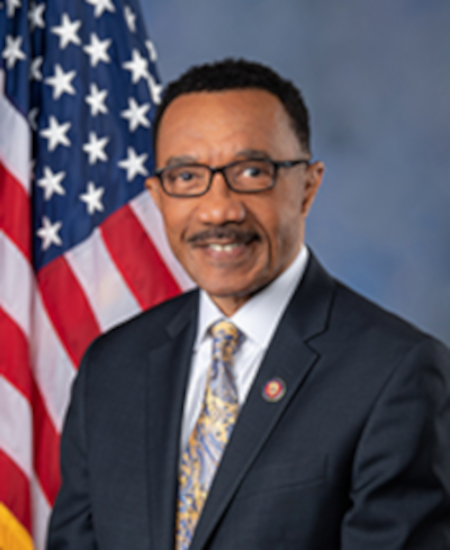
Rep. Kweisi Mfume
Sponsored bills
Protect Older Job Applicants Act of 2021 or the POJA Act of 2021 This bill prohibits employers from limiting, segregating, or classifying job applicants based on an applicant's age. It also requires the Equal Employment Opportunity Commission to study and report on claims received from job applicants involving age discrimination.
Mental Health Workforce and Language Access Act of 2021 This bill establishes within the Department of Health and Human Services (HHS) two demonstration programs to increase access to mental health services provided in languages other than English at federally qualified health centers (FQHCs). In carrying out the programs, HHS must give preference to FQHCs at which at least 20% of the patients are best served in a language other than English. First, HHS must provide National Health Service Corps (NHSC) loan repayments to mental health care providers who agree to serve their period of obligated service in an FQHC. HHS may provide enhanced payments to those who serve in an FQHC with non-English language needs. (The NHSC is a scholarship and student loan repayment program for eligible health care providers who agree to work in areas with a shortage of primary care, dental care, and mental health care providers.) Second, HHS must award grants to FQHCs for recruiting and retaining mental health care providers who are fluent in a language other than English.
Untraceable Firearms Act of 2021 This bill establishes a federal statutory framework to regulate the manufacture, sale, offer to sell, transfer, purchase, and receipt of ghost guns (i.e., guns without serial numbers). Additionally, the bill revises the federal statutory framework regulating the manufacture, possession, sale, import, shipment, delivery, receipt, and transfer of undetectable firearms. Among the revisions, the bill defines undetectable firearm as a firearm without a major component wholly made of detectable material.
Raise the Age Act This bill establishes new restrictions on the sale or transfer of certain semiautomatic firearms to individuals under 21 years of age. Specifically, this bill makes it unlawful for a licensed gun dealer, importer, manufacturer, or collector to sell or deliver a semiautomatic center-fire rifle that has (or has the capacity to accept) an ammunition feeding device with a capacity of more than five rounds to an individual who the licensee knows or has reasonable cause to believe is under age 21. The prohibition does not apply if the individual under age 21 is a full-time law enforcement officer or active-duty member of the Armed Forces. The bill also requires the Federal Bureau of Investigation to report on the operation of its public access line, including a description of information sharing protocols and recommendations for improving such protocols.
Service Education Reallocation for Vacant Elected offices Act of 2021 or the SERVE Act of 2021 This bill modifies the authority to make nominations for cadets or midshipmen to the military service academies in situations where a Member of Congress has not submitted a nomination due to death, resignation from office, or expulsion from office and no successor member has been sworn in to office. Specifically, in the event a Senator does not make a nomination for one of the specified reasons, the nominations must be made by the other Senator from the state concerned. In the event a Representative does not make a nomination for one of the specified reasons, the Senators from the state of the congressional district concerned must make the nomination, with nominations divided equally among Senators and any remainder going to the senior Senator from the state.
This resolution expresses that the House of Representatives applauds the Biden administration for reaffirming the U.S. commitment to the Paris Agreement on climate change and to our collective responsibility to globally combat climate change; encourages the Biden administration to implement measures to ensure global climate change remains a top priority for this and future administrations and to cement the United States as a global leader in the fight to mitigate its most severe consequences; voices strong commitment as legislators toward achieving the climate goals of the Paris Agreement, fulfilling the forthcoming pledges from the COP26 in Glasgow, Scotland, and advancing other international efforts to keep global warming to no more than 1.5 degrees Celsius and realize global net-zero carbon emissions by 2050 using a whole-of-government approach; and recognizes the critical responsibility of the United States and other developed nations to ensure all societies have the capabilities to transition to a clean energy economy, the resources to protect against climate-induced disasters, and the necessary assistance to endure climate-related challenges to food security, regional migration, and public health.
National Domestic Violence Prevention Action Plan Act of 2021 This bill establishes an interagency steering committee within the Department of Health and Human Services (HHS) to expand, intensify, and coordinate federal and nonfederal actions to prevent domestic violence. HHS may include nonfederal subject matter experts if necessary to carry out the committee's activities. Specifically, the committee must develop an action plan to guide a whole-of-government, goal-oriented approach to domestic violence prevention. The committee must include, as part of the plan, a national media campaign to engage with the public on matters concerning domestic violence prevention.
Social Security 2100: A Sacred Trust This bill makes changes to Social Security benefits, taxes, and other aspects of the program, including by raising the primary insurance amount, increasing the maximum taxable earnings that are subject to Social Security payroll taxes, and requiring Social Security account statements to be mailed unless the individual recipient opts for electronic delivery.
Family Violence Prevention and Services Improvement Act of 20 21 This bill modifies, expands, and reauthorizes through FY2026 the Family Violence and Prevention Services program, which funds emergency shelters and supports related assistance for victims of domestic violence. Specifically, the bill requires the Department of Health and Human Services (HHS) to award grants and enter cooperative agreements with state and tribal domestic violence coalitions, and community-based organizations, to support prevention services. Depending on the type of organization, grant recipients must use funding to (1) provide technical assistance; (2) promote evidence-informed prevention strategies; (3) implement coordinated, community responses to reduce risk factors for family violence; and (4) develop prevention partnership strategies. Further, HHS must award specified grants to organizations that provide population-specific services in underserved communities and to community-based organizations that provide culturally specific domestic violence services to racial and ethnic minority groups. The bill also establishes a grants program for tribal domestic violence coalitions to support the provision of local, tribal, family domestic or dating violence services and requires HHS to award a grant for the administration of a hotline dedicated to serving Indians affected by domestic violence. In addition, the bill modifies certain program-wide definitions; changes the requirements for specified grant applications, eligibility criteria, and use of funds; and makes other technical revisions.