

Maddy summaryThis bill requires the Bureau of Prisons to help federal prisoners obtain essential identification documents before release. It directly affects U.S. citizen prisoners (who need social security cards and proof of citizenship) and certain noncitizen prisoners (who need proof of lawful status and work authorization). The Bureau must provide photo ID cards meeting REAL ID standards, assist in obtaining missing documents (like birth certificates or passports for citizens, or immigration forms for noncitizens), and offer written explanations if documents cannot be secured. For direct-release prisoners, it also mandates probation officers to help develop release plans prior to release.
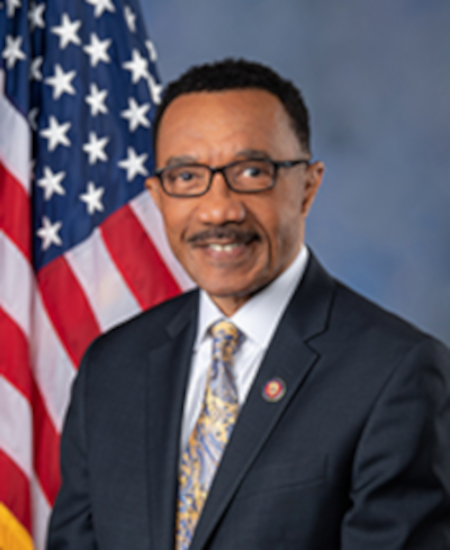
Rep. Kweisi Mfume
Sponsored bills
Raise the Age Act of 2023 This bill establishes new restrictions on the sale or transfer of certain semiautomatic firearms to individuals under 21 years of age. Specifically, this bill makes it unlawful for a licensed gun dealer, importer, manufacturer, or collector to sell or deliver a semiautomatic center-fire rifle or semiautomatic center-fire shotgun that has (or has the capacity to accept) an ammunition feeding device with a capacity of more than five rounds to an individual who the licensee knows or has reasonable cause to believe is under age 21. The prohibition does not apply if the individual under age 21 is a full-time law enforcement officer or active-duty member of the Armed Forces. The bill also requires the Federal Bureau of Investigation to report on the operation of its public access line, including a description of information sharing protocols and recommendations for improving such protocols.
Maddy summaryHR 2370, the Access to AEDs Act, authorizes $25 million in federal funding (2024-2028) to help public elementary and secondary schools improve access to automated external defibrillators (AEDs) and CPR training. The bill directs the Secretary of Health and Human Services to award grants to school districts and partners for developing AED programs, training staff and students, purchasing and maintaining AEDs, and creating cardiac emergency response plans. It specifically targets schools to address sudden cardiac arrest (SCA), which is a leading cause of death among student athletes and youth, with 90% of SCA victims dying without immediate CPR and defibrillation. The law requires grantees to report on their activities and establishes a clearinghouse to collect data on school AED access and costs.
Maddy summaryThe School Shooting Safety and Preparedness Act (HR 2869) requires the U.S. Department of Education to publish an annual report on school crime and safety, including detailed data on every school shooting incident. The report must track the number of shootings, whether they were mass incidents, the age, race, and gender of victims and shooters, firearm details, how incidents ended, and safety measures like security protocols or emergency plans in place at the school. This applies to all schools defined by the bill, including elementary, secondary, and higher education institutions. The law also mandates collecting historical data on shootings before the bill's enactment to provide a comprehensive national record.
Maddy summaryThe Young Americans Financial Literacy Act would create federal grants to fund centers of excellence that develop and deliver research-based financial education programs for young people aged 8-24. These programs would teach essential money management skills like budgeting, saving, debt management, and financial decision-making, with a focus on accessibility through digital and traditional methods. The bill authorizes $27.5 million to $55 million annually (through 2025) for these centers, prioritizing programs serving at-risk youth, families, and communities facing financial challenges. Centers must use evidence-based approaches, address unique needs (e.g., student loans, predatory lending), and report annually to Congress on their outcomes.
Maddy summaryThe Water Affordability, Transparency, Equity, and Reliability Act of 2023 establishes a new trust fund funded by increasing the corporate tax rate from 21% to 24.5% to support water infrastructure and affordability programs. It allocates funds to clean water programs (42%), safe drinking water funding (42.5%), household water wells (1%), colonias assistance (0.5%), Indian health services (3%), and water operator job training (0.5%). The bill requires the EPA to conduct a study and submit a report on water affordability, discrimination in water services, public participation in regionalization, and data collection related to service disconnections. It includes specific provisions for colonias, household water wells, and job training programs for water system operators to improve water access and equity.
Maddy summaryThis bill establishes a comprehensive framework to address environmental justice by requiring federal agencies to identify and address disproportionately adverse environmental and health effects on communities of color, low-income communities, and Tribal and Indigenous communities. It creates a White House Environmental Justice Interagency Council to coordinate federal efforts, mandates that agencies develop environmental justice strategies, and requires consideration of cumulative impacts in permitting decisions for pollution sources. The bill also establishes grant programs for environmental justice communities, creates training requirements for federal employees, and includes specific provisions for safer cosmetics and economic revitalization in fossil fuel-dependent communities. These provisions aim to ensure fair treatment and meaningful involvement of all people in environmental decision-making processes, directly affecting federal agencies and communities disproportionately burdened by environmental hazards.
Maddy summaryHR 2777, the School Meals during School Closures Act, allows schools to continue providing meals during certain closures without following standard meal program rules. It directly affects schools and meal providers by enabling the Secretary to waive requirements under the National School Lunch Act for closures due to strikes (excluding employer lockouts), weather disasters, public health emergencies, unsafe facilities, construction, or other unanticipated events. The key provision creates a new waiver exception (added to Section 12 of the Act) that skips specific regulatory hurdles normally required for meal services during these closures. This change ensures students can still receive meals when schools close unexpectedly for covered reasons.
Maddy summaryHR 2725, the "Do No Harm Act," amends the Religious Freedom Restoration Act (RFRA) to clarify that RFRA does not apply when federal laws protect against discrimination or promote equal opportunity. It specifically exempts protections under the Civil Rights Act, Americans with Disabilities Act, workplace benefits like leave, child labor safeguards, and healthcare access from RFRA challenges. The bill also clarifies that RFRA does not block private lawsuits between individuals, applying only to cases involving government entities. This amendment ensures that existing federal civil rights and workplace protections remain enforceable under RFRA.
Maddy summaryThe Latonya Reeves Freedom Act of 2023 strengthens the Americans with Disabilities Act's requirement that individuals with disabilities receive long-term services and supports in community settings rather than institutions. It defines "community-based" services to include specific housing options where individuals with disabilities can live independently with maximum control over their lives, including access to integrated housing, employment, and community participation. The bill requires states to develop transition plans to move people from institutional settings to community-based services within 12 years, with measurable annual targets for reducing institutionalization. It establishes enforcement mechanisms through the Department of Justice and Department of Health and Human Services to ensure compliance with these requirements.