

This resolution acknowledges the importance of the U.S.-Egypt partnership and Egypt's role in the fight against terrorism and violent extremism. It also urges the Egyptian government to (1) enact serious and legitimate reforms to ensure that Coptic Christians have the same rights and opportunities as other Egyptian citizens, (2) complete the process of church certification, and (3) take steps to end the culture of impunity for attacks on Christians.
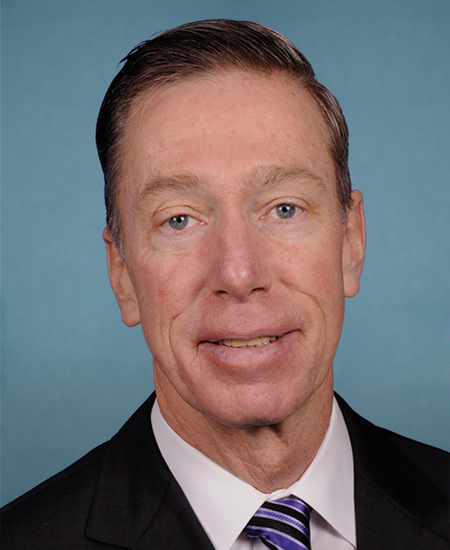
Rep. Stephen F. Lynch
Sponsored bills
Robust International Response to Pandemic Act This bill requires the Department of the Treasury and each U.S. Executive Director at an international financial institution to take certain actions in support of the global response to COVID-19 (i.e., coronavirus disease 2019). Specifically, each U.S. Executive Director at an international financial institution (e.g., the International Bank for Reconstruction and Development or the International Finance Corporation) must seek the suspension of debt service payments to the institution and the relaxation of fiscal targets for certain programs, oppose programs or loan agreements that would reduce countries' health care spending or other spending related to their responses to COVID-19, and require approval of all Special Drawing Rights (a currency support tool) allocation transfers from wealthier member countries to countries that are emerging or developing to ensure the allocations are used for the public good and in response to the global pandemic. Further, the U.S. Governor at the International Monetary Fund (IMF) must advocate for the issuance of Special Drawing Rights so that governments may access additional resources to finance their responses to COVID-19. Of these Special Drawing Rights allocated to the United States, Treasury must lend a specified amount to the Poverty Reduction and Growth Trust or other special purpose vehicle of the IMF to help eligible low-income countries respond to COVID-19. Treasury must also advocate for an extension of the current moratorium on debt service payments to official bilateral creditors by the world's poorest countries.
Law Enforcement Officers Equity Act This bill expands the definition of law enforcement officer under provisions of the Federal Employees Retirement System (FERS) and the Civil Service Retirement System (CSRS). Specifically, the bill expands the definition to include (1) federal employees whose duties encompass the investigation or apprehension of suspected or convicted criminals and who are authorized to carry a firearm; (2) Internal Revenue Service employees whose duties are primarily the collection of delinquent taxes and the securing of delinquent returns; (3) U.S. Postal Inspection Service employees; (4) Department of Veterans Affairs police officers; and (5) certain U.S. Customs and Border Protection employees who are seized-property specialists with duties relating to custody, management, and disposition of seized and forfeited property. The bill deems service performed by an incumbent law enforcement officer on or after the enactment date of this bill to be service performed as a law enforcement officer for retirement purposes. The past service of such incumbents shall be treated as service performed by a law enforcement officer for retirement purposes only if a written election is submitted to the Office of Personnel Management within five years after the enactment of this bill or before separation from government service, whichever is earlier. An incumbent who makes an election before the enactment of this bill may pay a deposit into the Civil Service Retirement and Disability Fund to cover prior service. A law enforcement officer shall not be subject to mandatory separation during the three-year period beginning on the enactment of this bill.
"Six Triple Eight" Congressional Gold Medal Act of 2021 This bill directs the Speaker of the House of Representatives and the President pro tempore of the Senate to arrange for the award of a Congressional Gold Medal in honor of the women of the 6888th Central Postal Directory Battalion (commonly known as the Six Triple Eight) in recognition of their pioneering military service, devotion to duty, and contributions to increase the morale of personnel stationed in the European theater of operations during World War II. The medal shall be given to the Smithsonian Institution and made available for display and research.
Horse Transportation Safety Act of 20 21 This bill prohibits a person from transporting a horse in interstate commerce in a motor vehicle (except a vehicle operated exclusively on rail or rails) containing two or more levels stacked on top of one another. The bill prescribes civil penalties for knowing violations of such prohibition.
Saracini Enhanced Aviation Safety Act of 20 21 This bill requires the Federal Aviation Administration to issue an order requiring installation of a secondary cockpit barrier on commercial passenger aircraft.
This resolution expresses the sense of the House of Representatives that U.S. Postal Service employees are frontline essential workers and must be prioritized accordingly for purposes of COVID-19 (i.e., coronavirus disease 2019) vaccine distributions.
American Family Act of 2021 This bill modifies the child tax credit to (1) make the credit fully refundable, (2) increase the amount of the credit and allow an additional credit for children who are under six years of age, (3) require the amount of the credit to be adjusted annually for inflation, and (4) require the Department of the Treasury to establish a program for making advance payments of the credit on a monthly basis.
This resolution expresses the sense of the House of Representatives that the U.S. Postal Service should continue door delivery for all customers.
Gym Mitigation and Survival Act of 2021 or the GYMS Act of 2021 This bill establishes a grant program to provide economic support to eligible fitness facilities in response to the COVID-19 (i.e., coronavirus disease 2019) pandemic. Specifically, the bill authorizes the Small Business Administration to make initial and supplemental grants to privately owned fitness facilities that primarily provide health or fitness services and that do not offer golf, hunting, sailing, or riding facilities. The total amount of grant funds for a recipient may not exceed $25 million, and the recipient must use these funds for payroll costs, rent or mortgage obligations, and other ordinary and necessary business expenses.