

Veteran Families Health Services Act of 2021 This bill addresses fertility treatments, counseling, and other health-related programs for veterans and members of the Armed Forces. Specifically, the bill requires the Department of Defense (DOD) and the Department of Veterans Affairs (VA) to provide fertility treatments and counseling to covered veterans and active duty service members or a spouse, partner, or gestational surrogate of such veteran or service member. A covered veteran or service member is a former or current member of the Armed Forces who has an infertility condition, unless it is demonstrable that the individual was completely infertile prior to serving in the Armed Forces. In the case of in vitro fertilization treatment, DOD and the VA may not furnish more than three completed cycles or six attempted cycles, whichever occurs first. DOD must establish procedures related to gamete retrieval and storage. Additionally, DOD must provide service members with the opportunity to cryopreserve and store their gametes prior to deployment to a combat zone or a hazardous duty assignment. DOD and the VA must share best practices and facilitate referrals for the furnishing of fertility treatment and counseling to eligible individuals. Fertility counseling and treatment are included within authorized VA medical services. The VA may pay the adoption expenses (for up to three adoptions) for a covered member who is enrolled in the VA health care system. The VA must facilitate specified reproduction and infertility research conducted collaboratively by DOD and the Department of Health and Human Services.
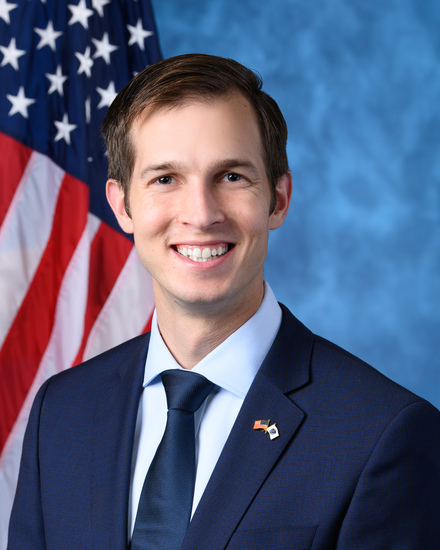
Rep. Jake Auchincloss
Sponsored bills
Cancer Patient Equity Act of 2021 This bill provides for coverage of certain cancer diagnostic and laboratory tests under Medicare, Medicaid, and the Children's Health Insurance Program (CHIP). Specifically, the bill provides for coverage of microarray analysis, DNA and RNA sequencing, whole-exome sequencing, and other next-generation sequencing for individuals diagnosed with cancer. Additionally, the Department of Health and Human Services must establish an education and awareness program for physicians and the public about genomic testing and the role of genetic counselors.
We Need Eviction Data Now Act of 2021 This bill requires the Department of Housing and Urban Development (HUD) to establish and maintain a national eviction database. The database must contain eviction data compiled annually by state courts. HUD must award grants to local governments and nonprofit organizations to collect data from landlords on illegal self-help evictions for inclusion in the database. The bill also requires HUD to establish an advisory committee on eviction research.
Securing the Rights our Veterans Earned Act or the SERVE Act This bill provides eligibility for specified Department of Veterans Affairs benefits to former members of the Armed Forces who were separated or discharged (honorably or otherwise) by reason of sexual orientation or gender identity.
Gun Safety Board and Research Act This bill establishes a gun safety board in the Department of Health and Human Services. The board must (1) conduct original research about firearm violence reduction; (2) publish policy recommendations for and findings about the efficacy of federal, state, and local actions to reduce firearm violence; and (3) establish a grant program to support original research on firearm violence reduction and education for the public about the effects of and ways to mitigate firearm violence.
Streamlining Nutrition Assistance Paperwork Act of 2021 or the SNAP Act of 2021 This bill provides statutory authority for a Department of Agriculture (USDA) waiver that allows states to use a written record to document telephonic signatures for Supplemental Nutrition Assistance Program (SNAP) applications. Under current law, states may allow individuals to sign their SNAP applications over the telephone, but states must preserve audio recordings of those telephonic signatures. During the COVID-19 emergency, USDA waived the requirement to preserve the audio recording and allowed states to document the telephonic signatures through written records.
John R. Lewis Voting Rights Advancement Act of 2021 This bill establishes new criteria for determining which states and political subdivisions must obtain preclearance before changes to voting practices may take effect. Preclearance is the process of receiving preapproval from the Department of Justice (DOJ) or the U.S. District Court for the District of Columbia before making legal changes that would affect voting rights. A state and all of its political subdivisions shall be subject to preclearance of voting practice changes for a 10-year period if 15 or more voting rights violations occurred in the state during the previous 25 years; 10 or more violations occurred during the previous 25 years, at least 1 of which was committed by the state itself; or 3 or more violations occurred during the previous 25 years and the state administers the elections. A political subdivision as a separate unit shall also be subject to preclearance for a 10-year period if three or more voting rights violations occurred there during the previous 25 years. States and political subdivisions that meet certain thresholds regarding minority groups must preclear covered practices before implementation, such as changes to methods of election and redistricting. Further, states and political subdivisions must notify the public of changes to voting practices. Next, the bill authorizes DOJ to require states or political subdivisions to provide certain documents or answers to questions for enforcing voting rights. The bill also outlines factors courts must consider when hearing challenges to voting practices, such as the extent of any history of official voting discrimination in the state or political subdivision.
Collaborate in an Orderly and Cohesive Manner Act This bill requires the Department of Health and Human Services (HHS) to award grants for implementing and evaluating specified models of care that integrate the delivery of behavioral health and primary care services. Specifically, HHS must award grants to primary care providers for the initial costs (e.g., hiring staff) of implementing such models. In awarding the grants, HHS must prioritize recipients that provide care to medically underserved populations and in areas where the prevalence of behavioral health conditions exceeds the national average. HHS must also provide additional incentive payments to recipients that use appropriate billing codes and quality measures for behavioral health services. In addition, HHS must award grants to national and regional organizations for providing technical assistance to health care providers and systems to improve implementation of integrated behavioral health and primary care models. Furthermore, HHS may direct its agencies to expand efforts to evaluate current and emerging integrated behavioral health and primary care models.
This resolution calls on all Americans to observe the 20th anniversary of the September 11 attacks and honor those who lost their lives.
Working Dog Commemorative Coin Act This bill directs the Department of the Treasury to mint and issue 50,000 $5 gold coins, 500,000 $1 silver coins, and 750,000 half-dollar clad coins in commemoration of the service that working dogs provide to society. The designs of the coins minted under this bill shall be emblematic of the contributions of working dogs to society, including in detection, military service, therapy and assistance. Treasury may issue coins only during the one-year period beginning on January 1, 2023. All sales of coins shall include a surcharge, which shall be paid to America's VetDogs for general expenses associated with the fulfillment of its mission.