

Presidential Tax Filings and Audit Transparency Act of 2022 This bill requires the Internal Revenue Service (IRS) to conduct an examination to determine the correctness of a Presidential income tax return as rapidly as practicable after it is filed. The IRS must disclose and make publicly available (on the internet) an initial report, periodic reports, and a final report on the examination of such tax returns. The final report must include the date on which the IRS examination of the return was completed, a list of audit materials, and a description of each proposed adjustment to a return and any controversy relating to its examination. This disclosure of tax return information is an exception to the general rule of confidentiality of taxpayer returns. The bill provides criteria for approving a request for an extension of the filing of a tax return and for failing to file a return within the required time period. The bill defines Presidential income tax return as any relevant income tax return of (1) a president while the president is in office, (2) the spouse of a president, (3) a corporation or partnership controlled by a president or a president's spouse, and (4) the estate of a president or a president's spouse.
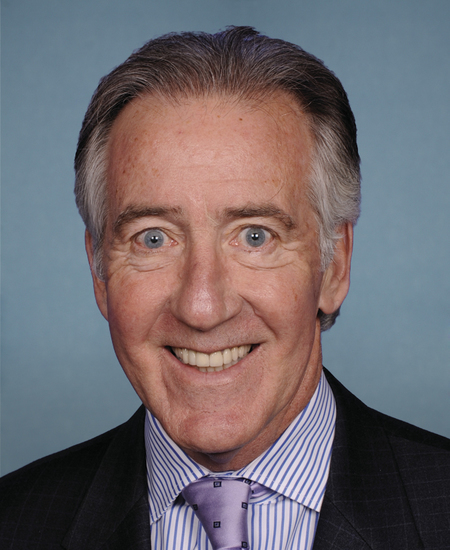
Rep. Richard E. Neal
Sponsored bills
This act directs the Speaker of the House of Representatives and the President pro tempore of the Senate to arrange for the posthumous award of a Congressional Gold Medal to commemorate Glen Doherty, Tyrone Woods, J. Christopher Stevens, and Sean Smith, four Americans killed in the September 11, 2012, attack on the U.S. consulate in Benghazi, Libya. (Stevens was the U.S. Ambassador to Libya at the time, Smith was an officer in the Foreign Service, and Doherty and Woods were both government contractors and former Navy SEALs.) After the medal has been awarded, it shall be given to the Central Intelligence Agency Museum.
Fair and Open Skies Act This bill prohibits the Department of Transportation (DOT) from issuing a foreign air carrier permit or an exemption from certain air carrier certificate requirements under the United States-European Union Air Transport Agreement of April 2007, unless DOT finds that issuing the permit or exemption would be consistent with Article 17 bis of the agreement, which provides that opportunities created by the agreement do not undermine labor standards or the labor-related rights and principles contained in the laws of the respective parties to the agreement; and imposes conditions on the permit or exemption necessary to ensure compliance with Article 17 bis . The bill modifies policy considerations relating to air carrier certificates to require DOT to consider preventing entry into U.S. markets by flag of convenience carriers (i.e., foreign air carriers established in a country other the home country of their majority owner in order to avoid regulations of the home country) and preventing the undermining of labor standards. In carrying out such air carrier certificate requirements, DOT must consider preventing entry of flag of convenience carriers into U.S. markets as being in the public interest and consistent with public convenience and necessity for safety in air transportation and air commerce. In formulating U.S. international air transportation policy relating to the elimination of discrimination and unfair competition, the Department of State and DOT must include in their considerations the undermining of labor standards.
Big Cat Public Safety Act This act revises requirements governing the trade of big cats (i.e., species of lion, tiger, leopard, cheetah, jaguar, or cougar or any hybrid of such species) under the Lacey Act to limit the possession, breeding, and exhibition of big cats. The Lacey Act prohibits any person from importing, exporting, buying, selling, transporting, receiving, or acquiring big cats across state lines or the U.S. border. However, some exemptions are provided for certain entities, such as universities and wildlife sanctuaries. (Sec. 3) The act expands the Lacey Act prohibitions to include a prohibition on possessing or breeding big cats. Breeding means facilitating propagation or reproduction (whether intentionally or negligently), or failing to prevent propagation or reproduction. Owners of big cats that were born before this act's enactment may keep their big cats, but the owners must register them with the U.S. Fish and Wildlife Service. The act modifies the list of entities that are exempt from prohibitions to export, buy, sell, transport, receive, acquire, possess, or breed big cats. The modified list includes exemptions for entities or facilities exhibiting animals to the public if they (1) hold a Class C license in good standing under the Animal Welfare Act, and (2) do not allow individuals to come into direct physical contact with big cats. However, direct contact is allowed if the individual is a trained professional, a veterinarian, or directly supporting conservation programs that do not involve commercial activities and meet other specified restrictions. (Sec. 4) A person who knowingly violates the act must be fined not more than $20,000, or imprisoned for no more than five years, or both. The act considers each violation to be a separate offense. The offense must be deemed to have been committed not only in the district where the violation first occurred, but also in any district in which the defendant may have taken or been in possession of the prohibited wildlife species. (Sec. 5) The act extends forfeiture provisions to fish, wildlife, or plants that are bred or possessed; thus, big cats bred or possessed in violation of the act are subject to forfeiture. (Sec. 6) The Department of the Interior must issue regulations to implement this act.
Puerto Rico Status Act This bill provides for a plebiscite to be held on November 5, 2023, to resolve Puerto Rico's political status. Specifically, such plebiscite shall offer eligible voters a choice of independence, sovereignty in free association with the United States, or statehood. The Puerto Rico State Elections Commission shall carry out a nonpartisan voter education campaign through traditional paid media and make available at all voting locations voter education materials related to the plebiscites, and invite national and international election observers to ensure transparency and confidence in the electoral process. All voter educational materials and ballots used to carry out this bill shall be made available in English and Spanish. The bill sets forth transition and implementation provisions for each choice offered in the plebiscite.
Respect for Marriage Act This act provides statutory authority for same-sex and interracial marriages. Specifically, the act replaces provisions that define, for purposes of federal law, marriage as between a man and a woman and spouse as a person of the opposite sex with provisions that recognize any marriage between two individuals that is valid under state law. (The Supreme Court held that the current provisions were unconstitutional in United States v. Windsor in 2013.) The act also replaces provisions that do not require states to recognize same-sex marriages from other states with provisions that prohibit the denial of full faith and credit or any right or claim relating to out-of-state marriages on the basis of sex, race, ethnicity, or national origin. (The Supreme Court held that state laws barring same-sex marriages were unconstitutional in Obergefell v. Hodges in 2015; the Court held that state laws barring interracial marriages were unconstitutional in Loving v. Virginia in 1967.) The act allows the Department of Justice to bring a civil action and establishes a private right of action for violations. The act does not (1) affect religious liberties or conscience protections that are available under the Constitution or federal law, (2) require religious organizations to provide goods or services to formally recognize or celebrate a marriage, (3) affect any benefits or rights that do not arise from a marriage, or (4) recognize under federal law any marriage between more than two individuals.
The Jackie Walorski Maternal and Child Home Visiting Reauthorization Act of 2022 This bill reauthorizes through FY2027, increases funding for, and modifies the Maternal, Infant, and Early Childhood Home Visiting Program. This program supports home visits for expectant and new parents who live in communities that are at-risk for poor maternal and child health outcomes. Changes to the program include setting out requirements for allocating program funds; increasing the percentage of funds reserved for tribal entities; establishing a publicly available dashboard that reports program outcomes; requiring activities to reduce unnecessary data collection, reporting, and other administrative requirements of the program; and allowing for virtual home visits (provided certain conditions are met). The bill also reduces funding for the Medicare Improvement Fund.
Commitment to Veteran Support and Outreach Act This bill authorizes the Department of Veterans Affairs (VA) to provide grants to states and Indian tribes to implement programs that improve outreach and assistance to veterans and their families to ensure that such individuals are fully informed about veterans' benefits and programs. Specifically, the VA may provide grants to states and tribes to (1) implement or enhance outreach activities; (2) increase the number of county or tribal veterans service officers in the state or tribe; or (3) expand, implement, or otherwise enhance existing programs and services of the existing state or tribal organization that is recognized by the VA in the preparation, presentation, and prosecution of claims for veterans benefits through representatives who hold positions as county or tribal veterans service officers. The VA must prioritize awarding grants in areas with a critical shortage of county or tribal veterans service officers, areas with high rates of suicide among veterans, and areas with high rates of referrals to the Veterans Crisis Line. The bill also extends certain loan fee rates through February 10, 2031, under the VA's home loan program. During FY2024-FY2028, the VA is authorized to hire two or more additional full-time equivalent employees in the VA's Office of General Counsel to carry out duties under the accreditation, discipline, and fees program.
Prevent All Soring Tactics Act of 2022 or the PAST Act of 2022 This bill addresses the practice of soring horses. The soring of horses includes various actions taken on horses' limbs to produce higher gaits that may cause pain, distress, inflammation, or lameness. Specifically, the bill expands soring regulation and enforcement at horse shows, exhibitions, sales, and auctions, including by establishing a new system for inspecting horses for soring. In addition, the bill increases penalties for violations.
Maddy summaryHRES 566 is a resolution passed by the U.S. House of Representatives to commemorate the 80th anniversary of the Civil Air Patrol (CAP). The resolution recognizes CAP's 80 years of service, including its roles in disaster response (such as Hurricane Katrina, the Deepwater Horizon spill, and the COVID-19 pandemic), search and rescue operations, support for the U.S. Air Force, and youth aviation education programs. It honors CAP's contributions as a volunteer organization with over 10,000 trained members and assets like 560 aircraft, which have impacted millions of Americans through community support and emergency services.