

Maddy summaryThis bill amends the E-Verify system (used by employers to check immigration status) to strengthen data privacy and address wrongful job losses. It prohibits E-Verify from collecting or storing sensitive personal data like race, religion, genetic information, biometrics, or health records, and requires an annual DHS Inspector General report to monitor compliance. Employers may temporarily hire workers they believe were wrongly rejected by E-Verify for up to 180 days, but must notify the government, and must terminate if the rejection was confirmed valid. Individuals wrongfully denied jobs or fired due to E-Verify errors can seek compensation through specific legal channels (28 U.S.C. Chapter 171) but cannot file class-action lawsuits.
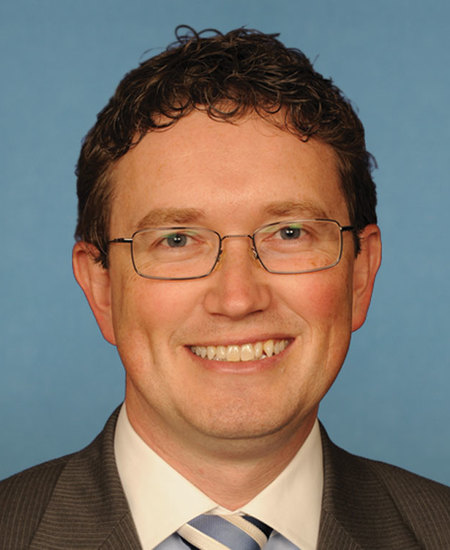
Rep. Thomas Massie
Sponsored bills
Maddy summaryHJRES 44 is a congressional resolution seeking to block a 2021 rule by the Bureau of Alcohol, Tobacco, Firearms, and Explosives (ATF). The rule classified firearms with stabilizing braces as "short-barreled rifles," which would have required additional licensing and regulation. This resolution uses a specific legal process (under Title 5, U.S. Code) to formally disapprove the ATF rule, meaning the rule would no longer be in effect. It directly affects firearm owners, manufacturers, and dealers who would have been subject to the rule’s requirements.
Maddy summaryHR 277 would require Congress to approve major federal regulations before they take effect. Major rules are defined as those with significant economic impact ($100 million+ annually), major cost increases for consumers or industries, or significant adverse effects on competition, employment, or innovation. Agencies must submit detailed information about these rules to Congress, including cost-benefit analyses, before they can take effect. Congress would have 70 session days to approve the rule with a joint resolution; if they don't act within that timeframe, the rule would not take effect. This would increase congressional oversight of federal regulations and require more detailed information about proposed rules before they become law.
Maddy summaryHRES 495 is a procedural resolution that sets rules for the House to debate and vote on five specific bills and resolutions. It enables consideration of: H.J. Res. 44 (disapproving a firearms rule), H.R. 277 (requiring congressional approval for major agency rules), H.R. 288 (clarifying judicial review of agency rules), H.R. 1615 (blocking federal funding for gas stove bans), and H.R. 1640 (stopping an energy efficiency rule for cooking products). The resolution waives most objections and limits debate time to facilitate voting on these items. It does not change policy itself but streamlines the process for the House to address these specific legislative proposals.
Maddy summaryHRES 463 is a procedural resolution that allows the House of Representatives to debate and vote on four separate bills. It enables consideration of H.R. 277 (requiring congressional approval for major executive branch rules), H.R. 288 (clarifying judicial review of agency interpretations), H.R. 1615 (banning federal funding for gas stove bans), and H.R. 1640 (blocking a specific energy efficiency rule for cooking appliances). The resolution streamlines the process by waiving points of order, limiting debate time, and setting rules for amendments. It does not change policy itself but facilitates the legislative process for these four bills.
Maddy summaryHR 3712, the Digital Dollar Pilot Prevention Act, prohibits the Federal Reserve from testing or implementing a digital dollar without new congressional approval. The bill amends the Federal Reserve Act to explicitly block the Fed and its banks from launching any pilot program for a central bank digital currency (a digital form of U.S. dollars issued directly by the Federal Reserve) or partnering with private entities for such testing. This directly affects the Federal Reserve System, preventing it from moving forward with any digital dollar initiatives until Congress passes a separate law authorizing them. The law aims to halt potential development of a Fed-issued digital currency until lawmakers address its implications through new legislation.
Processing Revival and Intrastate Meat Exemption Act or the PRIME Act This bill exempts from federal inspection requirements animals and meats that are slaughtered and prepared at custom animal slaughter facilities for distribution within the state. Under current law, a custom slaughter exemption applies if the meat is slaughtered exclusively for personal, household, guest, or employee uses. Specifically, the bill expands the federal inspection exemption to include the slaughter of animals or the preparation of carcasses, meat, and meat food products that are slaughtered and prepared at a custom slaughter facility in accordance with the laws of the state where the facility is located; and prepared exclusively for distribution to household consumers in the state or restaurants, hotels, boarding houses, grocery stores, or other establishments in the state that either prepare meals served directly to consumers or offer meat and food products for sale directly to consumers in the state. The bill does not preempt any state law concerning (1) the slaughter of animals or the preparation of carcasses, meat, and meat food products at a custom slaughter facility; or (2) the sale of meat or meat food products.
Direct Capital Access Act of 2023 or the DCA Act of 2023 This bill increases the number of daily round-trip flights allowed at Ronald Reagan Washington National Airport (DCA). Specifically, this bill adds 56 new slots at DCA to allow for 28 additional daily round-trip flights. (Airlines flying to and from DCA are subject to slot and perimeter rules set by federal law and regulation. The slot rules determine the total number of flight slots that can be handled in a given time period. In addition, a statutory perimeter rule limits nonstop flights to a 1,250-mile radius unless they are granted an exemption in law.) Current law limits DCA to a maximum of 67 hourly slots for flights both within- and beyond-perimeter; a round-trip flight serving DCA requires two slots (or a slot pair). Of those slots, 40 daily slots are exempt from the perimeter rule. Under the bill's slot increase, operations at DCA may not increase by more than eight flights per hour.
Maddy summaryThis bill requires the Pentagon to obtain a clean audit of its finances. If the Department of Defense fails to get an unqualified audit (a "clean" opinion) for a department or agency, it triggers automatic spending cuts: 0.5% in the first year of failure and 1.0% in subsequent years. These cuts apply broadly across programs but exclude military personnel, National Guard, reserve forces, and the Defense Health Program. The President may temporarily waive cuts for national security reasons, but must justify the waiver to Congress. The goal is to link defense spending to financial accountability, using existing audit standards.
Maddy summaryHJRES 27 is a congressional resolution seeking to block a federal rule that redefined which waterways fall under the Clean Water Act's protections. It targets a rule submitted by the Army Corps of Engineers, Department of Defense, and Environmental Protection Agency (EPA) on January 18, 2023, which aimed to revise the "Waters of the United States" definition. The resolution would formally disapprove this rule under a specific federal procedure (Chapter 8 of Title 5), preventing it from taking effect. This would directly affect how federal agencies regulate pollution and development near water bodies, including wetlands and smaller streams.