

Recovering America’s Wildlife Act of 2022 This bill provides funding for the conservation or restoration of wildlife and plant species of greatest conservation need, including endangered or threatened species, and establishes related requirements. TITLE I--WILDLIFE CONSERVATION AND RESTORATION (Sec. 101) This title establishes and funds a subaccount of the Wildlife Conservation and Restoration Account, which was established under the Pittman-Robertson Wildlife Restoration Act. The subaccount must be used to support efforts of states, territories, or the District of Columbia to recover and manage wildlife and plant species of greatest conservation need. The Department of the Interior must use a portion of the funding from the subaccount for grants to state fish and wildlife departments, the District of Columbia fish and wildlife department, fish and wildlife departments of territories, nonprofit organizations, or regional associations of fish and wildlife departments. The grants must be used for innovative recovery efforts for species of greatest conservation need, species listed as endangered or threatened species, or the habitats of such species. Funding for the subaccount must supplement existing funds available to the states from funds distributed under the Dingell-Johnson Sport Fish Restoration Act and the Wildlife Conservation and Restoration Account. Recipients of the funding from the subaccount must match federal funds as specified by the title. The Government Accountability Office must study and report on the progress of states, territories, the District of Columbia, and Indian tribes in protecting species of greatest conservation need, endangered species, and threatened species. TITLE II--TRIBAL WILDLIFE CONSERVATION AND RESTORATION (Sec. 201) This title establishes and funds a Tribal Wildlife Conservation and Restoration Account to support Indian tribes' efforts to recover and manage wildlife and plant species of greatest conservation need. Indian tribes are not required to provide matching funds. TITLE III--ENDANGERED SPECIES RECOVERY AND HABITAT CONSERVATION LEGACY FUND (Sec. 301) This title establishes and funds through FY2026 the Endangered Species Recovery and Habitat Conservation Legacy Fund. The U.S. Fish and Wildlife Service must use the fund to (1) implement an Endangered Species Recovery Grant Program; (2) address its interagency consultation responsibilities under the Endangered Species Act of 1973; (3) work with nonfederal entities to conserve wildlife habitat and at-risk species, threatened or endangered species, or species proposed to be listed as threatened or endangered species; or (4) address the development and permitting of voluntary conservation agreements under such act. Amounts made available under the fund must supplement other federal amounts made available to carry out such activities. The President must annually submit to Congress, together with the annual budget of the United States, a list of threatened species and endangered species for which recovery plans will be developed or implemented with amounts from the Endangered Species Recovery and Habitat Conservation Legacy Fund. TITLE IV--REPORT (Sec. 401) Interior must also report on information concerning the amount of grants and contracts that were awarded or are allocated under this bill to Historically Black Colleges and Universities, Hispanic-serving educational institutions, tribally controlled colleges and universities, minority-serving educational institutions, minority-owned business enterprises, women-owned business enterprises, and community-based organizations that are principally administered by, operated by, or serving minority communities.
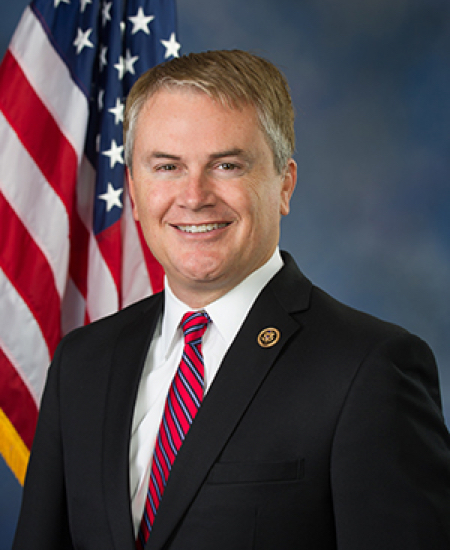
Rep. James Comer
Sponsored bills
Chase COVID Unemployment Fraud Act of 2022 This bill addresses fraud and overpayments of pandemic unemployment assistance, including by allowing states to retain a specified percentage of recovered funds and prohibiting the Department of Labor from allowing blanket waivers of overpayments.
Stopping Home Office Work's Unproductive Problems Act of 2022 or the SHOW UP Act of 2022 This bill requires each executive agency to reinstate the telework policies that were in place on December 31, 2019. Agencies may not implement expanded telework policies unless the Office of Personnel Management certifies that such policies, among other requirements, will have a positive effect on the agency's mission and operational costs.
Community Services Block Grant Modernization Act of 2022 This bill reauthorizes the Community Services Block Grant program through FY2032 and otherwise modifies the program. The program supports various antipoverty activities, primarily through formula-based allotments to states, Indian tribes, and territories. In particular, the bill makes changes to the program's administration and leadership; performance measurement; and allotments to states and territories. The bill also expands eligibility for services and activities funded by the program to 200% of the federal poverty line (FPL). Under current law, eligibility is generally set at the FPL.
Artificial Intelligence Training for the Acquisition Workforce Act or the AI Training Act This bill requires the Office of Management and Budget (OMB) to establish or otherwise provide an artificial intelligence (AI) training program for the acquisition workforce of executive agencies (e.g., those responsible for program management or logistics), with exceptions. The purpose of the program is to ensure that the workforce has knowledge of the capabilities and risks associated with AI. The OMB must (1) update the program at least every two years, and (2) ensure there is a way to understand and measure the participation of the workforce and to receive and consider feedback from program participants.
Land Between the Lakes Recreation and Heritage Act or the LBL Recreation and Heritage Act This bill addresses the administration of the Land Between the Lakes National Recreation Area in Kentucky and Tennessee. The bill decreases from 17 to 13 the number of members who compose the Land Between the Lakes Advisory Board. The bill permits members of the advisory board to serve multiple terms, but not serve consecutive terms. In addition to carrying out its current activities, the advisory board shall develop an annual work plan for recreation and environment education areas in the Recreation Area, including the heritage program, with the nonappropriated amounts in the Land Between the Lakes Management Fund; develop an annual forest management and harvest plan for the Recreation Area; and maintain the balance and status of the fund. The bill requires the advisory board to meet at least twice each year. The Department of Agriculture (USDA) shall charge (currently may charge) reasonable fees, as determined by the advisory board, for admission to and the use of the designated sites, or for activities, within the recreation area. The bill states that amounts in the fund shall be available to USDA to perform new work or deferred maintenance in the recreation area and shall not be available for the payment of salaries or other expenses. USDA, on request from a qualified resident or relative or a cemetery association, shall grant additional land for the expansion of existing cemeteries within the recreation area to allow for the burial of qualified residents or relatives.
Protection of Women and Girls in Sports Act of 2021 This bill makes it a violation of federal law for a recipient of federal funds who operates, sponsors, or facilitates athletic programs or activities to permit a person whose sex is male to participate in an athletic program or activity that is designated for women or girls. The bill specifies that sex shall be recognized based solely on a person's reproductive biology and genetics at birth.
Prescription Information Modernization Act of 2022 This bill allows health care providers to receive prescribing information for drugs electronically rather than in paper form from manufacturers.
Postal Service Reform Act of 202 2 This bill addresses the finances and operations of the U.S. Postal Service (USPS). The bill requires the Office of Personnel Management (OPM) to establish the Postal Service Health Benefits Program within the Federal Employees Health Benefits Program under which OPM may contract with carriers to offer health benefits plans for USPS employees and retirees. The bill provides for coordinated enrollment of retirees under this program and Medicare. The bill repeals the requirement that the USPS annually prepay future retirement health benefits. Additionally, the USPS may establish a program to enter into agreements with an agency of any state government, local government, or tribal government, and with other government agencies, to provide certain nonpostal products and services that reasonably contribute to the costs of the USPS and meet other specified criteria. The USPS must develop and maintain a publicly available dashboard to track service performance and must report regularly on its operations and financial condition. The Postal Regulatory Commission must annually submit to the USPS a budget of its expenses. It must also conduct a study to identify the causes and effects of postal inefficiencies relating to flats (e.g., large envelopes). The USPS Office of Inspector General shall perform oversight of the Postal Regulatory Commission.
This resolution supports the preservation of the stepped-up basis tax rule that allows recipients of inherited assets such as land, equipment, or buildings to adjust the cost basis of the assets to reflect their fair market value. The resolution opposes any efforts to impose new taxes on family farms or small businesses and recognizes the importance of generational transfers of farm and family-owned businesses.