

Maddy summaryHJRES 29 is a procedural resolution seeking congressional disapproval of a U.S. Fish and Wildlife Service (FWS) rule that designated the northern lesser prairie-chicken population as "threatened" and the southern population as "endangered" under the Endangered Species Act. If passed, this resolution would prevent the FWS rule from taking effect, meaning the southern population would not be officially listed as endangered and the northern population would not be listed as threatened. The bill directly affects landowners, ranchers, and developers in states like Texas, Oklahoma, and New Mexico where the prairie-chicken habitat overlaps with agricultural or energy development. It uses the Congressional Review Act (Chapter 8 of Title 5, U.S. Code) to block implementation of the FWS rule without changing wildlife protection laws.
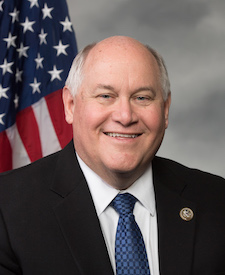
Rep. Ron Estes
Sponsored bills
Maddy summaryThis House resolution symbolically recognizes May as Jewish American Heritage Month, celebrating Jewish Americans' historical contributions to U.S. society and culture. It references rising antisemitism in 2022 (including ADL data showing a 36% increase in incidents) and includes a non-binding call for leaders to combat antisemitism. As a purely symbolic resolution, it does not create new policies or legal requirements.
Maddy summaryHR 3792 extends U.S. security funding for Israel through 2028 (Section 3) and expands energy cooperation to include advanced nuclear technologies and carbon capture (Section 5). It requires annual reports on regional security partnerships involving Israel (Section 6) and ensures countries in the Abraham Accords can access U.S. development programs (Section 8). The bill also mandates reports on diplomatic efforts against ICC investigations targeting the U.S. and Israel (Section 10) and encourages people-to-people programs to strengthen the Abraham Accords (Sections 7, 9). These provisions directly affect Israel’s diplomatic engagement, security partnerships, and economic cooperation in the Middle East.
Maddy summaryHR 3678, the Pay Less at the Pump Act, terminates the Hazardous Substance Superfund financing rate effective January 1, 2023, and changes how advances from the Superfund are repaid. Specifically, it ends the requirement to apply a specific financing rate to the Superfund after 2022 and modifies repayment rules to require quarterly payments from unobligated funds until fully repaid. The bill directly affects the Superfund program and entities receiving advances from it, altering its financial structure. Note: The bill’s title is misleading - the legislation does not address fuel prices or gasoline costs at the pump. It focuses solely on Superfund financing terms, with effective dates specified in the text.
Maddy summaryThis bill requires the Treasury Secretary to report quarterly on foreign countries imposing "extraterritorial" or "discriminatory" taxes targeting U.S. businesses. It mandates progressively higher tax rates (starting at 5% and increasing to 20% over time) on income and payments from foreign individuals and corporations in those countries. The U.S. government can also restrict federal procurement from such entities and consider these taxes in trade negotiations. These measures directly affect foreign businesses operating in the U.S. or conducting transactions with U.S. entities. The policy aims to counter foreign tax policies that the U.S. views as unfair under international tax norms.
Financing Our Energy Future Act This bill expands the types of partnerships that qualify for treatment as publicly traded partnerships instead of as corporations for tax purposes. Under current law, partnerships that meet certain gross income requirements (i.e., at least 90% of the partnership's gross income in a taxable year consists of qualifying income) are excepted from being treated as a corporation for tax purposes. This bill expands the sources of income that are considered qualifying income and make a partnership eligible for such an exception. Specifically, the bill provides that income derived from the generation of specified alternative energy, alternative fuel projects, or the associated property, storage, or transportation for such projects (e.g., the conversion of renewable biomass into renewable fuel or the storage or transportation of such fuel) is considered qualifying income.
Maddy summaryThis bill requires that AM radio receivers be included as standard equipment in all new motor vehicles (such as cars and trucks) sold in the United States, with a rule to be issued by the Department of Transportation within one year. The rule must ensure AM radio is easily accessible on the dashboard and allows manufacturers to use digital AM radio technology instead of traditional AM. During the one-year period between the bill's enactment and the rule's effective date, manufacturers must clearly label vehicles without AM radio. The bill also directs a study to evaluate whether an alternative system could deliver emergency alerts as reliably as AM radio across the country, especially during crises.
Maddy summaryHR 3337, the Fuels Parity Act, removes a prohibition that previously excluded corn starch ethanol from being counted as "advanced biofuel" under the Clean Air Act. This change directly affects corn-based ethanol producers by allowing corn starch ethanol to qualify under renewable fuel standards. The bill also requires the EPA to update its methodology for calculating greenhouse gas emissions from corn-based ethanol and biomass-based diesel every five years, starting 90 days after enactment, with the first update mandating the use of the Argonne National Laboratory's GREET model. These provisions aim to standardize how emissions are assessed for these fuels under federal renewable fuel programs.
Maddy summaryThe CERTS Tax Exemption Act (HR 3510) exempts certain grants received by transportation service providers from federal taxation under the Coronavirus Economic Relief for Transportation Services Act. It directly affects eligible transportation providers who receive these specific grants by excluding the grant amounts from their gross income and preventing related tax deductions or basis adjustments from being denied. Key provisions ensure that for partnerships and S corporations, excluded grant amounts are treated as tax-exempt income, and partner basis increases align with grant-funded costs. This creates a clear tax treatment for these grants without altering the underlying grant program.
Maddy summaryHJRES 61 is a resolution seeking to block a Department of Labor rule published in March 2023. The rule would have removed legal requirements related to religious exemptions under the Equal Opportunity Clause in federal employment regulations. If passed, this resolution would prevent the rule from taking effect, maintaining the existing requirements for religious exemptions. It uses a specific congressional disapproval process under Title 5 of the U.S. Code to stop the rule without requiring presidential action.