

Maddy summaryHR 9527, the *Protecting Our Land from Federal Overreach Act of 2024*, prohibits the federal government from using eminent domain or federal funds to acquire land for interstate electric transmission lines. It amends the Federal Power Act to block federal agencies from forcing land sales for such projects and requires states to approve permits before transmission facilities can be built or modified within their borders. Specifically, the bill eliminates federal authority to exercise eminent domain for these facilities and mandates that the Federal Energy Regulatory Commission (FERC) cannot issue permits if a state objects. This directly affects landowners whose property might be targeted for transmission projects, states with siting authority, and federal energy agencies managing infrastructure.
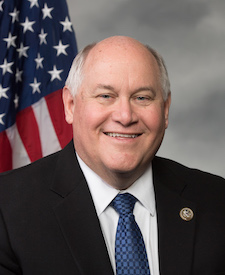
Rep. Ron Estes
Sponsored bills
Maddy summaryThis bill requires federal agencies (like the Interior or Agriculture Departments) to follow state water laws when managing permits for water use, such as irrigation or groundwater access. It directly affects states managing water rights, water users (including farmers and tribes), and federal agencies by preventing federal overreach into state water decisions. Key provisions include banning federal conditions that would transfer water rights to the U.S., alter state definitions of "beneficial use," or impose stricter rules than state law allows. The bill explicitly does not change existing federal laws like the Endangered Species Act or tribal water rights.
This resolution supports the designation of National FFA Week. It also (1) recognizes the important role of the National FFA Organization (Future Farmers of America) in developing the next generation of globally conscious leaders who will change the world; and (2) celebrates the 10th anniversary of the Give the Gift of Blue program, which has donated more than 17,000 FFA blue jackets to FFA members in need.
Maddy summaryThis resolution aims to block a rule issued by the National Highway Traffic Safety Administration (NHTSA) that sets new fuel efficiency standards for passenger cars, light trucks (starting in 2027), and heavy-duty pickup trucks/vans (starting in 2030). If passed, it would prevent this specific rule from taking effect by disapproving it under a congressional review process. The rule directly affects vehicle manufacturers by requiring them to meet these updated fuel economy targets for future model years. This is a procedural resolution, not a new law, focused solely on halting the implementation of the existing NHTSA rule.
Maddy summaryThis bill defines "sex," "male," and "female" in federal law based on biological characteristics present at birth, specifically referencing reproductive anatomy (e.g., sperm production for males, egg production for females). It mandates that all federal agencies, courts, and laws interpret these terms strictly according to this biological definition, excluding self-identification or gender identity. The bill directly affects how federal programs, regulations, and legal decisions interpret terms like "sex," "gender," and "gender identity" in all federal contexts. Key provisions clarify that "gender" refers only to biological sex differences and explicitly states that gender identity does not override these definitions.
Maddy summaryThe SAVE Act (HR 8281) requires U.S. citizens to provide documentary proof of citizenship when registering to vote in federal elections. It defines acceptable proof as documents like passports, REAL ID-compliant IDs, military IDs, or birth certificates, and mandates that states verify citizenship using information from government agencies like DHS and Social Security. States must establish processes for voters without required documentation to provide an attestation under penalty of perjury. The law also requires states to remove noncitizens from voter rolls when verified evidence shows they're not citizens. This bill directly affects all applicants registering to vote in federal elections and state election officials who must implement these requirements.
Maddy summaryHR 7053, the Orphan Well Grant Flexibility Act of 2024, modifies a 2005 law to give states more flexibility in using federal grants to plug abandoned oil and gas wells (called "orphaned wells"). It removes the requirement for states to measure methane emissions or conduct specific activities to qualify for these grants, allowing states to choose whether to use pre-plugging data for estimates. The bill also directs the Interior Secretary to commission a National Academies study, within 18 months, examining how plugging these wells affects local economic development, housing, and water quality in communities with many plugged sites. This study will involve input from at least one state per U.S. region and consult with agencies like HUD and the oil and gas compact commission.
Maddy summaryHJRES 148 is a joint resolution seeking to block a Treasury Department rule that would have modified clean vehicle tax credits. The rule, published in the Federal Register on May 6, 2024, aimed to restrict credits for vehicles using critical minerals or battery components sourced from "Foreign Entities of Concern" and to limit credit transfers. This resolution would nullify that rule, preventing it from taking effect and preserving the existing structure of the clean vehicle credit program under Sections 25E and 30D of the tax code. It directly affects electric vehicle buyers, manufacturers, and dealers participating in the federal tax credit program.
Maddy summaryHJRES 164 is a congressional resolution seeking to block a rule issued by the Department of Commerce regarding firearms license requirements. It directly targets the rule published in the Federal Register (89 Fed. Reg. 34680), which would have revised licensing procedures for firearms dealers. If passed, the resolution would prevent this rule from taking effect by invoking the congressional disapproval process under federal law. The bill does not create new regulations but aims to halt an existing rule affecting gun license applicants and dealers.
Maddy summaryHRES 1303 is a resolution passed by the U.S. House of Representatives on June 14, 2024, that condemns the Biden administration's suspension of pending approvals for liquefied natural gas (LNG) exports to countries without free trade agreements with the U.S. The resolution argues this action is politically motivated, citing studies showing economic benefits of LNG exports and noting that previous administrations conducted similar environmental reviews without halting permits. It calls for lifting the suspension to restore confidence in the energy sector, prioritize U.S. workers and communities, and align with the administration's stated goals of economic growth. As a non-binding resolution, it does not change policy but formally expresses congressional disapproval of the administration's approach.