

Sustaining Our Democracy Act This bill establishes and provides funds through FY2032 for the State Election Assistance and Innovation Trust Fund for purposes of promoting election activities. Specifically, the bill establishes the Democracy Advancement and Innovation Program, through which the Office of Democracy Advancement and Innovation (also established by this bill) shall make allocations to states for carrying out democracy promotion activities. These activities include improving the administration of federal elections, recruiting and training nonpartisan election officials and poll workers, and increasing voting access. The bill requires each state, in order to receive allocated funds, to (1) submit a plan for approval that describes how the state will distribute resources and carry out democracy promotion activities, and (2) establish uniform and nondiscriminatory state-based administrative complaint procedures. The bill prohibits states from using funds for certain activities, including any activity that diminishes the ability of any eligible voter to participate in the electoral process.
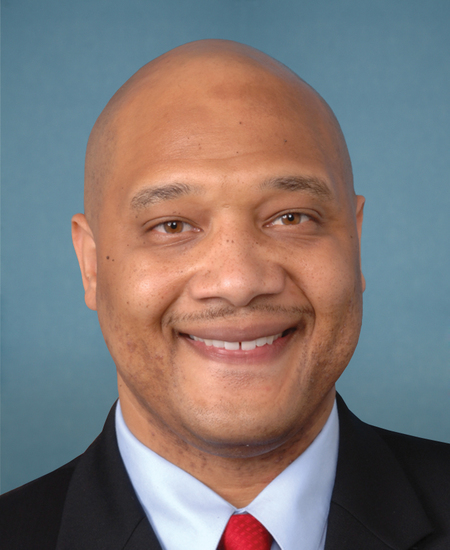
Rep. André Carson
Sponsored bills
Ocean Regional Opportunity and Innovation Act of 2022 This bill directs the Department of Commerce to designate at least seven entities as Ocean Innovation Clusters. Ocean Innovation Clusters are hubs of operation and entrepreneurship for private, public, and academic stakeholders to collaborate on opportunities to promote and enhance the maritime industry. In designating entities, Commerce shall prioritize entities with a history of supporting cross-sector growth and development of the Blue Economy. Additionally, Commerce must designate at least one Ocean Innovation Cluster in (1) each of the regions covered by the five regional offices of the National Marine Fisheries Service, (2) the Great Lakes region, and (3) the Gulf of Mexico region. Commerce may award competitive grants for the establishment, operation, and administration of Ocean Innovation Clusters.
Plant Biostimulant Act of 2022 This bill excludes plant biostimulants (i.e., a substance, micro-organism, or mixture thereof that supports a plant's natural processes independently of the biostimulant's nutrient content) from regulation under the Federal Insecticide, Fungicide, and Rodenticide Act. The bill also requires the Department of Agriculture to study the types of plant biostimulants and practices of plant biostimulant use that best achieve certain results, such as increasing organic matter content.
Maddy summaryHR 301 would amend U.S. law to officially designate "Lift Every Voice and Sing" as the national hymn of the United States. This change would add the song's full composition (words and music) to Title 36 of the U.S. Code, replacing the current designation of "The Star-Spangled Banner" as the sole national anthem for formal recognition purposes. The bill directly affects federal law and official government ceremonies where the national hymn is performed, though it does not alter the status of "The Star-Spangled Banner" as the national anthem. The policy change is purely procedural, establishing a new official designation without impacting any other laws or rights.
Keep Infant Formula Safe and On the Shelves Act of 2022 This bill requires the Food and Drug Administration (FDA) to periodically inspect infant formula manufacturing facilities and addresses related issues. The FDA must periodically conduct inspections, including unannounced inspections, of infant formula manufacturer facilities. If the FDA makes a notable regulatory finding at such a facility, the manufacturer must undergo a comprehensive food safety audit that includes a root cause analysis, enhanced testing, and comprehensive environmental samples. A manufacturer of infant formula or essential medical food must notify the FDA no later than five business days after becoming aware of circumstances that could lead to a shortage of the relevant product in the United States. Further, the FDA must create and annually update a list of U.S. manufacturing facilities that could be converted to manufacture infant formula during a shortage. In the event of a shortage, the FDA may require infant formula manufacturers to provide certain information, such as the quantity of formula in a manufacturer's inventory. The bill also establishes under statute that food, including infant formula, is a critical material essential to the national defense and therefore subject to authorities under the Defense Production Act of 1950. (Such authorities authorize the President to take various actions, such as requiring businesses to prioritize certain government contracts and incentivizing the domestic industrial base to expand the production of critical materials.) The Occupational Safety and Health Administration must issue a fact sheet and provide technical assistance to infant formula manufacturers to promote compliance with occupational health and safety standards.
Military Access to Reproductive Care and Health for Military Servicemembers Act or the MARCH for Military Servicemembers Act This bill repeals the restriction on utilizing Department of Defense funds and facilities for performing abortions. The restriction only allows such funds and facilities to be used for abortions in cases of rape, incest, or where the mother's life is endangered.
This joint resolution directs the President to remove U.S. Armed Forces from hostilities against the Houthis in Yemen within 30 days of the enactment of this joint resolution unless Congress authorizes a later withdrawal date, issues a declaration of war, or specifically authorizes the use of the Armed Forces. Prohibited activities include sharing intelligence or providing logistical support to enable offensive strikes by the coalition led by Saudi Arabia. This joint resolution shall not affect any military operations directed at Al Qaeda or associated forces.
Domestic Terrorism Prevention Act of 2022 This bill establishes new requirements to expand the availability of information on domestic terrorism, as well as the relationship between domestic terrorism and hate crimes. It authorizes domestic terrorism components within the Department of Homeland Security (DHS), the Department of Justice (DOJ), and the Federal Bureau of Investigation (FBI) to monitor, analyze, investigate, and prosecute domestic terrorism. The domestic terrorism components of DHS, DOJ, and the FBI must jointly report on domestic terrorism, including white-supremacist-related incidents or attempted incidents. DHS, DOJ, and the FBI must review the anti-terrorism training and resource programs of their agencies that are provided to federal, state, local, and tribal law enforcement agencies. Additionally, DOJ must make training on prosecuting domestic terrorism available to its prosecutors and to assistant U.S. attorneys. It creates an interagency task force to analyze and combat white supremacist and neo-Nazi infiltration of the uniformed services and federal law enforcement agencies. Finally, it directs the FBI to assign a special agent or hate crimes liaison to each field office to investigate hate crimes incidents with a nexus to domestic terrorism.
Relief for Restaurants and other Hard Hit Small Businesses Act of 2022 This bill addresses support for restaurants, arts and entertainment venues, and small businesses impacted by the COVID-19 pandemic. The bill provides an additional $42 billion in FY2021 for the Restaurant Revitalization Fund and gives priority to previous applicants who have not received a grant. The Small Business Administration (SBA) must provide to applicants an explanation for denied applications, establish a reconsideration process for denied applications, and institute an audit and oversight plan with respect to grant recipients. Additionally, the bill establishes the Hard Hit Industries Award Program for small businesses that suffered a pandemic-related revenue loss of 40% or more. Aggregate grant amounts are capped at $1 million. Funds may be used for expenses including mortgage, rent, and utility payments and payroll. SBA must prioritize entities that have experienced significant pandemic-related revenue loss, with first priority going to those that experienced a loss of at least 80%, and second priority going to those that experienced a loss of at least 60%. Finally, the bill extends to March 11, 2023 (or a later date as determined by the SBA), the time frame during which Shuttered Venue Operators Grant recipients may use grant funds to cover their expenses.
Bipartisan Background Checks Act of 2021 This bill establishes new background check requirements for firearm transfers between private parties (i.e., unlicensed individuals). Specifically, it prohibits a firearm transfer between private parties unless a licensed gun dealer, manufacturer, or importer first takes possession of the firearm to conduct a background check. The prohibition does not apply to certain firearm transfers or exchanges, such as a gift between spouses in good faith.