

Maddy summaryHR 130, the Thin Blue Line Act, amends federal death penalty law to add a new consideration for sentencing. It specifies that killing or targeting a law enforcement officer (including firefighters and other first responders) while they are performing official duties, because of their duties, or due to their status as a public official qualifies as an aggravating factor. This change directly affects defendants convicted of such killings, making the death penalty a potential sentence in these specific cases. The bill does not alter sentencing ranges but adds this circumstance as a factor judges must weigh during sentencing.
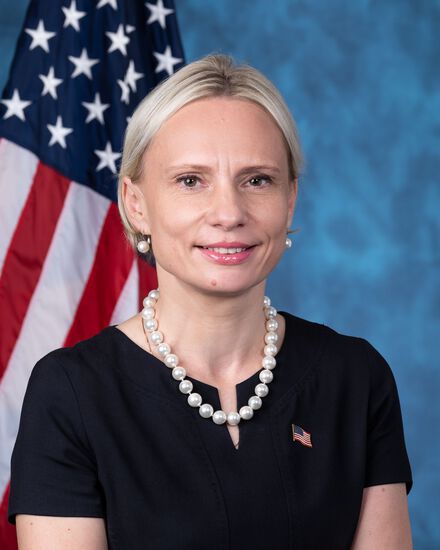
Rep. Victoria Spartz
Sponsored bills
This bill authorizes the Thomas Paine Memorial Association to establish a commemorative work on federal land in the District of Columbia in honor of the philosopher and patriot, Thomas Paine. Thomas Paine is best known for writing Common Sense , a pamphlet that helped to inspire the Revolutionary War. The establishment of the commemorative work shall be in accordance with the Commemorative Works Act. Federal funds may not be used to pay any expense to establish the commemorative work.
Human Trafficking Prevention Act of 2022 This act requires the posting of contact information of the national human trafficking hotline in specific places. Specifically, the information must be posted in a visible place in all federal buildings; in the restrooms of each U.S. aircraft, airport, over-the-road bus, bus station, passenger train, and passenger railroad station; and at each port of entry.
Patents for Humanity Act of 2022 This bill provides statutory authority for a program to award certificates that may be used to accelerate certain proceedings and applications at the U.S. Patent and Trademark Office (PTO). The program established under this bill shall be treated as the successor to the existing Patents for Humanity program. Under this bill, the PTO must hold a competition at least once every two years to award certificates to eligible entities that submit a patent application that addresses a humanitarian issue.
This resolution states that the House of Representatives holds the Russian government responsible for the illegal kidnapping of children from Ukraine and condemns these actions. The resolution also (1) declares that illegal adoptions are contrary to the Genocide Convention (the 1948 Convention on the Prevention and Punishment of the Crime of Genocide); (2) claims that Russia is attempting to wipe out a generation of Ukrainian children; and (3) asserts that Russia's invasion of Ukraine has increased the risks of children being exposed to human trafficking, exploitation, child labor, gender-based violence, hunger, injury, trauma, deprivation of education and shelter, and death.
Stop Anticompetitive Healthcare Act of 2022 This bill provides the Federal Trade Commission with enforcement authority over certain tax-exempt, hospital or cooperative hospital service organizations.
This resolution supports the annual recognition of Interscholastic Athletic Administrators' Day. In addition, the resolution commends (1) athletic administrators for their commitment to secondary school student athletes, and (2) the National Interscholastic Athletic Administrators Association for providing continuous learning and preparation to athletic administrators.
Maddy summaryHR 7075 designates a specific triangular area in Washington, D.C. (bounded by 22nd Street NW, P Street NW, and Florida Avenue NW) as "Ukrainian Independence Park," including National Park Service reservations 57D and 360 (which contains the Taras Shevchenko Memorial). The bill updates all federal references to this area to use the new name and authorizes signage highlighting Ukraine's independence and U.S.-Ukraine solidarity. This is a procedural designation bill with no substantive policy changes, solely renaming a park area.
This resolution condemns recent attacks on pro-life facilities, groups, and churches and calls on the current presidential administration to use appropriate law enforcement authorities to support their safety.
This resolution expresses the sense of the House of Representatives that (1) for purposes of federal law, a person's sex means the person's biological sex at birth; and (2) distinctions between the sexes are justified in certain settings, laws, and policies.