

Maddy summaryThe Strengthening Local Processing Act of 2023 provides targeted support for smaller meat and poultry processing businesses (defined as those with fewer than 50 employees under existing regulations). It creates a free, searchable database of validation studies and scale-appropriate model safety plans to help these businesses meet federal food safety requirements, while increasing federal funding for state inspection programs from 50% to 65%. The bill also establishes a $20 million annual grant program to help small processors improve safety, expand capacity, and access training, with priority given to businesses serving farmers within 200 miles and those owned by disadvantaged individuals. These changes directly benefit small meat and poultry processing establishments that often struggle with compliance costs and resources.
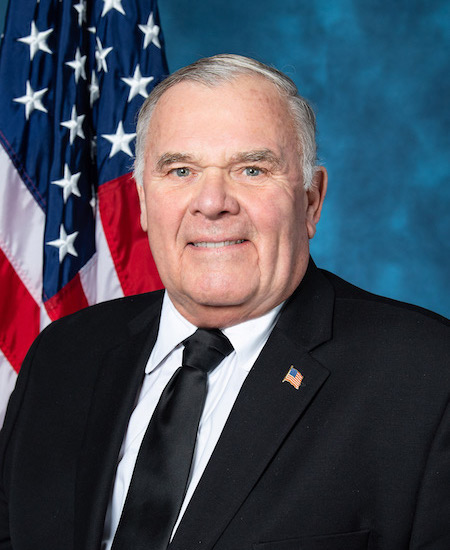
Rep. James R. Baird
Sponsored bills
Amplifying Processing of Livestock in the United States Act or the A-PLUS Act This bill directs the Department of Agriculture to revise its regulations to allow livestock market agencies (e.g., auction market owners) to hold an ownership interest in, finance, or participate in the management or operation of a meat packer with a cumulative slaughter capacity of (1) less than 2,000 animals per day or 700,000 animals per year for cattle and sheep, and (2) less than 10,000 animals per day or 3 million animals per year for hogs.
Maddy summaryThe STEM RESTART Act creates a federal grant program to help mid-career workers, particularly women and people from underrepresented racial groups, return to STEM careers. It provides funding for small and medium-sized businesses to establish "returnship" programs that offer above-entry-level positions with full benefits for 10 weeks or more. The program requires grantees to track participants' demographics and employment outcomes, with $50 million authorized annually from 2024-2028. These returnships must provide compensation equivalent to full-time employees with similar experience, including benefits like health care and child care. The bill targets workers who left the workforce but want to return, especially those from rural areas or underrepresented populations.
This resolution supports the designation of National FFA Week. It also (1) recognizes the important role of the National FFA Organization (Future Farmers of America) in developing the next generation of leaders who will change the world, and (2) celebrates the 90th anniversary of the iconic FFA jacket.
Maddy summaryThis bill amends the Higher Education Act to exempt certain family-owned assets from being counted when calculating federal student aid eligibility. Specifically, it excludes family farms where the family resides and small businesses with 100 or fewer full-time equivalent employees owned and controlled by the family. These assets will no longer be considered when determining a student's financial need for aid programs. The change directly affects students from qualifying family farms or small businesses when applying for federal financial aid. The exemption applies to assets held by the family, not just the business itself.
Maddy summaryHR 1200, the National Right-to-Work Act, prohibits requiring workers to join a union or pay dues as a condition of employment in both private-sector workplaces (covered by the National Labor Relations Act) and railroad industries (covered by the Railway Labor Act). The bill amends key sections of these laws to eliminate provisions that allowed union security agreements, meaning workers in unionized settings would no longer be forced to pay dues to retain their jobs. This directly affects employees in unionized workplaces across the U.S., particularly those in industries with existing union contracts that included mandatory dues. The law changes the legal framework to ensure union membership and dues payment remain voluntary for all workers.
Maddy summaryThis bill makes it a federal crime to defraud veterans of their benefits, including benefits for dependents or survivors. It targets individuals who create schemes to steal or improperly obtain veterans' benefits, with penalties of up to five years in prison or fines. The law directly affects veterans, their families, and anyone seeking to exploit the benefits system. Key provisions define "veterans' benefits" broadly under federal law and establish criminal penalties for fraud attempts.
Women's Public Health and Safety Act This bill allows a state to exclude from participation in the state's Medicaid program a provider that performs an abortion, unless (1) the pregnancy is the result of rape or incest, or (2) the woman suffers from a physical issue that would place her in danger of death unless an abortion is performed. Under current law, a state plan for medical assistance must provide that any individual eligible for medical assistance may obtain required services from any provider qualified to perform them.
This resolution states that the House of Representatives opposes South Africa's hosting of military exercises with China and Russia in February 2023. The resolution calls on the government of South Africa to (1) cancel all future military exercises with China and Russia and (2) rejoin U.S.-led exercises. Additionally, the resolution calls on the Biden administration to conduct a review of the status of the United States-South Africa bilateral relationship.
Second Chance at Life Act of 2023 This bill requires abortion providers to disclose information about the possibility of reversing a medication abortion. This is a procedure that uses a medication regimen to terminate a pregnancy, typically with a two-drug protocol. Providers must inform patients that it may be possible to reverse the effects of a medication abortion after taking the first drug. They must also let patients know that more information and assistance is available on the Department of Health and Human Services (HHS) website. At least 24 hours before the procedure, the provider must share this information with the patient in person or by telephone. The provider must also include the information in written discharge instructions after the first drug is dispensed. The bill sets out an exception to these notification requirements when an abortion is necessary to resolve a physical injury or condition that threatens the life of the woman. The provider must document the circumstances giving rise to the exception in the patient's medical file. Furthermore, providers must post signs with this information in their offices or facilities, and HHS must maintain information about reversing medication abortions on its website.