

Maddy summaryHR 7900, the EPA Accountability to Farm Country Act, requires the Secretary of Agriculture to review EPA publications (like regulations or guidance) within 30 days if they could significantly impact farm production, food prices, or the agricultural economy. If a major economic impact is found, a review panel - including four farmer representatives from diverse regions - must analyze the rule and produce a report within 60 days, including cost estimates and recommendations. The EPA cannot finalize such rules until it implements the panel's recommendations to reduce negative economic effects on agriculture. This directly affects farmers, agricultural businesses, and food producers by giving them a formal role in shaping EPA regulations that impact their operations.
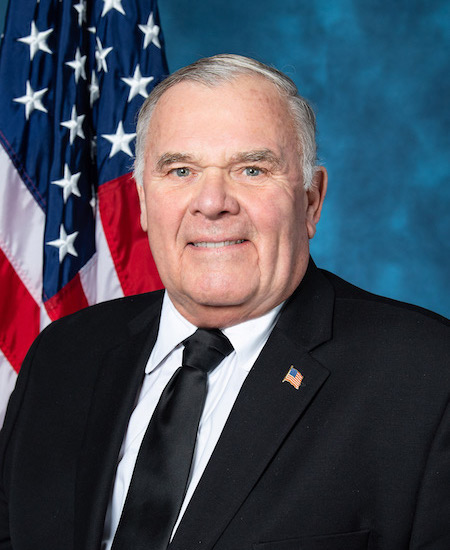
Rep. James R. Baird
Sponsored bills
Maddy summaryHR 7770, the Rosie the Riveter Commemorative Coin Act, authorizes the U.S. Mint to produce and sell three commemorative coins honoring women who worked on the U.S. home front during World War II. It specifies $5 gold coins (max 50,000), $1 silver coins (max 400,000), and half-dollar coins (max 750,000), all to be issued between January 1, 2025, and December 31, 2025. Each coin sale includes a surcharge ($35 for gold, $10 for silver, $5 for half-dollar), with all surcharge funds directed to the Rosie the Riveter Trust for maintaining the Rosie the Riveter WWII Home Front National Historical Park and educational programs. The coins will feature designs reflecting the legacy of diverse women workers and must meet specific weight, diameter, and composition standards.
Maddy summaryHR 7772, the Safeguarding Benefits for Americans Act of 2024, requires individuals to prove U.S. citizenship or nationality to receive most federal benefits like food assistance, housing aid, or Medicaid. It mandates applicants to submit documentary evidence (such as a Social Security card and photo ID) and have their status verified through the Social Security Administration and Department of Homeland Security systems. The bill applies to programs where eligibility is based partly on income or resources, with specific rules for children and households. It takes effect one year after enactment, giving most recipients two years to meet the new requirement, and includes an appeals process for denied applications.
Maddy summaryHR 7256, the U.S.-South Africa Bilateral Relations Review Act, requires the President to certify within 30 days whether South Africa's foreign policy actions undermine U.S. national security, based on findings about its support for Hamas, cooperation with Russia and China, and domestic governance issues. It mandates a 120-day comprehensive review of U.S.-South Africa relations by the executive branch, covering diplomatic, military, and economic ties. The review will assess South Africa's alignment with entities like Hamas (a U.S. designated Foreign Terrorist Organization) and its strategic partnerships with Russia and China, as detailed in the bill's findings. This procedural bill directs the administration to evaluate the relationship but does not impose new restrictions or change existing policy.
Maddy summaryThis bill establishes new eligibility rules for women's and girls' amateur sports by defining "female" and "male" based on biological sex at birth. It prohibits individuals designated as male under these definitions from participating in athletic competitions designated for females, women, or girls. The law amends existing U.S. Code provisions to add this requirement, directly affecting athletes and organizations managing female-designated teams. The key change is a clear ban on male-identified participants in female sports, replacing previous eligibility standards with biological sex criteria.
Maddy summaryHR 6727 establishes the United States Foundation for International Conservation, a nonprofit organization that will provide grants to support long-term management of protected and conserved areas in eligible countries. The Foundation requires a 2:1 cost match from other sources, demands host country and community consent through binding agreements, and prioritizes areas with high biodiversity or species of significant importance. It will be governed by a Board of Directors including government officials and private sector experts, operate for 10 years with $1 million authorized for 2024 and $100 million annually from 2025-2035, and must follow international conservation standards while prohibiting funding for countries supporting terrorism or violating human rights.
Maddy summaryThis bill directs the U.S. Department of Homeland Security to implement the Migrant Protection Protocols (MPP) at the U.S.-Canada border, rather than the U.S.-Mexico border as previously applied. It requires asylum seekers arriving at the northern border to wait in Canada while their cases are processed, following the 2019 policy guidance. The bill directly affects individuals seeking asylum who cross into the U.S. from Canada. It makes no new funding or structural changes but shifts the geographic application of an existing policy. The summary reflects the bill’s concrete policy change without commentary on its implications.
Maddy summaryThis bill prohibits the U.S. State Department from acquiring, leasing, or authorizing construction on overseas diplomatic facilities (like embassies and consulates) where the People’s Republic of China or its entities have ownership control (defined as 25% or more). It applies to all new building acquisitions, leases, and construction contracts after the law’s enactment. The law defines "covered construction" to include all building work, repairs, and essential systems like electrical or plumbing. Violations require the Secretary of State to notify relevant congressional committees within seven days.
Maddy summaryThis resolution (HRES 1086) is a symbolic gesture expressing the House's support for designating March 19, 2024, as "National Agriculture Day." It does not create new laws or policies, but instead formally recognizes agriculture as a vital industry in the U.S. economy. The resolution celebrates agriculture's broad economic impact without imposing any requirements or changes on farmers, consumers, or government programs. It is a commemorative statement, not a substantive legislative action.
Maddy summaryThis bill establishes a new U.S. Ambassador-at-Large for the Arctic Region within the State Department, appointed by the President with Senate approval. The Ambassador coordinates U.S. foreign policy across Arctic issues including energy, environment, trade, indigenous affairs, scientific research, and security, reporting directly to the Secretary of State. The position covers the defined Arctic region (north of 66.56°N latitude, U.S. Arctic territories, and surrounding seas) and oversees cooperation with the eight Arctic Council nations (U.S., Canada, Denmark, Iceland, Norway, Sweden, Finland, and Russia). The role focuses on integrating federal agency efforts and advancing U.S. interests in the region through diplomatic coordination.