

Maddy summaryThe FARMLAND Act of 2025 strengthens oversight of foreign ownership of U.S. agricultural land, particularly from countries like China and other "foreign entities of concern" as defined in the law. It requires agricultural land buyers to conduct due diligence and certify compliance, creates civil penalties for false or missing reports, and prohibits foreign persons from participating in Farm Service Agency programs. The bill mandates annual reports to Congress on foreign ownership of farmland by specific countries and requires development of a centralized database tracking foreign ownership. It also expands the Committee on Foreign Investment in the United States' authority to review certain real estate transactions involving foreign entities of concern.
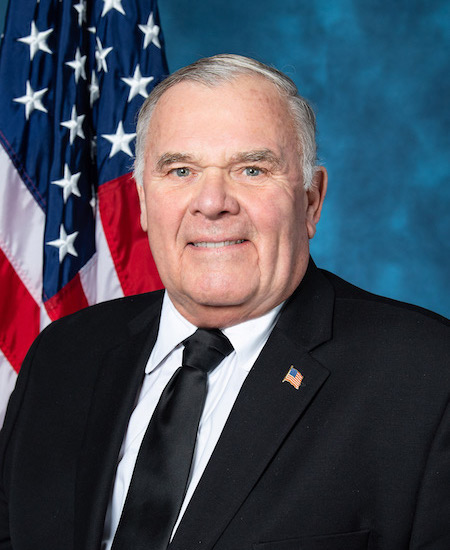
Rep. James R. Baird
Sponsored bills
Maddy summaryHR 1762, the Forest Service Accountability Act, is a procedural bill changing how the Forest Service Chief is appointed. It requires the President to nominate a candidate with substantial forest management experience for Senate confirmation, with nominations referred jointly to the Senate Agriculture and Energy Committees. The bill also mandates that the President submit a new nomination within 30 days of enactment, applying to the current Chief. This affects the President, Senate committees, and the current Forest Service leadership.
Securing Our Lands and Resources Act or the SOLAR Act This bill prohibits the Department of Agriculture from providing financial assistance for certain projects that would result in the conversion of covered farmland for solar energy production. Under the bill, covered farmland generally refers to prime farmland, unique farmland, and farmland that is of statewide or local importance. Conversion means any activity that results in the covered farmland no longer meeting certain requirements for agricultural production, activity, or use. The bill includes an exception for certain smaller projects that result in the conversion of (1) less than 5 acres of covered farmland, or (2) less than 50 acres of covered farmland if the majority of the energy produced by the project is for on-farm use. The bill also includes an exception for projects that have the approval or support from the local county and municipality. For these projects, the applicant must (1) develop a farmland conservation plan for the project (e.g., implementing best practices to protect future soil health and productivity), and (2) ensure that sufficient funds are provided for the decommissioning of the solar energy production system and the remediation and restoration of the farmland.
Maddy summaryHR 2398, the Rural Veterinary Workforce Act, amends federal tax law to exempt certain student loan repayment or forgiveness assistance from income tax for veterinarians working in rural areas. It specifically expands existing tax exclusions to include programs under the National Agricultural Research, Extension, and Teaching Policy Act (7 U.S.C. 3151a) and similar state-level programs designed to increase rural veterinary access. This change directly affects veterinarians participating in qualifying loan repayment or forgiveness programs in states prioritizing rural veterinary services. The policy change modifies IRS tax treatment to reduce the financial burden on veterinarians serving underserved rural communities.
TAP Promotion Act This bill requires that pre-separation counseling under the Transition Assistance Program include a presentation that promotes the benefits available to veterans from the Department of Veterans Affairs (VA). The bill also requires the VA to annually report on the presentation to (1) identify veterans service organizations that participate, (2) provide the number of members of the Armed Forces who attend, and (3) provide any recommendations for changes to the presentation.
Maddy summaryThis bill requires the Department of Energy (DOE) and National Science Foundation (NSF) to work together on collaborative research projects. It mandates a competitive, merit-reviewed process for funding joint initiatives in key areas like quantum computing, fusion energy, AI for climate science, and advanced manufacturing, directly affecting researchers at universities, national labs, and non-profits. The law also requires DOE and NSF to share data, support STEM workforce development through internships and training, and report to Congress within two years on their coordination efforts and research outcomes. The focus is on strengthening federal research collaboration without altering existing funding mechanisms.
Maddy summaryThis bill authorizes $10 million annually (2026-2030) for the National Science Foundation to fund grants supporting mathematical and statistical modeling education in K-12 schools. It requires funded projects to focus on engaging students from groups historically underrepresented in STEM, using real-world data and computational tools, and addressing transitions like middle school to high school. The bill also allocates $1 million to fund a National Academies study on best practices for integrating these skills across curricula. These efforts aim to address a projected STEM workforce shortage by better preparing students for data-driven careers in fields like technology, healthcare, and engineering.
Ensuring Continuity in Veterans Health Act This bill requires the consideration of continuity of care when determining whether care through the Veterans Community Care Program is in the best medical interest of a veteran.
Investing in Rural America Act of 2025 This bill allows Farm Credit System (FCS) institutions to make and participate in loans and commitments (and extend other technical and financial assistance) for essential community facility projects as part of the Department of Agriculture's Community Facilities Direct Loan & Grant Program. This program provides funding to develop essential community facilities in rural areas. The FCS financing and technical assistance may be provided in order to make capital available to develop, build, maintain, improve, or provide related equipment or other support for essential community facilities in rural communities (e.g., certain facilities that provide healthcare, community support, public safety, educational, or utility services). Under the bill, the financing provided by an FCS institution may not exceed 15% of the total of all outstanding loans of the institution. Further, an FCS institution must (1) offer at least one non-FCS lending institution an interest in the financing under reasonable terms and conditions acceptable to the borrower, and (2) report the offer to the Farm Credit Administration (FCA). The FCA must submit an annual report to Congress on the activities undertaken by FCS institutions under this bill, including through the partnerships between FCS institutions and other lending institutions. The FCA must post the report on the administration's website.
Maddy summaryThe Innovative FEED Act of 2025 establishes a new regulatory category for "zootechnical animal food substances" - additives in animal feed that affect digestive byproducts, reduce foodborne pathogens, or alter an animal's gut microbiome without providing nutrition. These substances would be regulated as food additives (not drugs) under the Federal Food, Drug, and Cosmetic Act, requiring manufacturers to submit specific safety and efficacy data for approval. The bill mandates labeling stating "Not for use in the diagnosis, cure, mitigation, treatment, or prevention of disease in animals" and allows optional claims about intended effects on animal body function. It explicitly excludes existing drugs, hormones, ionophores, and other substances from this category, ensuring no mandatory use of these additives.