Greyhound Protection Act of 2021 This bill modifies the federal criminal statute commonly known as the Wire Act. Currently, the Wire Act contains four prohibitions on the use of a wire transmission facility (e.g., the telephone or internet) for certain gambling activities. All four prohibitions apply to sports gambling. However, there have been conflicting interpretations of the applicability of the prohibitions to nonsports gambling (e.g., state lotteries). This bill amends the Wire Act to expressly state that the statute does not authorize the use of wire communications to gamble on commercial greyhound racing or permit the transport of animals for commercial dog racing or related activities.
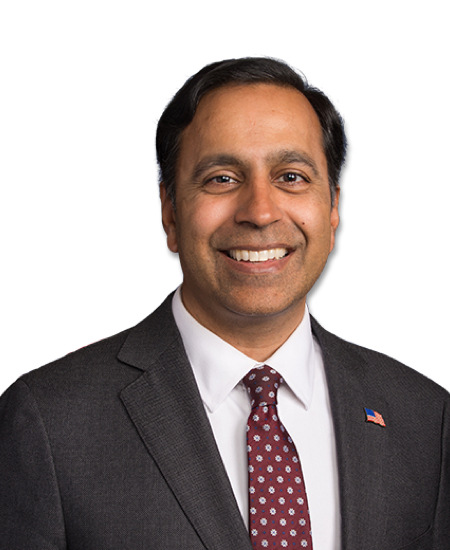
Rep. Raja Krishnamoorthi
Sponsored bills
Temporary Family Visitation Act This bill establishes a new nonimmigrant visa classification for an alien temporarily entering the United States to visit a relative who is a U.S. citizen or lawful permanent resident. The maximum period of stay for a family visitor visa shall be 90 days. An alien seeking such a visa must have health insurance for the duration of the stay. An alien who holds such a visa may not change to another nonimmigrant visa classification except in certain limited instances. If an alien has been approved for a family-based immigrant visa and is waiting for one to become available, the alien may obtain a family visitor visa if the alien meets the eligibility requirements.
Rural Area Opioid Prevention Pilot Program Act This bill expands the allowable uses of grant funds under the Comprehensive Opioid Abuse Grant Program administered by the Department of Justice. Specifically, the bill allows grants to be used for pilot programs for rural areas to implement community response programs that focus on alternatives to incarceration and reducing opioid overdose deaths. The bill also requires at least 10% of grants under the program to be awarded to rural areas.
Maddy summaryHR 5904, the Deepavali Day Act, would add "Deepavali Day" to the list of recognized days in federal law, specifically amending the U.S. Code section that lists federal holidays. It recognizes Deepavali - a festival celebrated by over six million Americans, including Hindu, Buddhist, Sikh, Jain, and Indo-Caribbean communities - as a day symbolizing the victory of light over darkness. The bill does not create a paid holiday or change government operations; it simply adds Deepavali Day to the existing federal holiday schedule. This recognition aligns with Congress's acknowledgment of Deepavali's cultural significance and its shared values with U.S. democratic principles.
Fiscal State of the Nation Resolution This concurrent resolution requires the congressional budget committees to conduct an annual joint hearing to receive a presentation from the Comptroller General regarding (1) the Government Accountability Office's audit of the financial statement of the executive branch, and (2) the financial position and condition of the federal government.
Burial Equity for Guards and Reserves Act of 2021 This bill prohibits the Department of Veterans Affairs (VA) from establishing a condition for a cemetery grant that restricts the ability of a state to inter certain reservists (or their spouses and children) at a state-owned veterans' cemetery solely because such individuals are ineligible for burial in an open national cemetery. Specifically, as a condition for grants, the VA cannot restrict the ability of a state to inter a member of a reserve component whose service was terminated under honorable conditions; member of the Army National Guard or Air National Guard whose service was terminated under honorable conditions; member of the Reserve Officers' Training Corps of the Army, Navy, or Air Force who died under honorable conditions while a member; and spouse, minor child, or unmarried adult child of any member described above. The VA is prohibited from (1) denying an application for a grant solely on the basis that the recipient state may use funds to expand, improve, operate, or maintain a veterans' cemetery to allow for the internment of the specified individuals; and (2) enforcing certain conditions on grants for state veterans' cemeteries that were established before the date of enactment of this bill. The bill also provides for plot allowances for the individuals listed in the bill.
Ending the Monopoly of Power Over Workplace Harassment through Education and Reporting Act or the EMPOWER Act This bill makes it an unlawful labor practice for an employer to enter into, or attempt to enforce, a contract with an employee or job applicant that contains a nondisparagement or nondisclosure clause that covers workplace or sexual harassment, including retaliation for participating in a workplace harassment proceeding. The bill exempts certain settlement or separation agreements from such prohibition. The bill also requires the Securities and Exchange Commission to promulgate a regulation that requires any issuer of securities to submit a report for the most recent five-year period with respect to workplace and sexual harassment. The commission must provide for the development and dissemination of training programs and information regarding workplace and sexual harassment. The bill denies a tax deduction for amounts related to judgments and expenses in connection with litigation related to workplace or sexual harassment. It also excludes from gross income, for income tax purposes, any amount received in connection with a claim or settlement related to workplace or sexual harassment, or other unlawful discrimination.
Nondebtor Release Prohibition Act of 2021 This bill addresses the release by bankruptcy courts of creditor or other third-party claims against non-debtors. Complex bankruptcies may involve third-party claims against non-debtors associated with the debtor, such as the debtor's officers, directors, or employees. Currently, in carrying out a bankruptcy plan, bankruptcy courts may release non-debtors from liability (there is a split in the judicial circuits regarding this practice). The bill generally prohibits a bankruptcy court from (1) releasing or modifying a non-debtor's liability through the approval of a bankruptcy plan or through an order, or (2) enjoining a judicial proceeding or other act to collect or otherwise enforce such a claim or cause of action against a non-debtor. However, the bill provides for the release of such liability if express consent is given by the third party. The bill also generally limits an order or decree to temporarily enjoin a proceeding against a non-debtor to 90 days. Additionally, the bill gives appellate jurisdiction to the appropriate U.S. court of appeals regarding an order or decree to temporarily enjoin or stay a proceeding against a non-debtor in a Chapter 11 reorganization bankruptcy case. Currently, U.S. district courts have appellate jurisdiction for these matters. Upon request of an interested party, and after notice and a hearing, the court shall dismiss a Chapter 11 reorganization bankruptcy case if the debtor was involved in certain restructuring activity that (1) had the intent or foreseeable effect of separating a debtor's assets from a debtor's liabilities and the debtor assuming or retaining such liabilities, and (2) occurred in the 10-year period prior to the filing of the bankruptcy petition.

Help Ensure Lower Patient Copays Act or the HELP Copays Act This bill requires health insurance plans to apply certain payments made by, or on behalf of, a plan enrollee toward a plan's cost-sharing requirements. Specifically, plans must apply third-party payments, financial assistance, discounts, product vouchers, and other reductions in out-of-pocket expenses toward the requirements.
This resolution expresses that the House of Representatives applauds the Biden administration for reaffirming the U.S. commitment to the Paris Agreement on climate change and to our collective responsibility to globally combat climate change; encourages the Biden administration to implement measures to ensure global climate change remains a top priority for this and future administrations and to cement the United States as a global leader in the fight to mitigate its most severe consequences; voices strong commitment as legislators toward achieving the climate goals of the Paris Agreement, fulfilling the forthcoming pledges from the COP26 in Glasgow, Scotland, and advancing other international efforts to keep global warming to no more than 1.5 degrees Celsius and realize global net-zero carbon emissions by 2050 using a whole-of-government approach; and recognizes the critical responsibility of the United States and other developed nations to ensure all societies have the capabilities to transition to a clean energy economy, the resources to protect against climate-induced disasters, and the necessary assistance to endure climate-related challenges to food security, regional migration, and public health.