

Keeping Girls in School Act This bill authorizes the U.S. Agency for International Development (USAID) to enter into agreements to address social, cultural, health, and other barriers that adolescent girls face in accessing quality secondary education. The USAID shall seek to ensure that such activities meet various requirements related to monitoring and evaluating outcomes, collecting data, and using specified indicators and methodologies for international basic education. The Department of State shall periodically update and report to Congress a publicly available U.S. global strategy to empower adolescent girls, and the USAID shall periodically report to Congress on the activities initiated under this bill and efforts to monitor and evaluate such activities.
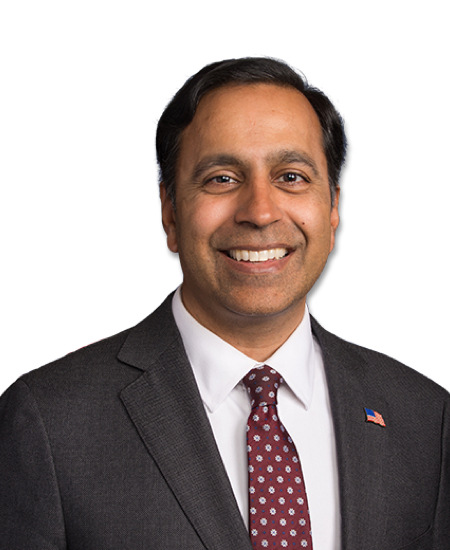
Rep. Raja Krishnamoorthi
Sponsored bills
Securing and Enabling Commerce Using Remote and Electronic Notarization Act of 2022 or the SECURE Notarization Act of 2022 This bill allows a notary public commissioned under state law to remotely notarize electronic records and perform notarizations for remotely located individuals. The bill provides technical requirements for such notarizations, including the creation and retention of video and audio recordings and the use of communication technologies (i.e., video chat). Additionally, the bill requires U.S. courts and states to recognize notarizations—including remote notarizations of electronic records and notarizations of remotely-located individuals—that occur in or affect interstate commerce and are performed by a notary public commissioned under the laws of other states. The bill also allows a notary public to remotely notarize electronic records involving an individual located outside of the United States, subject to certain requirements.
South Asian Heart Health Awareness and Research Act of 2022 This bill authorizes the Department of Health and Human Services to establish programs that support heart-disease research and awareness among communities disproportionately affected by heart disease, including the South Asian population of the United States. The programs include (1) grants to states for awareness initiatives and educational materials; and (2) research regarding heart disease, type 2 diabetes, and other heart health-related ailments with respect to the South Asian population and other at-risk populations.
Gabriella Miller Kids First Research Act 2.0 This bill reauthorizes through FY2027 a pediatric disease research initiative within the National Institutes of Health (NIH) and requires the NIH to coordinate pediatric research activities to avoid duplicative efforts. Additionally, the Department of Health and Human Services must report, within five years, to Congress about research funded through the initiative.
Original Slavery Remembrance Day Resolution of 2021 This resolution supports the designation of a Slavery Remembrance Day and condemns slavery and its progenies.
Atrocity Crimes, Relief and Accountability Act or the ACRA Act The bill requires the State Department and the U.S. Agency for International Development to provide assistance to suspected victims, survivors, and witnesses of war crimes; establishes a Ukraine victims trust fund; and establishes a Ukraine atrocity crimes rewards fund. The bill also allows the International Criminal Court to conduct limited activities in the United States relating solely to foreign nationals suspected of committing war crimes in Ukraine.
This resolution recognizes the mental health concerns faced by adolescents and the need for adequate mental health resources to address those concerns, particularly among minority populations.
Great Lakes Restoration Semipostal Stamp Act of 2022 This bill directs the U.S. Postal Service to issue a semipostal stamp (a stamp sold at a premium to raise funds for a cause of national public interest) to contribute to funding operations supported by the Great Lakes Restoration Initiative.
No Tax Breaks for Union Busting (NTBUB) Act This bill denies employers a tax deduction for any expenditures incurred for attempting to influence their employees with respect to labor organizations or labor organization activities, such as elections, labor disputes, and collective actions. The bill requires employers to report on their attempts to influence their employees with respect to labor organizations and their activities.
Improving Digital Identity Act of 2021 This bill establishes the Improving Digital Identity Task Force to establish a government-wide effort to develop secure methods for governmental agencies to validate identity attributes to protect the privacy and security of individuals and support reliable, interoperable digital identity verification in the public and private sectors. The National Institute of Standards and Technology (NIST) shall develop and periodically update a framework of standards, methodologies, procedures, and processes as a guide for federal, state, and local governments to follow when providing services to support digital identity verification. The Department of Homeland Security (DHS) shall award grants to states to upgrade systems that provide drivers' licenses or other types of identity credentials to support the development of highly secure, interoperable state systems that enable digital identity verification. The Government Accountability Office shall submit to Congress a report that includes (1) an analysis of legal and regulatory requirements with respect to the collection and retention of Social Security numbers by nongovernmental organizations, and (2) a recommendation on the necessity and effectiveness of any such legal and regulatory requirement analyzed and the use of a form of identification other than a Social Security number. DHS shall issue binding operational directives to federal agencies to implement (1) the Digital Identity Guidelines published by NIST; and (2) the memorandum of the Office of Management and Budget issued on May 21, 2019, which includes the subject Enabling Mission Delivery through Improved Identity, Credential, and Access Management .