

National Infrastructure Bank Act of 2021 This bill creates the National Infrastructure Bank to facilitate the long-term financing of infrastructure projects. Specifically, the bank must provide loans to public and private entities for financing, developing, or operating eligible infrastructure projects. An eligible project must have a public sponsor as well as local, regional, or national significance. The bill treats the bank as a government corporation exempt from tax and treats contributions to the bank as charitable contributions. The bill also provides for criteria and preferences for deciding whether to provide a loan, such as whether a project promotes job creation or provides environmental benefits. Projects that receive a loan must (1) pay all laborers and mechanics locally prevailing wages, and (2) use only certain U.S.-produced construction materials unless a waiver is secured from the bank. The bank shall issue stock and may also issue bonds and maintain a discount line of credit with the Federal Reserve System. The bank must apply for a national bank charter and, once chartered, accept deposits from individuals, corporations, and public entities and pay interest on those deposits. The bill imposes requirements related to the bank's operation, such as minimum reserve requirements and requirements for handling loan losses. In addition, the bank must facilitate the organization of at least seven regional economic accelerator planning groups to, among other activities, identify infrastructure needs and priorities. Within five years, the Government Accountability Office must report on the bank's activities.
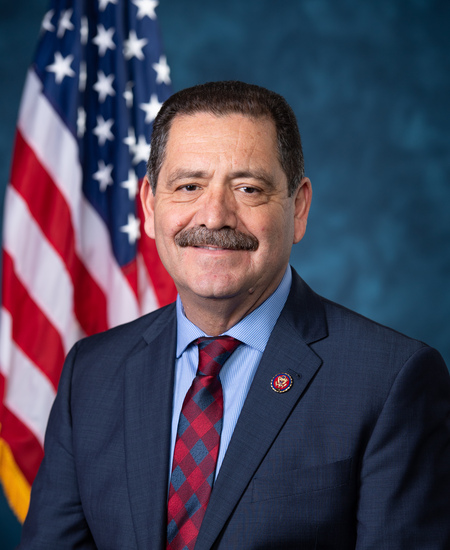
Rep. Jesús G. "Chuy" García
Sponsored bills
Medicare Dental, Vision, and Hearing Benefit Act of 2021 This bill provides for Medicare coverage of dental, vision, and hearing care. Coverage includes (1) routine dental cleanings and exams, basic and major dental services, emergency dental care, and dentures; (2) routine eye exams, eyeglasses, and contact lenses; and (3) routine hearing exams, hearing aids, and exams for hearing aids. With respect to such care, the bill establishes special payment rules, limitations, and coinsurance requirements.
Eliminating the HHS Discrimination Division Act of 2021 This bill eliminates the Conscience and Religious Freedom Division in the Office of Civil Rights of the Department of Health and Human Services (HHS) and prohibits the use of federal funds to establish or operate a similar entity with respect to HHS programs and activities.
Creation of Opportunities for Medical Manpower in Underserved Neighborhoods by Indemnifying Tuition and Incentivizing Exceptional Service Act or the COMMUNITIES Act This bill increases the amount of student loan repayment available to eligible health care providers who agree to complete a five-year period of obligated service in a health professional shortage area. Specifically, for each year of service, the Department of Health and Human Services shall pay one-fifth of the total amount owed on a participating provider's qualifying student loans. Current law caps the maximum amount of student loan repayment that a provider may receive in exchange for such service.
Animal Welfare Enforcement Improvement Act This bill revises the licensing process of the Department of Agriculture (USDA) for animal dealers and exhibitors to expand USDA's oversight and enforcement of animal welfare requirements. The bill also authorizes citizen suits to enforce the Animal Welfare Act. Dealers and exhibitors must apply to USDA for licenses or renewal licenses each year. In order to obtain the licenses or renewals, dealers and exhibitors must meet certain standards for the humane treatment of animals and pass inspections as specified by this bill. USDA may not issue or renew such licenses if the dealers or exhibitors have violated laws relating to animals or if the issuance of the licenses would facilitate the circumvention of state or local laws that prohibit the private ownership of certain animals. Further, USDA must suspend the licenses of dealers or exhibitors whose violations present a risk to animal welfare. USDA must revoke the licenses if the violations persist or if the licensees commit multiple violations. Dealers and exhibitors with suspended or revoked licenses may not be (1) granted another license, (2) granted another license through another person or entity, or (3) employed by another licensee to work with animals during the period of the suspension or revocation.
Connecting Youth to Jobs Act This bill establishes and provides funding through FY2031 for grant programs to address barriers to youth employment. The bill also excludes certain youth employment income from Supplemental Nutrition Assistance Program (SNAP) eligibility determinations. Specifically, the bill requires the Department of Labor to provide formula grants to states and local areas, and competitive grants to community-based organizations and other eligible entities, to assist in carrying out subsidized public employment programs for youth with barriers to employment. Funding to states and local areas must be used for programs that lead eligible youth to unsubsidized full-time employment or to attainment of at least one recognized postsecondary credential. Grants to eligible entities must be used to match youth with employment barriers to subsidized employment programs funded by the bill and to provide hands-on work experience. The Government Accountability Office must evaluate and report on the activities funded by the bill. The bill also excludes from SNAP income eligibility determinations any income earned by a household member who is younger than 22 years old, is an elementary or secondary school student, and lives with a parent.
Pet Safety and Protection Act of 2021 This bill revises requirements concerning the sources of dogs and cats used by research facilities. Specifically, the bill revises the list of permissible sources of dogs and cats used by research facilities to include dogs and cats obtained (1) from a licensed dealer, (2) from a publicly owned and operated pound or shelter that meets specified requirements, (3) by donation from a person who bred and raised the dog or cat or owned it for not less than one year, or (4) from a research facility licensed by the Department of Agriculture. The requirements pertaining to sources apply to dogs and cats obtained through sales, donations, or offers. Monetary penalties are established for violations.
Audit the Pentagon Act of 2021 This bill requires defense spending reductions during any fiscal year after FY2022 where the Comptroller of the Department of Defense (DOD) fails to certify that a department, agency, or other element of DOD has achieved an unqualified opinion on its full financial statements. The amount of any reductions must be deposited in the General Fund of the Department of the Treasury and must be available for deficit reduction. The bill excludes from any reductions accounts related to military personnel, reserve personnel, National Guard personnel, and the Defense Health Program. The President may waive a reduction if the President certifies that a reduction would negatively affect (1) national security or members of the Armed Forces who are deployed in combat zones, or (2) the Defense Health Program account.
Vieques Recovery and Redevelopment Act of 2021 This bill provides a framework to compensate certain residents of the island of Vieques, Puerto Rico, for the use of such island for military readiness. The bill sets forth provisions regarding award amounts for individuals and for claims by the municipality of Vieques. An individual claimant who has resided on the island of Vieques for not less than five years shall be awarded monetary compensation if the claimant contracted a chronic or life threatening case of cancer, hypertension, cirrhosis, kidney disease, diabetes, or heavy metal poisoning during or after the government used the island for military readiness. The bill limits total amounts awarded to $1 billion and bars claims not filed within 15 years of enactment.
Tenant Empowerment Act of 2021 This bill generally expands the rights of tenants in federally assisted housing. Specifically, the bill allows tenants to place rent in an escrow account in the event that a housing project is found to be in violation of certain housing standards; seek judicial enforcement of specified housing agreements; and access information related to a housing project, including the ownership, specified reports, and contracts. The bill also provides for continuing rental assistance payments for tenants if the property is in foreclosure.