Safety Enhancements for Communities Using Reasonable and Effective Firearm Storage Act or the SECURE Firearm Storage Act This bill establishes security requirements for the business premises of a licensed firearms importer, manufacturer, or dealer. Specifically, when the premises are closed for business, an importer, manufacturer, or dealer must secure the firearms inventory and securely store paper business records. A violator is subject to penalties—a civil fine, suspension or revocation of a license, or both a civil fine and suspension or revocation of a license.
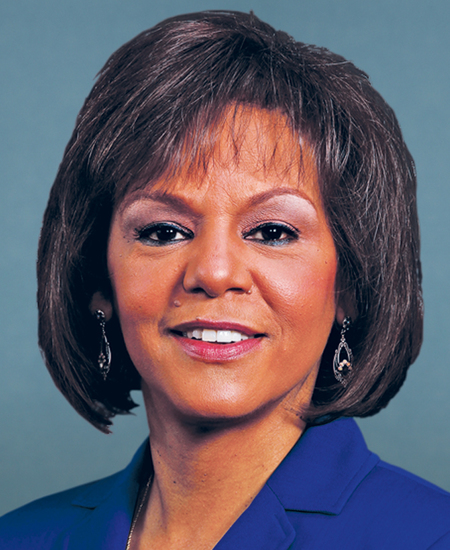
Rep. Robin L. Kelly
Sponsored bills
Gun Trafficker Detection Act This bill requires gun owners to report the theft or loss of a firearm to law enforcement. It imposes civil monetary penalties on a violator.
Lifting Immigrant Families Through Benefits Access Restoration Act of 2021 or the LIFT the BAR Act of 2021 This bill repeals certain limits on the eligibility of noncitizens who lawfully reside in the United States for federal means-tested programs, including Medicaid, the Children's Health Insurance Program (CHIP), programs funded through Temporary Assistance for Needy Families (TANF) grants, Supplemental Security Income (SSI), and certain nutrition and housing programs.
Local Public Health And Safety Protection Act This bill authorizes the Department of Justice to make grants to states that allow local governments to impose firearms laws that are more restrictive than state firearms laws. A state that receives a grant must award subgrants to localities to help implement the more restrictive firearms laws.
Unlawful Gun Buyer Alert Act This bill establishes a notification requirement following a firearms-related background check that results in a denial. Specifically, the bill requires the national instant criminal background check system to notify federal, state, and local law enforcement agencies if a firearms-related background check determines that an individual is ineligible to receive or possess a firearm. The notification requirement applies even if more than three business days have elapsed since the background check was initiated, and a firearm has already been transferred to the individual.
Improving Access for Afghan Refugees Act This bill requires the Department of State to provide priority refugee status to eligible habitual residents of Afghanistan. To be eligible for such priority status, a habitual resident of Afghanistan must also be a national of Afghanistan or stateless. Such an individual shall receive priority refugee status if the individual (1) has suffered persecution or has a well-founded fear of persecution and worked in a specified field that makes the individual a target of persecution on account of race, religion, or other characteristics; (2) was employed for at least one year in Afghanistan by U.S.-based media or nongovernmental entities or an entity that received a contract or grant from the U.S. government; or (3) is the beneficiary of a visa petition sponsored by a relative who is a U.S. citizen or permanent resident. The State Department may also provide priority status to other groups of individuals who are nationals and residents of Afghanistan. Certain annual numerical limits on refugee admissions shall not apply to individuals who receive priority status under this bill. For refugee applications under this bill, the State Department and the Department of Homeland Security shall ensure that all steps in the approval process in the U.S. government's control are completed within six months of an application's submission, with exceptions for cases that need more time to address national security concerns.
Gun Theft Prevention Act This bill makes various changes to federal firearms laws related to detecting and deterring the theft of firearms from federally licensed gun dealers. Among the changes, the bill establishes security requirements for gun dealers; background check requirements for employees of gun dealers; inspection requirements for the Bureau of Alcohol, Tobacco, Firearms and Explosives; and reporting requirements for individual gun owners.
CARA 3.0 Act of 2021 This bill addresses substance use disorders by expanding access to treatment and recovery services, providing for housing protections, and requiring other activities. Specifically, the bill reauthorizes, establishes, and expands support for treatment and recovery services. This includes increasing access to treatment in the criminal justice system and other settings and for particular populations, such as pregnant and postpartum individuals and youth and young adults. Additionally, the bill expands Medicare and Medicaid coverage for treatment, including by expanding telehealth access to medication to treat substance use disorders. The bill also temporarily requires that non-opioid pain treatment options be reimbursed separately, instead of on a packaged basis, under Medicare. As a condition of receiving certain federal funding, states must mandate the use of prescription drug monitoring programs (PDMPs) by prescribers and dispensers and impose additional PDMP requirements. Moreover, prescribers of potentially addictive drugs must complete continuing education requirements. The bill also revises the registration process for providers who prescribe certain medications to treat substance use disorders, including by eliminating the provider's patient limit for such medications. In addition, the Substance Abuse and Mental Health Services Administration must carry out activities to promote access to high-quality recovery housing. The bill also sets out protections for individuals with substance use disorders who live in, or apply to live in, federally assisted housing. Furthermore, the bill requires other activities to address substance use, such as support for workforce education and training; public awareness campaigns and similar outreach; and research on prevention strategies, insurance coverage, and treatment modalities.

Keeping Gun Dealers Honest Act of 2021 This bill modifies the requirements and penalties applicable to an individual who engages in the business of dealing, importing, or manufacturing firearms (i.e., a federal firearms licensee, or FFL). Among other things, the bill does the following: increases the allowable number of annual compliance inspections; authorizes the Bureau of Alcohol, Tobacco, Firearms and Explosives (ATF) to hire at least 80 additional personnel to conduct additional inspections; increases the maximum prison term for an FFL or licensed collector who knowingly makes a false statement or representation in required firearms records; allows the ATF to require an FFL to conduct physical inventories if the FFL unlawfully transfers a firearm or if 10 or more crime guns are traced back to the FFL; allows the ATF to deny an application for a federal firearms license if it would endanger public safety or if the applicant is unlikely to comply with the law; and modifies the liability standard for an FFL who fails to comply with laws or regulations.
3D Printed Gun Safety Act of 2021 This bill makes it unlawful to intentionally publish digital instructions for programming a three-dimensional printer to make a firearm.