

Rural Maternal and Obstetric Modernization of Services Act or the Rural MOMS Act This bill expands initiatives to address maternal health in rural areas. The bill provides funding through FY2026 for the Health Resources and Services Administration (HRSA) to establish rural obstetric networks. These networks must foster collaboration to improve birth outcomes and reduce maternal morbidity in rural areas. HRSA also must award demonstration grants to medical schools and other health professional training programs to support education and training on maternal health in rural areas. In addition, the bill incorporates maternal health services in certain telehealth grant programs. It also revises various research and other activities of the Department of Health and Human Services that pertain to maternal health. Furthermore, the Government Accountability Office must report on maternal health topics, including health inequities and data issues.
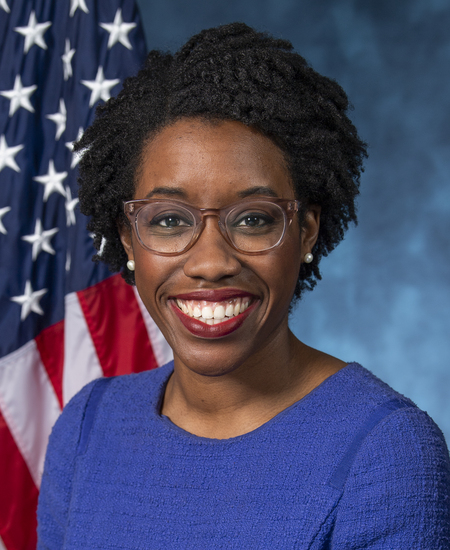
Rep. Lauren Underwood
Sponsored bills
Community Immunity During COVID-19 Act of 2021 This bill requires the Centers for Disease Control and Prevention (CDC) to award grants to health departments to increase rates of recommended immunizations during the COVID-19 (i.e., coronavirus disease 2019) public health emergency. The CDC must also develop, in consultation with specified entities, guidance for health care providers on counseling patients about COVID-19 vaccines.
Health Force, Resilience Force, and Jobs to Fight COVID-19 Act of 2021 This bill establishes and expands programs to bring on individuals to perform public health functions, such as contact tracing and vaccine administration, to respond to the COVID-19 (i.e., coronavirus disease 2019) emergency and meet future public health needs. The bill provides funding for the Centers for Disease Control and Prevention (CDC) to establish a Health Force. The funds are designated as an emergency requirement, which exempts the funds from discretionary spending limits and other budget enforcement rules. To establish the force, the CDC must award grants within 30 days to state, tribal, territorial, and local governments and community health centers to recruit and train individuals for roles in public health and health care. The Federal Emergency Management Agency (FEMA) must hire and train additional individuals for its Cadre of On-Call Response/Recovery Employees. These employees may be detailed to certain federal agencies or to state, local, or tribal governments to support response efforts related to COVID-19 or other disasters or emergencies.
Health Care Affordability Act of 2021 This bill revises the tax credit for health care premium assistance to expand the eligibility of low-income taxpayers for such credit and reduce the cost of health care premiums.
USPS Fairness Act This bill repeals the requirement that the U.S. Postal Service annually prepay future retirement health benefits.
Stopping the Mental Health Pandemic Act This bill requires the Substance Abuse and Mental Health Services Administration to award grants to states, tribal nations, local governments, behavioral health and primary care providers, and community organizations to support behavioral health treatment and services during the COVID-19 (i.e., coronavirus disease 2019) pandemic.
Stop COVID-19 Test Surprise Medical Bills Act of 2021 This bill modifies provisions requiring health insurance plans to cover COVID-19 (i.e., coronavirus disease 2019) diagnostic testing services at no cost, without prior authorization, and without medical management requirements. The bill specifies that a plan may not make determinations about the circumstances surrounding individuals' tests, such as why they sought testing or whether they showed symptoms of COVID-19. The bill also specifies that plans may encourage individuals to obtain tests from lower priced providers as long as such efforts do not delay, or impede access to, testing. The bill also requires the Department of Health and Human Services (HHS) to survey and report on the cash prices of testing services and the compliance of providers with the requirement to publish such prices. Additionally, HHS, jointly with the Department of the Treasury and the Department of Labor, must issue guidance clarifying the process for submitting claims for testing services.
Medicare Economic Security Solutions Act This bill modifies provisions relating to enrollment periods for Medicare medical services. Among other things, the bill establishes a late enrollment penalty of 15% of monthly premiums and applies the penalty for a period equal to twice the number of months in each 12-month period during which the individual was not enrolled. Currently, the late enrollment penalty is 10% of monthly premiums for each 12-month period during which the individual was not enrolled, and the penalty continues to apply for as long as the individual is enrolled in Medicare medical services. The bill also expands the special enrollment periods to individuals who have health insurance coverage other than through their employer.
Mental Health Access Improvement Act of 2021 This bill provides for coverage of marriage and family therapist services and mental health counselor services under Medicare. It also excludes such services from the skilled nursing facility prospective payment system, and authorizes marriage and family therapists and mental health counselors to develop discharge plans for post-hospital services.
Improving Social Determinants of Health Act of 2021 This bill requires the Centers for Disease Control and Prevention (CDC) to establish a program to improve health outcomes and reduce health inequities by, for example, coordinating activities across the CDC. As part of the program, the CDC must award grants to eligible organizations to build capacity to address social determinants of health. The CDC shall provide for an independent evaluation of certain grants and report findings to Congress.