Stop Foreign Interference in Ballot Measures Act This bill prohibits contributions or donations by foreign nationals in connection with state or local ballot initiatives or referenda.
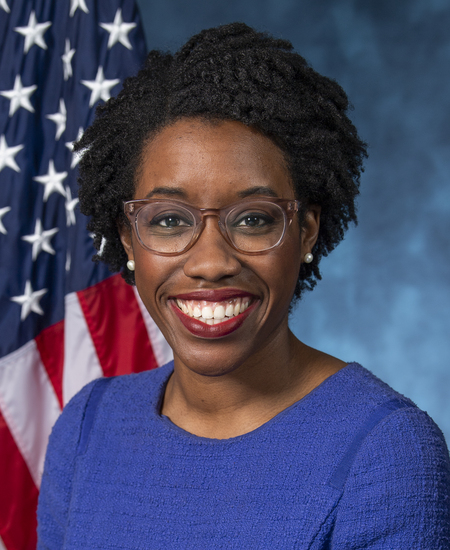
Rep. Lauren Underwood
Sponsored bills
Coronavirus Medicaid Response Act This bill increases the Medicaid federal matching rate, also known as the Federal Medical Assistance Percentage (FMAP), for states and U.S. territories that experience economic downturns (i.e., high unemployment) beginning on or after January 1, 2020, in accordance with specified requirements and limitations. The bill's increase is in addition to previously enacted FMAP increases relating to COVID-19 (i.e., coronavirus disease 2019) but may not result in an FMAP greater than 95%.
This resolution honors the life and legacy of former Representative John Robert Lewis and commends his achievements in the struggle for civil rights.
This bill provides for the presentation of a Congressional Gold Medal to the Freedom Riders, in recognition of their contribution to civil rights by fighting for equality in interstate travel.
Juneteenth National Independence Day Act This bill establishes Juneteenth Independence Day as a federal holiday.
Protecting LGBTQ Youth Act This bill expands programs that prevent and treat child abuse and neglect to address issues facing lesbian, gay, bisexual, and transgender youth. Specifically, these programs include (1) research and reporting requirements, (2) providing technical assistance, (3) grants to states and local agencies to train child-welfare personnel, and (4) community-based prevention-service grants, among others.
National Apprenticeship Act of 2021 This bill provides statutory authority for the registered apprenticeship program within the Department of Labor and for related grant programs. The bill provides statutory authority for the Office of Apprenticeship (OA) within Labor. The OA's responsibilities include (1) supporting the development of apprenticeship models; (2) recognizing qualified state apprenticeship agencies, and operating apprenticeship offices in states without a recognized agency; (3) providing technical assistance to state agencies; (4) periodically updating requirements for each occupation in the apprenticeship program and determining whether to approve new occupations for the program; (5) promoting greater diversity in the national apprenticeship system; and (6) awarding grants provided by this bill. The bill also establishes in statute the responsibilities of state apprenticeship agencies and offices, including (1) providing technical assistance to stakeholders, (2) resolving complaints, (3) establishing state performance goals, and (4) including in its written plan a description of how its apprenticeship programs align with the skills needs of the state's employers. The OA shall enter into an agreement with the Department of Education to promote the integration and alignment of apprenticeship programs with secondary, postsecondary, and adult education. The OA shall award grants, contracts, or cooperative agreements to eligible entities to (1) expand national apprenticeship system programs, including by expanding pre-apprenticeship and youth apprenticeship programs; (2) encourage employer participation; and (3) strengthen alignment between the apprenticeship system and education providers. The bill provides statutory authority for criteria for various programs, including (1) quality standards for apprenticeships, (2) requirements for apprenticeship agreements between a program sponsor and an apprentice, and (3) acceptable uses for grant funds awarded by this bill. The bill also provides statutory authority for the National Advisory Committee on Apprenticeships. The committee's duties shall include advising the OA on matters relating to this bill and providing recommendations on topics such as increasing the participation of populations not traditionally involved in the national apprenticeship system. Labor shall engage an independent entity to conduct research on ways to improve the management and effectiveness of national apprenticeship system programs.
Kira Johnson Act This bill establishes grants to improve maternal health outcomes for racial and ethnic minority groups and other underserved populations. Specifically, the Department of Health and Human Services must award grants for community-based programs to improve maternal health outcomes for Black pregnant and postpartum individuals, as well as individuals in other underserved groups; training for health care providers and others who work in maternity care settings on reducing and preventing racism, bias, and discrimination; and respectful maternity care compliance programs in specified health care facilities. The National Academies of Sciences, Engineering, and Medicine must study issues related to the training programs, and the Government Accountability Office must study issues related to the compliance programs.
Kids' Access to Primary Care Act of 2021 This bill modifies payments for Medicaid primary care services. Specifically, the bill applies a Medicare payment rate floor to Medicaid primary care services that are provided after the date of enactment of the bill and extends the payment rate to additional types of practitioners (e.g., obstetricians). The Centers for Medicare & Medicaid Services must conduct a study on the number of children enrolled in Medicaid, the number of providers receiving payment for primary care services, and associated payment rates before and after the bill's implementation.
This resolution impeaches President Donald John Trump for high crimes and misdemeanors. Specifically, the resolution sets forth an article of impeachment stating that President Trump incited an insurrection against the government of the United States. The article states that prior to the joint session of Congress held on January 6, 2021, to count the votes of the electoral college, President Trump repeatedly issued false statements asserting that the presidential election results were fraudulent and should not be accepted by the American people or certified by state or federal officials; shortly before the joint session commenced, President Trump reiterated false claims to a crowd near the White House and willfully made statements to the crowd that encouraged and foreseeably resulted in lawless action at the Capitol; members of the crowd, incited by President Trump, unlawfully breached and vandalized the Capitol and engaged in other violent, destructive, and seditious acts, including the killing of a law enforcement officer; President Trump's conduct on January 6, 2021, followed his prior efforts to subvert and obstruct the certification of the presidential election, which included a threatening phone call to the Secretary of State of Georgia on January 2, 2021; President Trump gravely endangered the security of the United States and its institutions of government, threatened the integrity of the democratic system, interfered with the peaceful transition of power, and imperiled a coequal branch of government; and by such conduct, President Trump warrants impeachment and trial, removal from office, and disqualification to hold U.S. office.